Facts
The petitioners are descendants/heirs of the erstwhile Rulers of the Princely States of Mysore and Sandur
Source reference: para. 2, 3Following the Indian Independence Act, 1947, these Rulers entered into Merger Agreements/Covenants with the Dominion of India, which guaranteed "Privy Purses," personal privileges, and succession to the Gaddi (throne) according to custom
Source reference: para. 19, 38, 39When the Hindu Succession Act (HSA), 1956 was enacted, Section 5(ii) excluded any estate descending to a single heir by the terms of any covenant or agreement from the Act's purview
Source reference: para. 35Later, the 26th Constitutional Amendment (1971) deleted Articles 291 and 362, abolished Privy Purses, and withdrew official recognition of Rulers
Source reference: para. 23, 24The petitioners, having filed civil suits for partition of royal properties, faced applications under Order VII Rule 11 CPC from respondents claiming the suits were barred by Section 5(ii) HSA
Source reference: para. 2(e), 3(e)The petitioners challenged the constitutional validity of Section 5(ii) HSA, arguing it had become otiose and discriminatory following the 26th Amendment
Source reference: para. 4Issues
1. Whether the deletion of Articles 291 and 362 and the insertion of Article 363-A of the Constitution rendered Section 5(ii) of the Hindu Succession Act, 1956 otiose and redundant
Source reference: para. 132. Whether Section 5(ii) of the Act has become arbitrary, discriminatory, and unconstitutional with the passage of time
Source reference: para. 133. Whether the Court should direct the Union of India to delete Section 5(ii) from the statute book
Source reference: para. 13Law Applied
The Court primarily applied Section 5(ii) of the Hindu Succession Act, 1956, which carves an exception for estates descending to a single heir under merger covenants
Source reference: para. 35It relied on the 26th Constitutional Amendment and the precedent in Raghunath Rao v. Union of India, which upheld the abolition of Rulers' privileges while noting it did not efface the underlying merger agreements
Source reference: para. 23, 50The Court heavily cited Tikka Shatrujit Singh v. Sukjith Singh (2024), which distinguishes between "private properties" (governed by personal law/HSA) and the "impartible estate/Gaddi" (governed by Section 5(ii) and custom)
Source reference: para. 47, 48Furthermore, it applied the "classification test" under Article 14 as established in Ram Krishna Dalmia v. S.R. Tendolkar
Source reference: para. 54and the "Doctrine of Reading Down" to preserve statutory validity as seen in Authorized Officer, Central Bank of India v. Shanmugavelu
Source reference: para. 69Reasoning
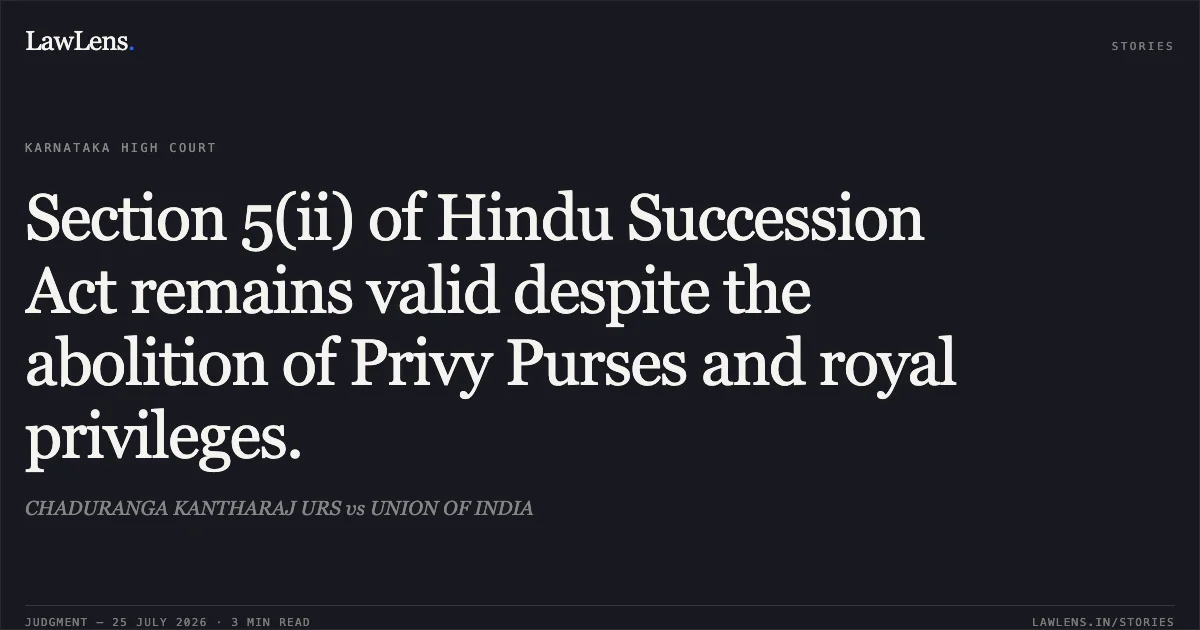
The Court reasoned that the 26th Amendment abolished the "political" rights of Rulers (Privy Purses and recognition) but did not automatically repeal statutory provisions like Section 5(ii) HSA, which are rooted in the Merger Covenants
Source reference: para. 50, 59Applying the ratio from Tikka Shatrujit Singh, the Court clarified that Section 5(ii) is limited in scope; it applies only to the "impartible estate" or "Gaddi" (throne) which carries cultural significance, but does not apply to the "private properties" of the erstwhile Rulers
Source reference: para. 48, 66Since private properties now devolve according to the HSA (for Hindus) or personal law, the petitioners' fear of being denied partition rights via Section 5(ii) was misplaced, provided they could plead and prove the nature of the property
Source reference: para. 67, 72The Court found that Section 5(ii) maintains a rational classification based on an intelligible differentia (specific estates under specific historical covenants) and serves a continuing purpose regarding ceremonial successions
Source reference: para. 61Therefore, the passage of time did not render the provision "manifestly arbitrary" or "discriminatory"
Source reference: para. 62, 70Holding
The Court answered the issues in the negative and dismissed the writ petitions
It held that Section 5(ii) of the HSA is neither otiose nor unconstitutional
Source reference: para. 72The Court clarified that while personal private properties of Rulers are governed by ordinary personal law (HSA), the perceived throne/Gaddi may still devolve by the rule of primogeniture under Section 5(ii)
Source reference: para. 72(f)No direction was issued to the Union of India to delete the provision as no violation of fundamental rights or lack of legislative competence was demonstrated
Source reference: para. 64, 71Acts & Sections Cited
9 provisions across 5 statutes referred to in this judgment. Each provision opens on LawLens.
Code of Civil Procedure, 19081
Special Marriage Act, 19541
Commissions of Inquiry Act, 19521
Original Court PDF
CHADURANGA KANTHARAJ URSvsUNION OF INDIA
Click to open original judgment
Original judgment, available to read, download and summarize on LawLens.in