Facts
The Petitioner, an enlisted contractor, was awarded an EPC contract by the Respondent (CPWD) for the construction of the IIM Jammu campus
Source reference: para. 6(a)-(c)Disputes arose regarding project delays, alleged defects, and payments
Source reference: para. 6(e)The Petitioner invoked the arbitration clause (Clause 25 of the GCC) and filed a Section 11 petition for the appointment of an arbitrator, along with three Section 9 petitions for interim protection
Source reference: para. 6(j)-(k)During proceedings, IIM Jammu (the project beneficiary) sought impleadment, which was granted by the Joint Registrar
Source reference: para. 6(l)-(m)The Petitioner challenged this via Chamber Appeals, which were initially allowed but remanded by a Division Bench to adjudicate a one-day delay in filing and the merits of impleadment
Source reference: para. 6(o)-(p)Issues
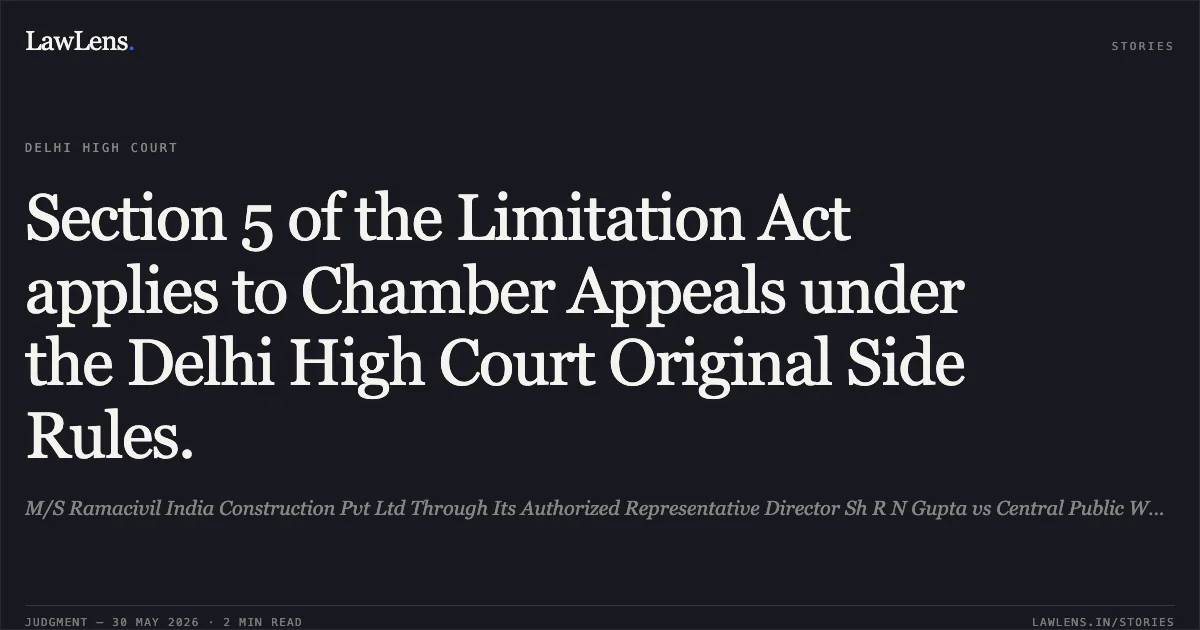
1. Whether the Court has the jurisdiction to condone delay in filing a Chamber Appeal under Chapter II Rule 5 of the Delhi High Court (Original Side) Rules, 2018, or if the Limitation Act is excluded by implication.
Source reference: para. 9, 462. Whether IIM Jammu, as the non-signatory "ultimate beneficiary" of the project, is a necessary or proper party to the arbitration proceedings.
Source reference: para. 72, 82Law Applied
The Court applied Section 5 of the Limitation Act, 1963, noting that the general law of limitation applies to "any appeal" unless expressly excluded by a special law
Source reference: para. 33-35It distinguished Ram Sarup Lugani v. Nirmal Lugani, stating that unless a rule uses prohibitory language like "but not thereafter," Section 5 remains applicable
Source reference: para. 62-65Regarding impleadment, the Court relied on the "Group of Companies" doctrine and the principle of party autonomy as reiterated in Cox and Kings Ltd. v. SAP India Pvt. Ltd. and Hindustan Petroleum Corporation Ltd. v. BCL Secure Premises Pvt. Ltd., which mandate that non-signatories can only be joined if there is clear evidence of consensual intent to be bound by the arbitration agreement
Source reference: para. 94Reasoning
The Court rejected the argument that Chapter II Rule 5 of the Original Side Rules is an absolute bar to condonation, finding no "peremptory embargo" or exclusionary phraseology in the rule's text
Source reference: para. 64-66Given the delay was only one day and no prejudice was shown, the Court condoned the delay in the interest of substantial justice
Source reference: para. 66-70On the merits of impleadment, the Court found that while IIM Jammu was the beneficiary, the contract was exclusively between the Petitioner and CPWD
Source reference: para. 83-85It held that "ultimate beneficiary" status is not a valid legal test for joining a non-signatory to arbitration
Source reference: para. 94-95The Court observed that Clause 36 of the NIT maintained a clear distinction between the executing authority (CPWD) and the beneficiary (IIM Jammu), and impleading the latter would violate the principle of party autonomy
Source reference: para. 96-99Holding
The Court allowed the applications for condonation of delay
set aside the Joint Registrar’s orders impleading IIM Jammu
Source reference: para. 103The Court allowed ARB.P. 1787/2025, directing CPWD to appoint a nominee arbitrator in strict accordance with the mandatory qualifications in Clause 25 of the GCC
Source reference: para. 116-118The three Section 9 petitions were converted into Section 17 applications to be adjudicated by the newly constituted Arbitral Tribunal
Source reference: para. 122-126Acts & Sections Cited
12 provisions across 4 statutes referred to in this judgment. Each provision opens on LawLens.
Arbitration and Conciliation Act, 19967
Code of Civil Procedure, 19083
Limitation Act, 19631
Delhi High Court Act, 19661
Original Court PDF
M/S Ramacivil India Construction Pvt Ltd Through Its Authorized Representative Director Sh R N GuptavsCentral Public Works Department Through Its Addl Director General
Click to open original judgment
Original judgment, available to read, download and summarize on LawLens.in