Facts
The Appellant was awarded, on 8 December 2009, the work of restoration and renovation of the Botany Department, University of Delhi, for ₹6,12,95,726.25.
Source reference: pp.1–2; paras. 2–7The work was completed and the Respondent paid ₹7,03,26,014, followed by release of the security amount on 26 October 2015.
Source reference: pp.1–2; paras. 2–7The Appellant subsequently raised additional claims of ₹1,47,92,860 under various heads and instituted a commercial suit for recovery.
Source reference: pp.1–2; paras. 2–7Before filing the suit, he approached the High Court under Section 11(6) of the Arbitration and Conciliation Act, 1996, but withdrew the petition on 5 December 2018 after it was found to be time-barred, with liberty to pursue a civil suit.
Source reference: pp.1–2, 6–10; paras. 2–7, 12–16The suit was thereafter filed in January 2019, along with an application seeking condonation of delay.
Source reference: pp.1–2, 6–10; paras. 2–7, 12–16The Commercial Court rejected the plaint under Order VII Rule 11 CPC, holding that the suit was barred by limitation and that the time spent in the arbitration proceedings could not be excluded under Section 14 of the Limitation Act, 1963.
Source reference: pp.1–2, 6–10; paras. 2–7, 12–16It also held that the contractual arbitration clause barred the civil suit.
Source reference: pp.1–2, 6–10; paras. 2–7, 12–16Issues
Whether the suit for recovery was barred by limitation, having been filed beyond three years from the date of release of the security amount on 26 October 2015.
Source reference: pp.6–9; paras. 12–15Whether the time spent by the Appellant pursuing a Section 11(6) arbitration petition could be excluded under Section 14 of the Limitation Act, 1963.
Source reference: pp.8–10; paras. 13, 16–18Whether delay in filing the suit could be condoned under Section 5 of the Limitation Act, 1963.
Source reference: pp.6, 10–12; paras. 12, 17Whether the plaint was liable to be rejected under Order VII Rule 11 CPC on the ground of limitation.
Source reference: pp.6–8, 12–13; paras. 12, 18–20Law Applied
Section 3 of the Limitation Act mandates dismissal of a suit instituted after the prescribed period, irrespective of whether limitation is pleaded.
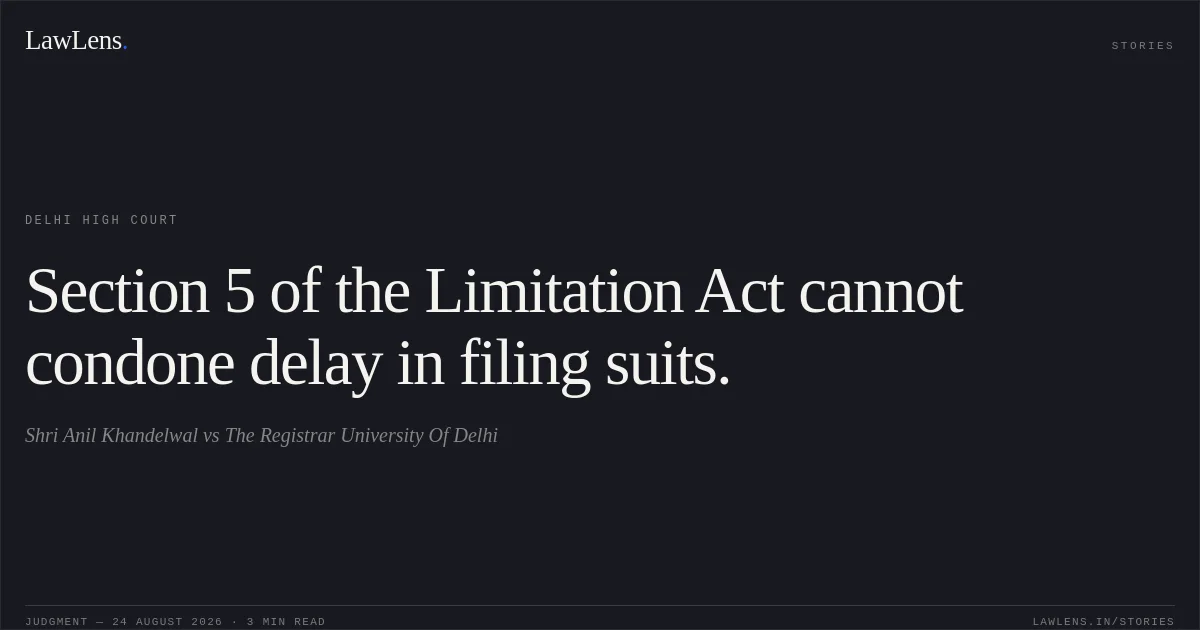
Source reference: pp.6, 10–12; para. 17Section 5 of the Limitation Act permits condonation of delay in appeals and applications, but does not extend to suits or other original proceedings; this principle was affirmed in The Deputy Commissioner and Special Land Acquisition Officer v. M/s Global Mill Limited, 2026 INSC 138.
Source reference: pp.6, 10–12; para. 17Section 14 permits exclusion of time spent bona fide prosecuting another civil proceeding that fails because of a defect of jurisdiction or other cause of a similar nature, but does not apply where the earlier proceeding was withdrawn because it was itself time-barred.
Source reference: pp.7–10; paras. 13, 16–18The Court also relied on Geo Miller and Company Private Limited v. Chairman, Rajasthan Vidyut Utpadan Nigam Limited, (2020) 14 SCC 643, for the rule that unilateral correspondence or reminders do not extend limitation once the cause of action has accrued.
Source reference: pp.3–5; para. 10A plaint can be rejected under Order VII Rule 11 CPC where the bar of limitation is apparent from the plaint and accompanying documents.
Source reference: pp.6–8; para. 12Reasoning
The Court accepted 26 October 2015, the date on which the security amount was released, as the latest relevant date for computing limitation.
Source reference: pp.6–9; paras. 12–15The three-year limitation period therefore expired on 25 October 2018, whereas the Appellant initiated the pre-litigation process and filed the suit only thereafter.
Source reference: pp.6–9; paras. 12–15The Section 11(6) petition had not been withdrawn because the High Court lacked jurisdiction or because of any analogous procedural defect; it was withdrawn after the Appellant acknowledged that the arbitration claim was time-barred.
Source reference: pp.8–10; paras. 13, 16, 18Consequently, Section 14 could not be invoked to exclude that period.
Source reference: pp.8–10; paras. 13, 16, 18The Appellant’s medical condition and the alleged inability to contact counsel could not assist him because Section 5 is inapplicable to suits.
Source reference: pp.3–5, 10–12; paras. 10, 17Further, subsequent demands or correspondence could not revive or extend an already-expired limitation period.
Source reference: pp.3–5, 10–12; paras. 10, 17Since the bar of limitation was apparent from the Appellant’s own pleadings, rejection of the plaint under Order VII Rule 11 CPC was held proper.
Source reference: pp.12–13; paras. 18–20Holding
The High Court held that the suit was instituted beyond the prescribed three-year limitation period and that the time spent in the withdrawn Section 11(6) proceedings could not be excluded under Section 14 of the Limitation Act.
Delay in instituting the suit could not be condoned under Section 5.
Source reference: p.13; paras. 18–20The Commercial Court’s order rejecting the plaint under Order VII Rule 11 CPC was upheld, and the appeal was dismissed.
Source reference: p.13; paras. 18–20Pending applications, if any, were also dismissed.
Source reference: p.13; paras. 18–20Acts & Sections Cited
7 provisions across 4 statutes referred to in this judgment. Linked provisions open on LawLens.
Arbitration and Conciliation Act, 19961
Limitation Act, 19634
Code of Civil Procedure, 19081
Commercial Courts Act, 20151
Original Court PDF
Shri Anil KhandelwalvsThe Registrar University Of Delhi
Click to open original judgment
Original judgment, available to read, download and summarize on LawLens.in