Facts
The petitioners invoked Section 528 of the Bharatiya Nagarik Suraksha Sanhita, 2023 (“BNSS”) seeking quashing of FIR Crime No. 19/2026, registered on 29 April 2026 at Mahila Police Thana, Balaghat, for offences under Section 85 of the BNSS/Section 498-A of the IPC and Sections 3/4 of the Dowry Prohibition Act.
Source reference: para. 1; p. 1The marriage between petitioner no. 1 and respondent no. 2 was solemnised on 22 November 2025.
Source reference: para. 2; p. 1Respondent no. 2 had approached the District Legal Services Authority, Balaghat, on 21 April 2026, where proceedings were initiated and listed for 28 April 2026.
Source reference: para. 2; p. 1The petitioners contended that the FIR, lodged on 29 April 2026, contained false and omnibus allegations, including allegations of unnatural acts and impotency against petitioner no. 1.
Source reference: para. 2; p. 1The State and the complainant opposed quashing, submitting that specific allegations had been made against all petitioners and that the investigation was still pending.
Source reference: para. 3; p. 2Issues
Whether the FIR and consequential criminal proceedings disclosed cognizable offences warranting interference and quashing under the High Court’s inherent jurisdiction?
Source reference: paras. 5–10; pp. 2–10Whether a petition under Section 528 of the BNSS for quashing an FIR alone was maintainable when neither the police report/charge-sheet nor the order taking cognizance had been placed on record?
Source reference: paras. 11–13; pp. 11–12Law Applied
The Court applied Section 528 of the BNSS, corresponding to Section 482 of the Code of Criminal Procedure, and held that inherent powers to quash an FIR must be exercised sparingly and only where the allegations, taken at face value and in their entirety, do not disclose any cognizable offence; disputed facts and defence documents ordinarily cannot be examined at that stage.
Source reference: paras. 5–7; pp. 2–4Relying on Kamaladevi Agrawal v. State of W.B., R. Kalyani v. Janak C. Mehta, Mahesh Chaudhary v. State of Rajasthan, State of M.P. v. Deepak, and Amit Kapoor v. Ramesh Chander, the Court reiterated that the High Court should not conduct a meticulous evidentiary assessment or determine the likelihood of conviction while considering quashing.
Source reference: paras. 5–8; pp. 2–5The principles in Neeharika Infrastructure—as reproduced in Directorate of Enforcement v. Niraj Tyagi—require courts ordinarily not to obstruct an investigation where the FIR discloses a cognizable offence.
Source reference: para. 9; pp. 5–10The Court also relied on Just Rights for Children Alliance v. S. Harish for the proposition that foundational factual and evidentiary issues should be left to the trial court.
Source reference: para. 10; pp. 10–11Finally, relying on Pradnya Pranjal Kulkarni v. State of Maharashtra, the Court held that where quashing is sought under Section 528 of the BNSS after filing of the charge-sheet and taking of cognizance, those proceedings and the cognizance order must be placed on record; in the absence of such material, the petition for quashing the FIR under Section 528 was not maintainable.
Source reference: paras. 11–13; pp. 11–12Reasoning
The Court found that the FIR contained specific allegations concerning cruelty, dowry-related conduct, and other alleged matrimonial misconduct against the petitioners, and therefore it could not, at the threshold, hold that no cognizable offence was disclosed.
Source reference: paras. 2–4, 10; pp. 1–2, 10–11The petitioners’ assertions that the allegations were false, omnibus, or motivated by the proceedings before the District Legal Services Authority involved disputed questions of fact and could not be adjudicated in a quashing petition.
Source reference: paras. 5–9; pp. 2–10Consistent with the rule that the police must be permitted to complete investigation where the FIR prima facie discloses an offence, the Court declined to assess the reliability of the allegations or the prospective chances of conviction.
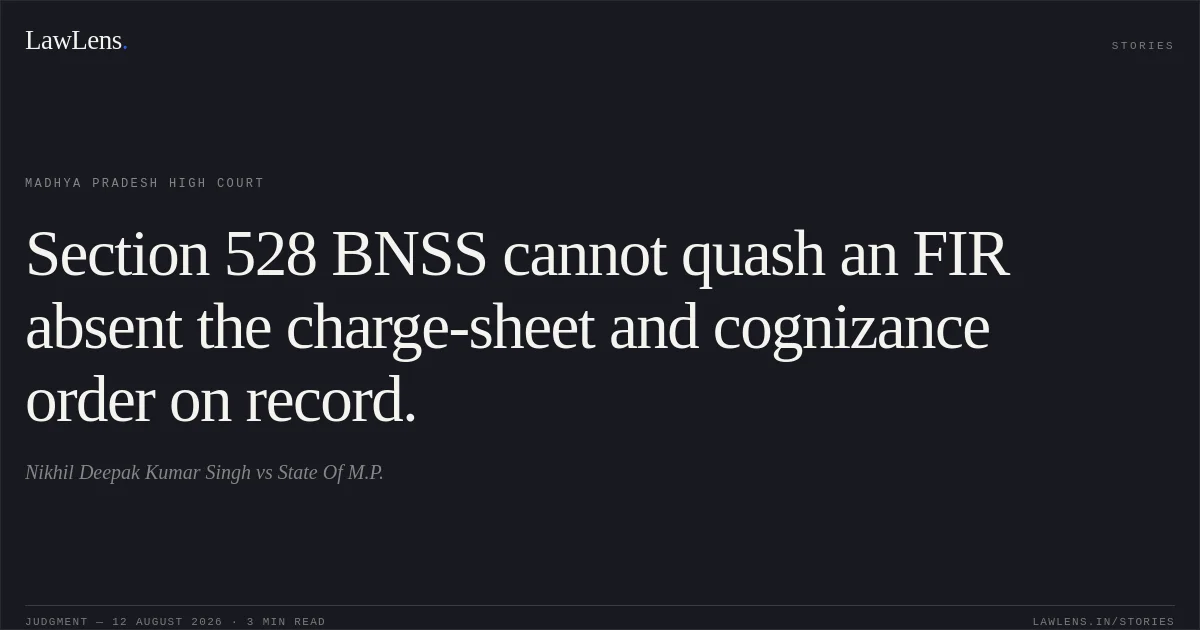
Source reference: para. 9; pp. 5–10Independently, the Court held that the petition was not maintainable under Section 528 because the petitioners had sought quashing only of the FIR and had not placed either the charge-sheet or the order taking cognizance before the Court.
Source reference: paras. 11–13; pp. 11–12Holding
The Court answered both issues against the petitioners.
It declined to quash the FIR or the consequential criminal proceedings, holding that the allegations required investigation and that the petition was additionally not maintainable under Section 528 of the BNSS in the absence of the charge-sheet and cognizance order.
Source reference: paras. 13–14; p. 12The petition was accordingly dismissed as devoid of merit.
Source reference: paras. 14–16; p. 12The Court clarified that its observations would not influence the trial court and directed that a copy of the order be sent to the concerned trial court for information and compliance.
Source reference: paras. 14–16; p. 12Acts & Sections Cited
8 provisions across 3 statutes referred to in this judgment. Each provision opens on LawLens.
Bharatiya Nagarik Suraksha Sanhita, 20232
Code of Criminal Procedure, 19734
Original Court PDF
Nikhil Deepak Kumar SinghvsState Of M.P.
Click to open original judgment
Original judgment, available to read, download and summarize on LawLens.in