Facts
The petitioner was convicted for murder and kidnapping for ransom (Sections 302 and 364A IPC) and sentenced to death by the trial court in 2003.
Source reference: p.3On appeal in 2013, the High Court commuted the death sentence to life imprisonment, directing that the accused should not receive "routine" commutation after 14 years and must serve the sentence "in terms of Section 57 of IPC".
Source reference: p.3Having completed 20 years of actual imprisonment as of January 15, 2025, the petitioner filed a writ of mandamus seeking immediate release.
Source reference: p.3He contended that the 2013 judicial direction effectively fixed his life sentence at 20 years, relying on the Supreme Court’s decision in Sukhdev Yadav @ Pehalwan v. State of NCT of Delhi.
Source reference: p.4-7Issues
1. Whether the direction to serve a life sentence "in terms of Section 57 of the IPC" restricts the sentence to a fixed term of 20 years.
Source reference: para 7(i)2. Whether the petitioner is entitled to automatic release upon completing 20 years of imprisonment based on Section 57 IPC and Sukhdev Yadav.
Source reference: para 7(ii)3. Whether life imprisonment must be understood as imprisonment for the remainder of natural life in the absence of a specific judicial cap.
Source reference: para 7(iii)4. Whether the power of remission lies exclusively within the executive domain of the Government.
Source reference: para 7(iv)Law Applied
The court primarily applied Section 57 of the IPC, which stipulates that for calculating fractions of terms of punishment, life imprisonment is reckoned as 20 years.
Source reference: p.8, 33It relied on the Constitution Bench precedent in Gopal Vinayak Godse v. State of Maharashtra, which established that life imprisonment means imprisonment for the remainder of the convict's natural life unless remitted by the appropriate authority.
Source reference: p.12, 40The court further applied Section 432 and 433-A of the CrPC (corresponding to Sections 473 and 474 of the BNSS), which vest the discretionary power of remission and commutation in the executive branch.
Source reference: p.51-54It also cited Mohinder Singh v. State of Punjab and Bangal @ Khoka v. B.K. Srivastava to reiterate that a life convict has no indefeasible right to release after 14 or 20 years.
Source reference: p.14, 16, 41Reasoning
The court analyzed the phrase "in terms of Section 57 of IPC" used in the 2013 sentencing order. It held that this was not a "definitional linkage" fixing the sentence at 20 years, but rather a "duration reference" establishing a higher minimum threshold (20 years) before the petitioner could even be eligible for remission consideration, thereby overriding the standard 14-year threshold under Section 433-A CrPC.
Source reference: para 9.15, 9.18, 12.9The court distinguished Sukhdev Yadav, noting that in that case, the sentencing order used the explicit language "Life imprisonment which shall be 20 years," creating a determinate sentence that does not exist here.
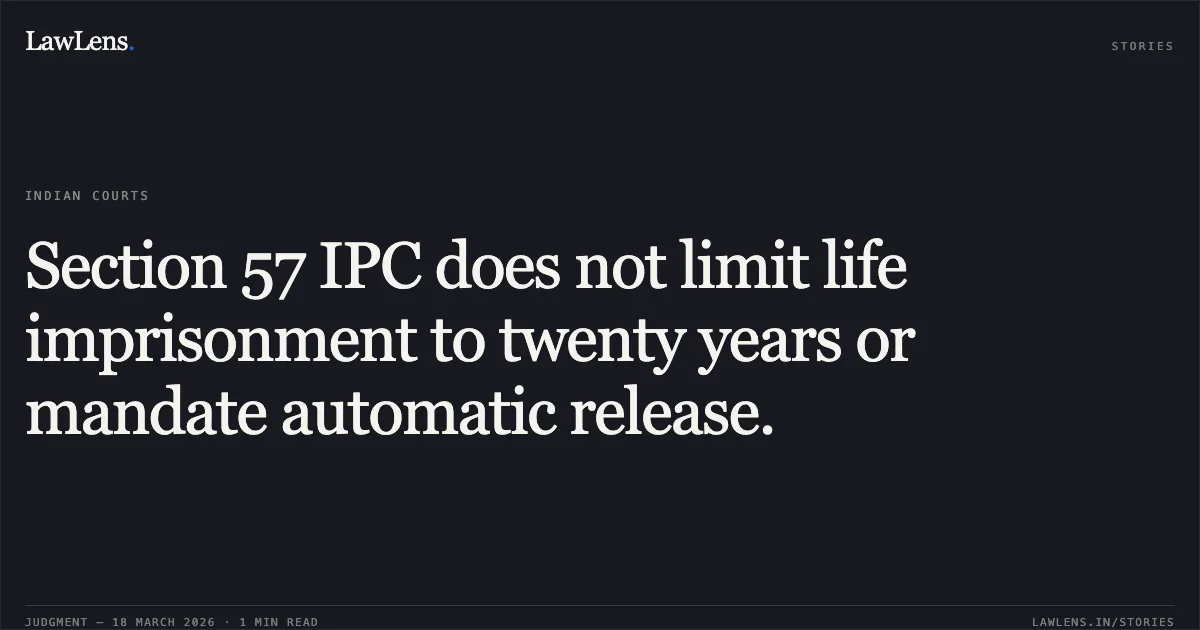
Source reference: para 9.18, 10.13Following Gopal Vinayak Godse, the court reasoned that Section 57 IPC is restricted to "calculating fractions" and does not determine the actual duration of a life sentence.
Source reference: para 10.9Furthermore, the court emphasized that a writ of mandamus cannot be issued because there is no mandatory legal duty for the prison authorities to release a life convict whose sentence has not been formally remitted by the Government.
Source reference: para 13.8-13.9Holding
The court dismissed the writ petition and rejected the prayer for immediate release.
It held that life imprisonment remains a sentence for the remainder of the convict's natural life unless the executive exercises its power of remission.
Source reference: para 15.3(iii)However, the court clarified that since the petitioner has crossed the 20-year threshold specified in his sentencing order, he is now eligible to apply for premature release.
Source reference: para 15.3(iv)The court directed that if such an application is made, the Government or Sentence Review Board must consider it on its individual merits and pass a reasoned order within 90 days, without treating the previous 2013 judgment as an absolute bar to release.
Source reference: para 15.3(v)Acts & Sections Cited
12 provisions across 4 statutes referred to in this judgment. Each provision opens on LawLens.
Indian Penal Code, 18605
Code of Criminal Procedure, 19733
Bharatiya Nagarik Suraksha Sanhita, 20233
West Bengal Correctional Services Act, 19921
Original Court PDF
SRI KISHANvsTHE STATE OF KARNATAKA
Click to open original judgment
Original judgment, available to read, download and summarize on LawLens.in