Facts
The Appellant challenged the order dated 12 May 2023 passed by the NCLT, Chennai Bench, disposing of an application filed by the Liquidator under Section 60(5) of the Insolvency and Bankruptcy Code, 2016 (“IBC”).
Source reference: para. 1The appeal was filed on 26 June 2023 along with an application seeking condonation of a 13-day delay.
Source reference: paras. 2, 7The Appellant asserted that it had been proceeded against ex parte before the NCLT and became aware of the order only on 27 May 2023; it also claimed that time was required to trace and examine voluminous records relating to earlier proceedings.
Source reference: paras. 3, 7–8The NCLAT noted that the 30-day limitation period had expired on 11 June 2023.
Source reference: para. 7Issues
Whether the Appellant had shown sufficient cause for condonation of the 13-day delay in filing the appeal under the proviso to Section 61(2) of the IBC?
Source reference: paras. 5–10Whether, upon dismissal of the condonation application, the appeal itself was liable to be dismissed as not duly constituted?
Source reference: p. 6Law Applied
Section 61(1) of the IBC confers a statutory right of appeal against an order of the Adjudicating Authority to the NCLAT.
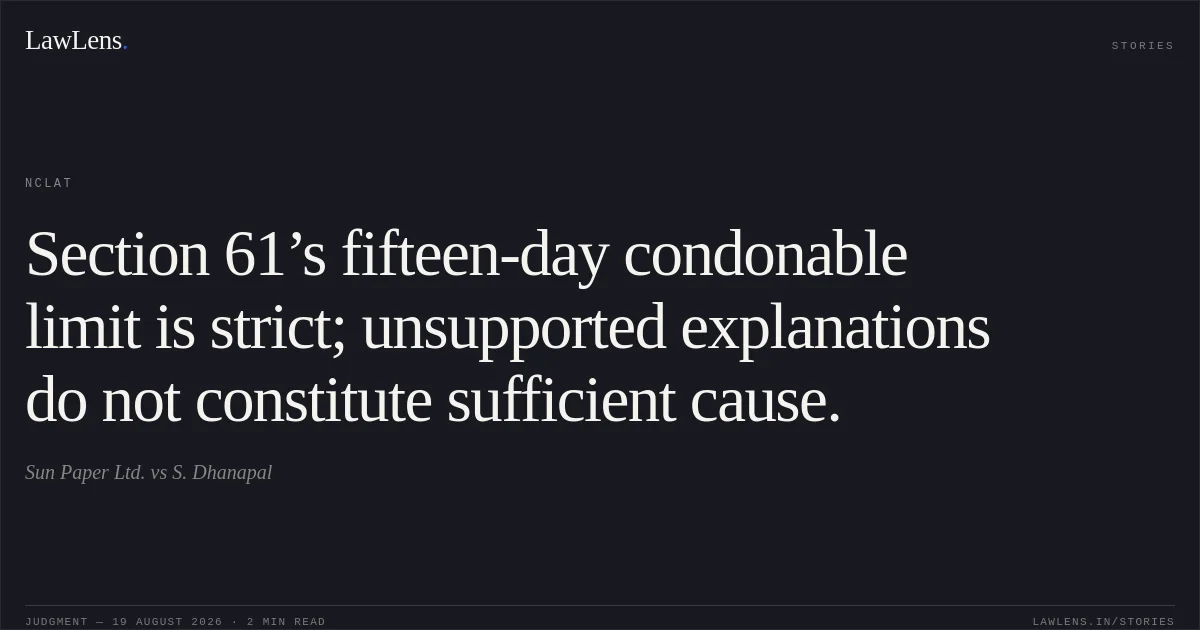
Source reference: para. 5Under Section 61(2), such appeal must ordinarily be filed within 30 days; the proviso permits the NCLAT to condone delay only if sufficient cause is established, and in any event the extension cannot exceed 15 days.
Source reference: paras. 5–6The statutory limitation framework reflects the IBC’s objective of expeditious resolution of insolvency-related litigation.
Source reference: para. 9The burden lies on the applicant to place material before the Tribunal demonstrating sufficient cause for the delay.
Source reference: paras. 6–10Reasoning
The NCLAT held that the Appellant failed to substantiate its assertion that it acquired knowledge of the order only on 27 May 2023. No evidence, even prima facie, was produced to establish the date or circumstances of such knowledge.
Source reference: para. 7The Appellant’s further explanation that it required time to consult voluminous records was considered a “lame excuse,” particularly because the Appellant had itself admitted that it had remained ex parte in the underlying proceedings, demonstrating a casual approach to the litigation.
Source reference: para. 8Although the claimed delay was within the maximum 15-day condonable window, the statutory limit did not create an automatic entitlement to condonation; sufficient cause still had to be established to the Tribunal’s satisfaction.
Source reference: paras. 6, 9–10Holding
The NCLAT answered the first issue in the negative and dismissed I.A. No. 671/2023, holding that the Appellant had not shown sufficient cause for condoning the delay.
Consequently, since the condonation application was dismissed, Company Appeal (AT) (CH) (Ins.) No. 205/2023 was held not to be duly constituted and was also dismissed.
Source reference: p. 6Acts & Sections Cited
4 provisions across 1 statute referred to in this judgment. Each provision opens on LawLens.
Insolvency and Bankruptcy Code, 2016.4
Original Court PDF
Sun Paper Ltd.vsS. Dhanapal
Click to open original judgment
Original judgment, available to read, download and summarize on LawLens.in