Facts
Originally, 6.5 cents belonged to Defendant No. 3 (Rajeswari), who allegedly sold it to Vanajakshi in 1978 (Ext. A3)
Source reference: p.2-3Vanajakshi and others then sold the full 13 cents to the Plaintiff in 1980
Source reference: p.3In 1996, Defendant No. 3 executed a second sale deed (Ext. A4) for the same 6.5 cents in favor of Defendant No. 1, who took possession and began construction
Source reference: p.3-4The Plaintiff sued for declaration of title, recovery of possession, and cancellation of Ext. A4
Source reference: p.2The Trial Court decreed the suit in favor of the Plaintiff
Source reference: p.6The First Appellate Court reversed this, finding the execution of the 1978 deed (Ext. A3) unproven because the attesting witness (PW3) was unreliable
Source reference: p.8The High Court of Kerala, in Second Appeal, restored the Trial Court's decree, holding that since Defendant No. 3 had not filed a separate suit or counterclaim to deny the 1978 deed, the "specific denial" required to trigger Section 68 of the Evidence Act was absent
Source reference: p.9-10Issues
1. Whether the High Court could decide a Second Appeal under Section 100 CPC without formulating any substantial question of law.
Source reference: para. 15(i)2. Whether the expression "specifically denied" in the proviso to Section 68 of the Evidence Act requires a denial in a suit or proceeding initiated by the executant (as opposed to a denial in a written statement).
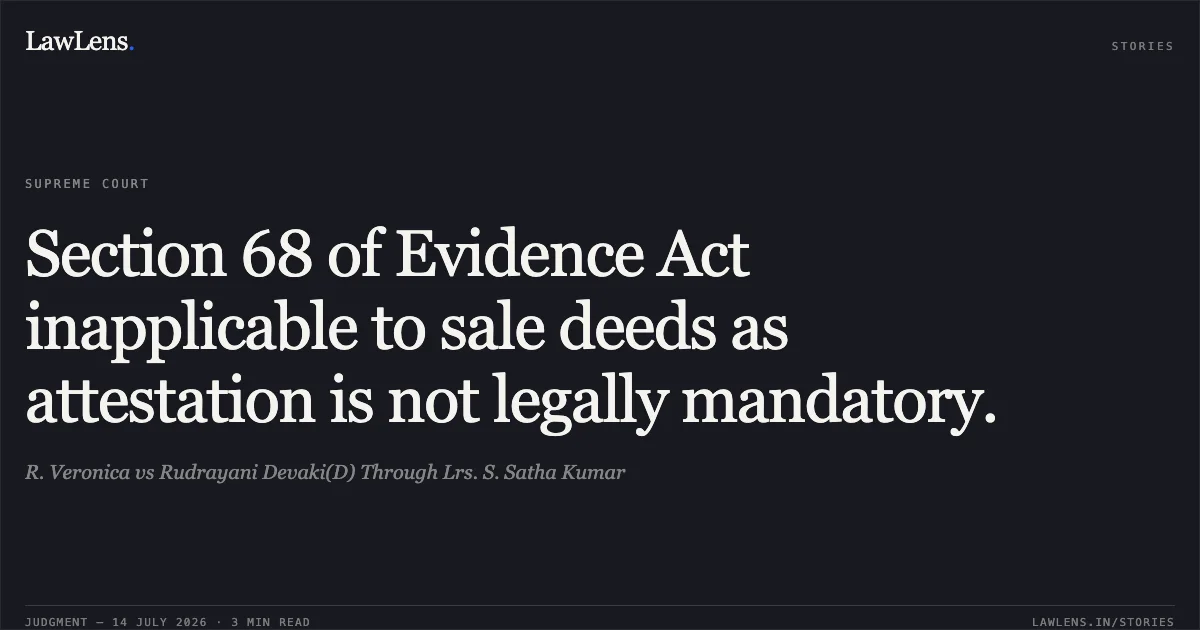
Source reference: para. 15(ii)3. Whether Section 68 of the Evidence Act and its proviso apply to a registered sale deed.
Source reference: para. 15(iii)Law Applied
Section 100 and Order XLII Rule 2 of the CPC, which mandate that a High Court must formulate substantial questions of law as a condition precedent to hearing a Second Appeal
Source reference: para. 16-17Section 54 of the Transfer of Property Act, 1882, which defines "sale" and does not require attestation for a sale deed
Source reference: para. 36Section 68 of the Indian Evidence Act, 1872, noting that the requirement to call an attesting witness applies only to documents "required by law to be attested"
Source reference: para. 37Nazir Mohamed v. J. Kamala
Source reference: para. 18Hans Raji v. Yosodanand and Bayanabai Kaware v. Rajendra, establishing that Section 68 does not apply to sale deeds
Source reference: para. 38-39Reasoning
The Supreme Court held that the High Court committed a jurisdictional error by allowing the Second Appeal without formulating substantial questions of law, rendering the judgment vitiated
Source reference: para. 24, 27First, the High Court erred in holding that a "specific denial" under the proviso to Section 68 must be made via a separate suit or counterclaim; a denial in a written statement is sufficient
Source reference: para. 33-34Since Section 54 of the Transfer of Property Act does not require a sale deed to be attested, Section 68 and its proviso are entirely inapplicable to sale deeds, regardless of whether they are registered or whether execution is denied
Source reference: para. 37, 40, 46The High Court’s focus on the "proviso" was misplaced as the sale deed did not fall within the "main provision" of Section 68
Source reference: para. 41, 46Holding
The Supreme Court answered all issues in the negative. It held that the High Court failed to follow the mandatory procedure under Section 100 CPC and misinterpreted the scope of Section 68 of the Evidence Act
The judgment and order of the High Court were set aside. The matter was remitted to the High Court for de novo hearing, with a direction to formulate substantial questions of law and dispose of the appeal within three months.
Source reference: para. 47, 49The Court further directed the Registry to circulate the judgment to all High Courts to clarify the non-applicability of Section 68 to sale deeds
Source reference: para. 51Acts & Sections Cited
6 provisions across 2 statutes referred to in this judgment. Each provision opens on LawLens.
Code of Civil Procedure, 19084
Transfer of Property Act, 18822
Original Court PDF
R. VeronicavsRudrayani Devaki(D) Through Lrs. S. Satha Kumar
Click to open original judgment
Original judgment, available to read, download and summarize on LawLens.in