Facts
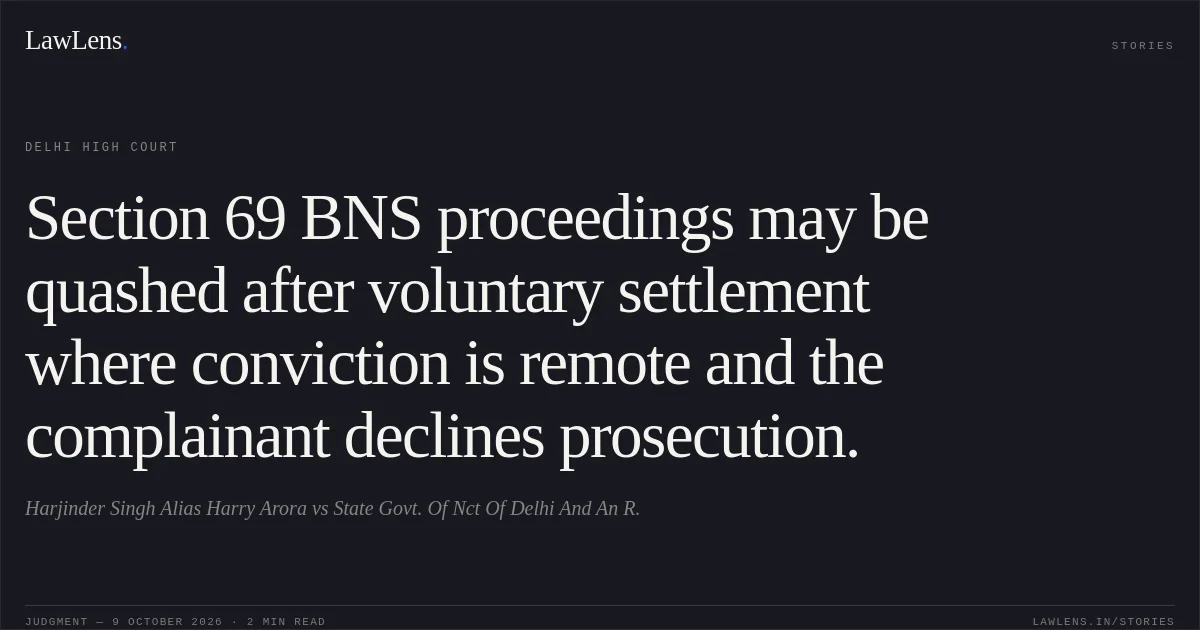
The petitioner sought quashing under Article 226 of the Constitution and Section 528 of the Bharatiya Nagarik Suraksha Sanhita, 2023 (BNSS), of an FIR registered under Section 69 of the Bharatiya Nyaya Sanhita, 2023 (BNS).
Source reference: para. 3, p. 1The complainant alleged that, after meeting the petitioner through a matrimonial website, she entered into a relationship with him on his representation that he was unmarried and would marry her; she later discovered he had been married since August 2023. The complaint also alleged financial exploitation.
Source reference: paras. 4–6, p. 2The petitioner was granted regular bail, and the parties subsequently entered into a memorandum of understanding (MoU). Before the Court, the complainant stated that the FIR arose from a misunderstanding, that she did not wish to pursue the matter, and that she had entered into the MoU voluntarily.
Source reference: paras. 7–10, pp. 2–3; para. 14, p. 6Issues
Whether the High Court should exercise its jurisdiction under Article 226 and Section 528 BNSS to quash the FIR under Section 69 BNS on the basis of the parties’ settlement and the complainant’s unwillingness to pursue the prosecution.
Source reference: paras. 3, 13–15, pp. 1, 6–7Whether, in the circumstances, continuation of the prosecution would serve the interests of justice or instead cause injustice despite the settlement.
Source reference: paras. 11–15, pp. 3–7Law Applied
Article 226 of the Constitution and Section 528 BNSS empower the High Court to quash criminal proceedings to secure the ends of justice or prevent abuse of process.
Source reference: no citationUnder Gian Singh v. State of Punjab, (2012) 10 SCC 303, quashing on settlement is distinct from statutory compounding; the Court must consider the nature and gravity of the offence, whether the dispute is predominantly private, and whether conviction is remote and continuation would defeat justice.
Source reference: para. 11, pp. 3–5Narinder Singh v. State of Punjab, (2014) 6 SCC 466, reiterates that this power must be exercised sparingly and with caution, and that the Court should consider whether conviction is remote and bleak and continuation would cause oppression or injustice.
Source reference: para. 12, pp. 5–6The Court applied these principles to the allegation under Section 69 BNS, concerning alleged deceit within a personal relationship.
Source reference: para. 13, p. 6Reasoning
The Court considered the complainant’s stated wish to move on, her characterisation of the FIR as arising from a misunderstanding, and her confirmation that the MoU was voluntary and free from coercion or undue influence.
Source reference: paras. 10, 14(i)–(ii), pp. 2, 6Given her unwillingness to pursue the complaint, the Court found the possibility of conviction remote and bleak.
Source reference: paras. 13–14(iii), p. 6It also considered that requiring her to continue with the investigation and trial would compel her to relive an episode she had chosen to put behind her, without serving the interest protected by Section 69 BNS.
Source reference: paras. 13–14(iii), p. 6Applying the settlement principles in Gian Singh and Narinder Singh, the Court concluded that giving effect to the settlement better served the ends of justice.
Source reference: paras. 11–15, pp. 3–7Holding
The Court held that the ends of justice would be better served by giving effect to the parties’ settlement than by continuing the proceedings.
It quashed FIR No. 0234/2026, registered on 1 July 2026 at P.S. Malviya Nagar, and all proceedings arising from it; the petition was disposed of accordingly.
Source reference: paras. 16–17, p. 7Acts & Sections Cited
4 provisions across 3 statutes referred to in this judgment. Each provision opens on LawLens.
Bharatiya Nagarik Suraksha Sanhita, 20231
Bharatiya Nyaya Sanhita, 20231
Code of Criminal Procedure, 19732
Original Court PDF
Harjinder Singh Alias Harry AroravsState Govt. Of Nct Of Delhi And An R.
Click to open original judgment
Original judgment, available to read, download and summarize on LawLens.in