Facts
The petitioner (husband) and respondent No. 7 (wife) were involved in matrimonial litigation.
Source reference: para. 1, 5In 2023, the wife filed FIR No. 03 of 2023 under Section 498A of the IPC and Section 3 of the Dowry Prohibition Act, 1961 (DP Act).
Source reference: para. 1, 5During the investigation, the wife and her family members made statements under Section 161 of the CrPC admitting to the payment of dowry.
Source reference: para. 5Based solely on these statements, the petitioner sought the registration of a counter-FIR against the wife and her family for the offence of ‘giving’ dowry under Section 3 of the DP Act.
Source reference: para. 1, 9The Judicial Magistrate First Class, Raipur, rejected the petitioner’s application under Section 156(3) of the CrPC, holding it amounted to a plea for reinvestigation.
Source reference: para. 6This order was upheld by the Sessions Judge and subsequently by the High Court of Chhattisgarh, which concluded that the petitioner's allegations would entail an oblique reinvestigation of the original FIR.
Source reference: para. 7-8The petitioner approached the Supreme Court via Special Leave Petition.
Source reference: no citationIssues
1. Whether statements made by a wife or her family members regarding the giving of dowry during an investigation can form the sole basis for prosecuting them for the offence of ‘giving dowry’ under Section 3 of the DP Act.
Source reference: para. 9, 132. Whether the protection/immunity afforded under Section 7(3) of the DP Act extends to the parents and relatives of the bride.
Source reference: para. 17, 203. Whether a second FIR can be registered for the offence of ‘giving dowry’ when the only evidence provided is the statement of the aggrieved person recorded in a prior investigation.
Source reference: para. 20Law Applied
Section 3 of the Dowry Prohibition Act, 1961, which penalizes both the giving and taking of dowry.
Source reference: para. 10Section 7(3) of the DP Act, which stipulates that a statement made by a person aggrieved by the offence shall not subject such person to prosecution under the Act.
Source reference: para. 13Joint Parliamentary Committee Report (1982), which emphasized that givers of dowry are often victims of societal compulsion and should not be equated with takers.
Source reference: para. 12Principles from Upkar Singh v. Ved Prakash and State of Rajasthan v. Surendra Singh Rathore, which allow for counter-complaints or rival versions under specific conditions.
Source reference: para. 19The Court expressly disapproved of the Delhi High Court's reasoning in Neera Singh v. State, noting it was decided per incuriam for failing to consider Section 7(3).
Source reference: para. 14-16Reasoning
The Court observed that the petitioner’s entire case for a counter-FIR rested exclusively on the statements made by the wife and her family under Section 161 CrPC.
Source reference: para. 9It reasoned that Section 7(3) of the DP Act creates a "shield of immunity" for the "person aggrieved" to ensure they can come forward to report dowry demands without the fear of self-incrimination for the act of giving.
Source reference: para. 13, 20The Court clarified that while a second FIR is permissible if independent evidence of ‘giving’ dowry exists, it cannot be sustained when the substratum of the prosecution is merely the protected statements of the victims.
Source reference: para. 20The Court affirmed the view that "person aggrieved" under Section 7(3) includes the parents and relatives of the bride, as they are typically the ones compelled to give dowry.
Source reference: para. 17-18Consequently, since no independent evidence was offered by the petitioner, the statutory protection barred the initiation of criminal proceedings against the respondents.
Source reference: para. 21Holding
The Supreme Court dismissed the Special Leave Petition, holding that the petitioner's grievance was bereft of merit.
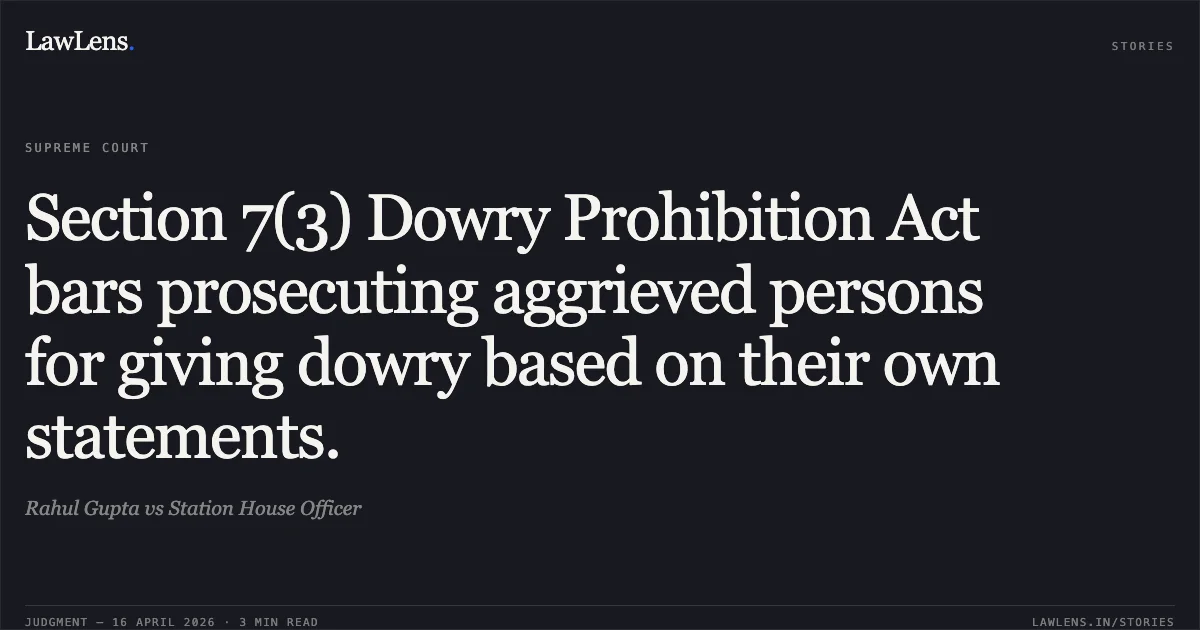
The Court held that statements made by the wife and her family regarding the giving of dowry are protected under Section 7(3) of the DP Act and cannot be used to launch a prosecution against them for the offence of 'giving' dowry under Section 3.
Source reference: para. 13, 20The orders of the lower courts and the High Court refusing to direct the registration of a counter-FIR were upheld, albeit on the specific ground of statutory immunity under the DP Act.
Source reference: para. 21Acts & Sections Cited
7 provisions across 4 statutes referred to in this judgment. Each provision opens on LawLens.
Bharatiya Nagarik Suraksha Sanhita, 20231
Code of Criminal Procedure, 19733
Code of Civil Procedure, 19081
Original Court PDF
Rahul GuptavsStation House Officer
Click to open original judgment
Original judgment, available to read, download and summarize on LawLens.in