Facts
The petitioner, a manufacturer of copper wires, challenged an order confirming ₹3,34,21,261 in allegedly ineligible ITC, interest and an equivalent penalty under Section 74 of the CGST Act, along with ₹50,30,256 in interest concerning payments to suppliers made beyond 180 days.
Source reference: para. 1, 5–10The demand rested on an audit objection that the suppliers’ GST registrations had been cancelled retrospectively, before the relevant invoices were issued.
Source reference: para. 6, 27–30The petitioner disputed the allegations, asserting that the transactions were genuine and the suppliers were registered at the relevant time; it also challenged the constitutionality of Section 16(2)(c) and the proviso concerning interest for delayed payment to suppliers.
Source reference: para. 2, 7, 9, 12–14The High Court considered the constitutional challenge and the legality of the adjudication order.
Source reference: para. 17–24Issues
Whether Section 16(2)(c) of the CGST Act should be struck down or read down to protect bona fide recipients where suppliers fail to discharge tax liability.
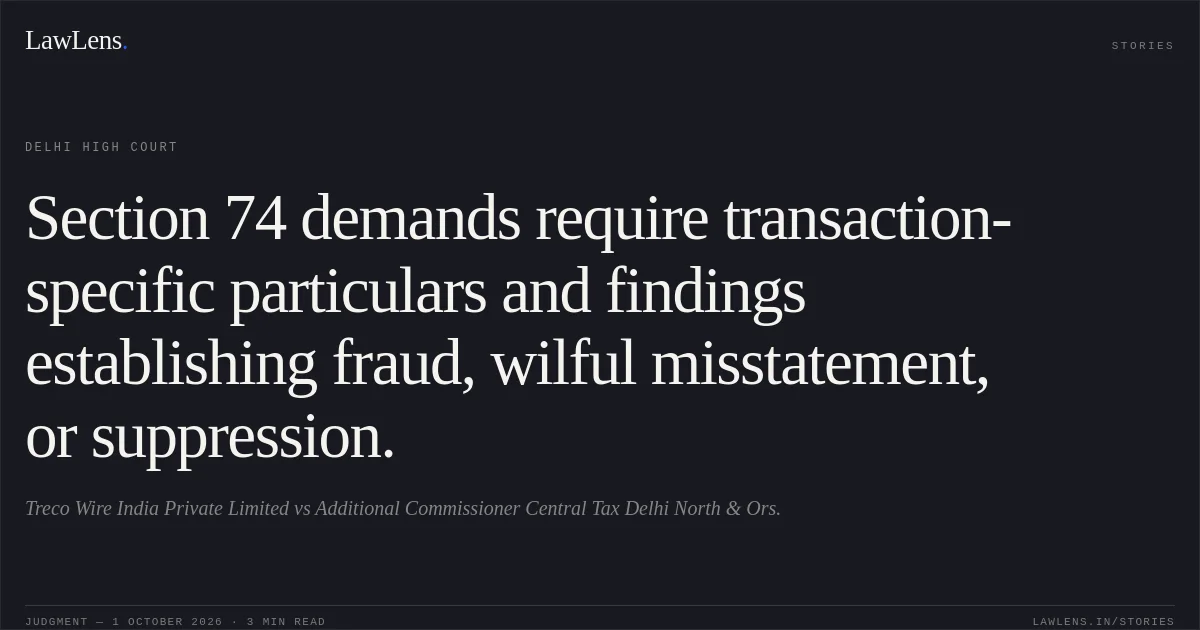
Source reference: para. 17–23Whether the demand and penalty under Section 74 could be sustained where the adjudication order did not identify the suppliers, relevant invoices, cancellation dates, supplier-wise ITC amounts, or specific findings of fraud, wilful misstatement or suppression.
Source reference: para. 24–35Whether the interest demand concerning payment to suppliers beyond 180 days required determination in this petition.
Source reference: para. 2, 10, 50Law Applied
Section 16(2)(c) of the CGST Act makes ITC subject to the statutory condition concerning payment of tax to the Government; the Supreme Court’s decision in Bhandari Scraps Traders v. Union of India, SLP (C) No. 23931/2026, decided 24 July 2026, declined to interfere with the Gujarat High Court’s decision in Maruti Enterprises v. Union of India, 2026 SCC OnLine Gujarat 4013, rejecting the challenge to that provision.
Source reference: para. 19–23Section 74 applies where tax has not been paid or has been short-paid, or ITC has been wrongly availed or utilised, by reason of fraud, wilful misstatement or suppression of facts to evade tax; an order invoking it must disclose the factual basis for finding those statutory ingredients satisfied, rather than merely reproduce the statutory language.
Source reference: para. 25–26, 31–32An adjudication order must also identify the transactions and material supporting the demand sufficiently to permit an effective response.
Source reference: para. 34–36Reasoning
The Court rejected the constitutional challenge because the Supreme Court had declined to interfere with the Gujarat High Court’s ruling upholding Section 16(2)(c).
Source reference: para. 19–23It nevertheless found the adjudication deficient: the order relied on a general assertion of retrospective cancellation but omitted supplier identities and GSTINs, invoice and cancellation dates, supplier-wise ITC amounts, and the material establishing the cancellation dates.
Source reference: para. 27–30It also failed to state how the petitioner had committed fraud, wilfully misstated facts or suppressed information to evade tax, or to demonstrate that its defence had been considered.
Source reference: para. 31–35Those omissions undermined both the factual basis of the demand and the petitioner’s opportunity to answer it, particularly given the equivalent penalty imposed under Section 74.
Source reference: para. 35–36The Court did not decide the merits of ITC eligibility or separately determine the 180-day interest challenge; it made no further order on consequential relief at that stage.
Source reference: para. 46, 50Holding
The Court held that Section 16(2)(c) would not be struck down or read down.
It set aside the Order-in-Original dated 15 January 2024 and consequential proceedings, and remanded the matter for fresh adjudication after notice and an effective hearing.
Source reference: para. 42–43The adjudicating authority must consider the petitioner’s reply and evidence, identify the suppliers and transactions if relying on retrospective cancellation, and make specific findings on whether Section 74’s requirements are met.
Source reference: para. 44–45It was directed to endeavour to pass a fresh order within eight weeks after the petitioner’s appearance, scheduled for 8 October 2026.
Source reference: para. 47–48The Court expressed no view on the merits of the ITC claim; the petition and pending application were disposed of.
Source reference: para. 46, 51Acts & Sections Cited
7 provisions across 2 statutes referred to in this judgment. Each provision opens on LawLens.
Central Goods and Services Tax Act, 20176
Integrated Goods and Services Tax Act, 20171
Original Court PDF
Treco Wire India Private LimitedvsAdditional Commissioner Central Tax Delhi North & Ors.
Click to open original judgment
Original judgment, available to read, download and summarize on LawLens.in