Facts
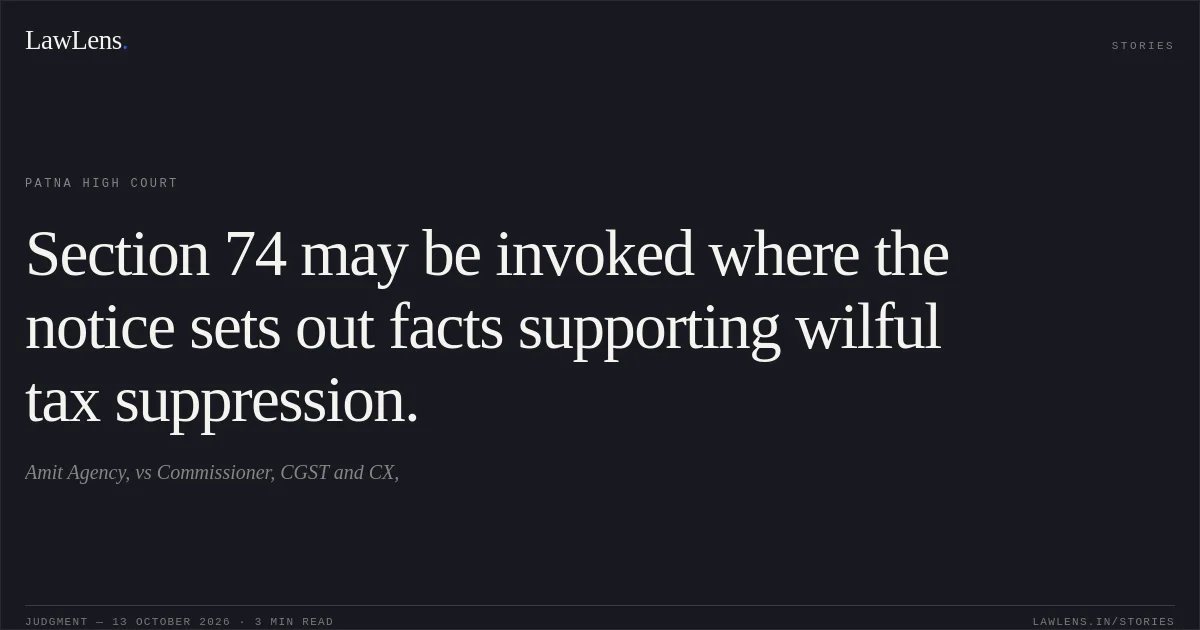
Amit Agency, a registered GST taxpayer, challenged an audit report relating to FYs 2017–18 to 2019–20, a show-cause notice (SCN) issued under Section 74 of the CGST Act, and the resulting order-in-original dated 22 April 2024.
Source reference: para. 1–11, 23–24It also questioned a subsequent corrigendum and a further order.
Source reference: para. 1–11, 23–24The petitioner alleged, among other things, that the audit exceeded the period prescribed by Section 65(4), that Section 74 had been invoked without the required fraud, wilful misstatement or suppression, and that procedural requirements concerning electronic uploading and digital signatures had not been met.
Source reference: para. 1–11, 23–24The respondents relied on the statutory appeal under Section 107 and maintained that the SCN set out the audit discrepancies and the basis for invoking Section 74.
Source reference: para. 13–20The High Court considered whether the SCN disclosed the jurisdictional basis for proceeding under Section 74, but ultimately declined to examine the appealable order on its merits.
Source reference: para. 25–27, 50Issues
1. Whether the High Court should entertain a writ petition challenging an appealable order under Section 74 when an effective statutory appeal is available under Section 107.
Source reference: para. 25–27, 502. Whether the SCN disclosed a sufficient basis for invoking Section 74, including the requisite grounds of fraud, wilful misstatement or suppression of facts.
Source reference: para. 27, 35–38, 45–493. Whether the audit-period and other procedural objections warranted interference under Article 226 in this proceeding.
Source reference: para. 1, 8–10, 27, 50, 54Law Applied
Section 65(7) of the CGST Act permits a proper officer, where an audit detects unpaid or short-paid tax or wrongly availed or utilised input tax credit, to initiate proceedings under Section 73, Section 74 or Section 74A.
Source reference: para. 34For the relevant period, Section 74(1) applies where tax is unpaid or short-paid, or input tax credit is wrongly availed or utilised, by reason of fraud, wilful misstatement or suppression of facts; the foundational facts supporting that allegation must appear in the notice, rather than being supplied later by affidavit.
Source reference: para. 39–44The Court considered this requirement in light of M/s G.R. Infra Projects Limited, Ratlam and M/s Tata Steel Limited.
Source reference: para. 39–44Section 107 provides a statutory appeal, and the Court applied the established rule that a writ petition will ordinarily not be entertained where an effective alternative remedy exists, subject to recognised exceptions for jurisdictional error and other exceptional circumstances, relying on Commissioner of Income Tax v. Chhabil Dass Agarwal and United Bank of India v. Satyawati Tandon.
Source reference: para. 25–26The Court also referred to the limited scope of judicial review over an officer’s formation of belief, while recognising that a court may examine whether relevant material supports it.
Source reference: para. 47Reasoning
Applying the alternative-remedy rule, the Court noted that the order-in-original was appealable and that the petitioner had an efficacious remedy under Section 107.
Source reference: para. 25–27It nevertheless examined the asserted jurisdictional defect in the SCN.
Source reference: para. 25–27The Court found that the notice identified specific instances of non-payment or short payment, late fees and other GST liabilities, and stated that the discrepancies had been detected through audit; it also recorded that the petitioner had not contested the final audit report before the SCN was issued.
Source reference: para. 29–33, 36–38, 45On that basis, it held that the notice was not a mere mechanical recital of the statutory expressions and distinguished G.R. Infra Projects and Tata Steel, where the notices lacked adequate foundational facts.
Source reference: para. 39–46, 48–49The Court therefore found no jurisdictional error in the SCN warranting writ intervention.
Source reference: para. 50It did not decide the order-in-original’s merits or finally determine the other objections, leaving them for consideration through the appropriate remedy.
Source reference: para. 50, 54Holding
The Court declined to quash the SCN or the order-in-original in writ jurisdiction and disposed of the petition, leaving the petitioner at liberty to pursue the statutory remedy.
It directed that if the petitioner filed an appeal within one month from the judgment, the appellate authority should consider it on its merits.
Source reference: para. 50–52All questions were left open; the Court clarified that its observations concerning the SCN were made only for considering the writ challenge and that the order-in-original remained open to consideration on its own merits.
Source reference: para. 53–54Acts & Sections Cited
17 provisions across 2 statutes referred to in this judgment. Each provision opens on LawLens.
BIHAR GOODS AND SERVICES TAX ACT, 20177
Central Goods and Services Tax Act, 2017
Original Court PDF
Amit Agency,vsCommissioner, CGST and CX,
Click to open original judgment
Original judgment, available to read, download and summarize on LawLens.in