Facts
The applicants (defendants) challenged an order dated 26/11/2025 passed by the Civil Judge, Senior Division, Aron, which rejected their application under Order 7 Rule 11 of the Code of Civil Procedure (CPC)
Source reference: para 3The applicants contended that the suit was barred by law because the plaintiff, after issuing a notice under Section 80 CPC, filed the suit before the expiry of the mandatory two-month period without seeking leave under Section 80(2) CPC
Source reference: para 4The underlying suit sought a declaration of title over specific agricultural lands, a permanent injunction against private parties, and a declaration that certain orders passed by the Tehsildar and sale deeds registered by the Sub-Registrar were null and void
Source reference: para 6Issues
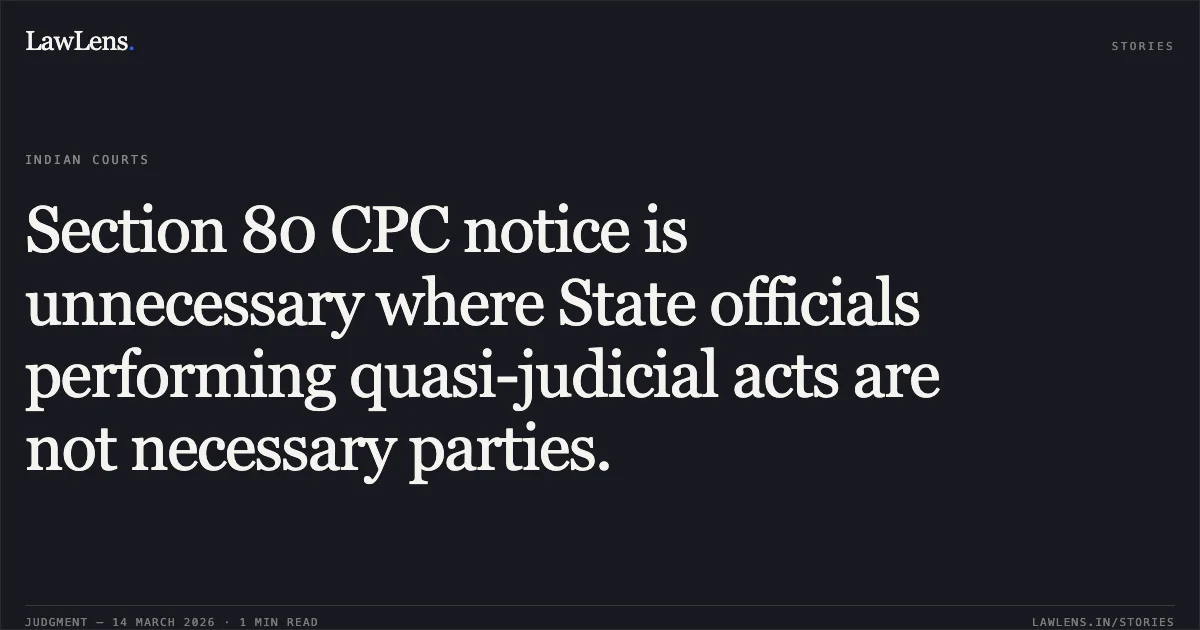
Whether a suit filed before the expiry of the two-month notice period under Section 80 CPC is maintainable when the primary dispute is between private parties and the state officials are not necessary parties
Source reference: para 4, 8Law Applied
Section 80 of the CPC, which stipulates that no suit shall be instituted against the Government or a public officer until the expiration of two months next after notice in writing has been delivered
Source reference: para 12Supreme Court’s holding in Bishandayal and Sons v. State of Orissa, (2001) 1 SCC 555, which established that Section 80 notice is for the benefit of the respondents and can be waived as it does not go to the root of jurisdiction
Source reference: para 11State of A.P. v. Pioneer Builders, A.P., (2006) 12 SCC 119, which clarifies that the legislative intent of Section 80 is to give the Government an opportunity to reconsider its decision and avoid unnecessary litigation
Source reference: para 12Reasoning
The court analyzed the relief sought in the plaint and concluded that the dispute was essentially between private parties, with no substantive relief sought against the State
Source reference: para 7The court reasoned that since the Tehsildar passed the impugned order in a quasi-judicial capacity, he was not a necessary party to the suit nor required to justify his order in the witness box
Source reference: para 13Similarly, the Sub-Registrar was deemed not a necessary party once the sale deed was executed
Source reference: para 13The court held that the procedural requirement of the two-month waiting period under Section 80 CPC applies only when the State is a necessary party against whom relief is sought; since the primary relief was private in nature, the failure to wait two months did not render the suit bad
Source reference: para 14Holding
The court dismissed the civil revision, holding that the applicants' contention regarding the mandatory nature of the two-month notice period was misconceived in the context of this suit
The court affirmed the trial court's decision to reject the application under Order 7 Rule 11 CPC, thereby allowing the suit to proceed
Source reference: para 15Acts & Sections Cited
2 provisions across 1 statute referred to in this judgment. Each provision opens on LawLens.
Code of Civil Procedure, 19082
Original Court PDF
Dinesh Singh RaghuvanshivsBhaiyalal
Click to open original judgment
Original judgment, available to read, download and summarize on LawLens.in