Facts
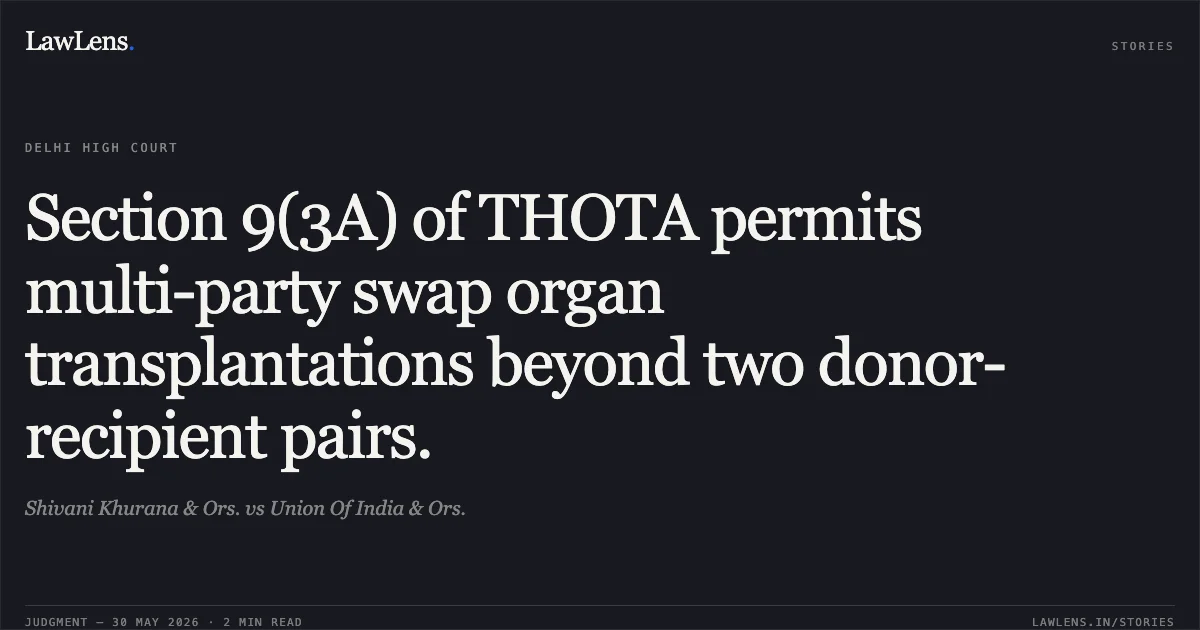
The petitioners (consisting of four donor-recipient pairs) sought permission for a "four-way-swap kidney transplantation"
Source reference: para. 1In each pair, the donor and recipient are "near-relatives" as defined under Section 2(i) of the Transplantation of Human Organs & Tissues Act, 1994 ("Act"), but are biologically incompatible
Source reference: para. 2The Authorization Committee and the Appellate Authority rejected the proposal on the singular ground that Section 9(3A) of the Act only permits swap transplants between two incompatible pairs and does not provide for multi-way swaps involving more than two pairs
Source reference: paras. 3-4The petitioners challenged this restrictive interpretation before the High Court
Source reference: para. 1Issues
Whether the Authorization Committee can permit, under Section 9(3A) of the Act, swap transplantations between multiple (more than two) donor-recipient pairs
Source reference: para. 8Law Applied
The court primarily interpreted Section 9(3A) of the Transplantation of Human Organs & Tissues Act, 1994, which outlines the procedure for swap donations between incompatible near-relative pairs
Source reference: para. 14Kuldeep Singh v. State of Tamil Nadu [(2005) 11 SCC 122], establishing that the Act’s object is to prevent commercial dealings rather than prohibit legitimate transplants
Source reference: para. 10Indian Society of Organ Transplantation v. Union of India [2025 INSC 1361], which directed the evolution of national swap transplantation guidelines
Source reference: para. 20GP Singh’s Principles of Statutory Interpretation that courts should adopt a reasonable and sensible construction that avoids anomalies or absurdities
Source reference: para. 17Reasoning
The court reasoned that Section 9(3A) is a remedial provision intended to assist donor-recipient pairs who face biological incompatibility
Source reference: para. 15It held that the statutory use of terms like "first donor" and "second donor" is illustrative of the procedure rather than a limitation on the number of participating pairs; interpreting it otherwise would border on "absurdity"
Source reference: para. 16The court observed that as long as the core objective of the Act—preventing commercialization and organ trafficking—is satisfied, technicalities should not impede the saving of human lives
Source reference: paras. 12-13, 18The court noted that other states (Karnataka and Kerala) and institutions (IKDRC, Gujarat) have already recognized and facilitated multi-way swaps, proving the scientific and ethical validity of the practice
Source reference: paras. 22-24Therefore, the purpose of the Act is furthered by an interpretation that expands the pool of compatible matches for sensitised patients
Source reference: para. 19Holding
The court allowed the petition and set aside the orders of the Appellate Authority and the Authorization Committee
It held that Section 9(3A) does not bar inter-se transplantation between more than two pairs
Source reference: para. 16The court directed the Authorization Committee to examine the feasibility of the proposed four-way swap transplant, ensuring all other legal requirements regarding the absence of commercial dealings are met
Source reference: para. 28Acts & Sections Cited
7 provisions across 2 statutes referred to in this judgment. Each provision opens on LawLens.
Transplantation of Human Organs and Tissues Act, 19943
Original Court PDF
Shivani Khurana & Ors.vsUnion Of India & Ors.
Click to open original judgment
Original judgment, available to read, download and summarize on LawLens.in