Facts
The Petitioner Society entered into a Development Agreement (DA) dated May 2, 2013, with Respondent No. 1 (Developer) for property redevelopment
Source reference: para. 3Following defaults by the Developer in paying corpus amounts, transit rent, and statutory dues, the Society filed a Section 9 Petition in 2017
Source reference: para. 4In December 2017, the Court issued an expansive injunction restraining the Developer from alienating any assets or creating third-party rights across *all* its projects
Source reference: para. 32Over time, 31 Interim Applications (IAs) were filed by third-party decree-holders and allottees from unrelated projects seeking to claim funds deposited in this Court
Source reference: paras. 11-14An Arbitral Tribunal was finally constituted on September 2, 2024, and has since passed a Section 17 order
Source reference: paras. 5, 7Issues
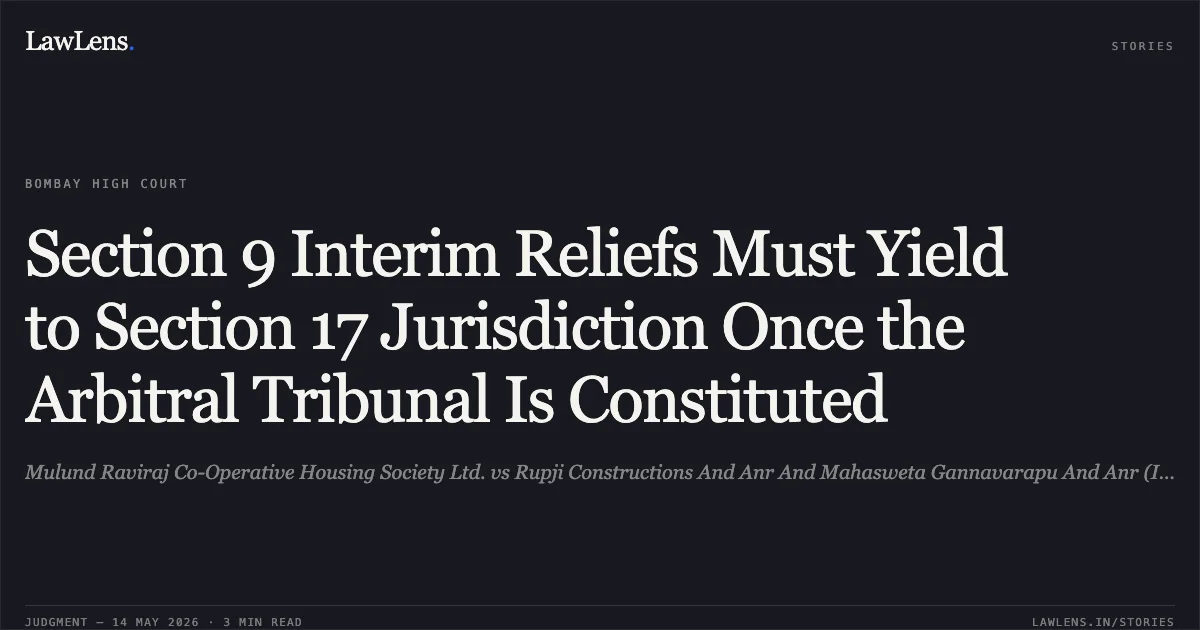
1. Whether a Section 9 Court should continue to exercise jurisdiction and maintain interim orders once an Arbitral Tribunal has been constituted and a Section 17 application is filed
Source reference: para. 222. Whether third parties (decree-holders or allottees) who are not signatories to the arbitration agreement can intervene in Section 9 proceedings to recover dues unrelated to the subject matter of the arbitration
Source reference: paras. 27-28Law Applied
The Court applied Section 9 and Section 17 of the Arbitration and Conciliation Act, 1996, emphasizing that Section 9 is intended only for the "preservation and protection" of the subject matter of the arbitration agreement
Source reference: para. 19Per Section 9(3), once a tribunal is constituted, the Court shall not entertain applications unless the Section 17 remedy is inefficacious
Source reference: para. 22Relying on *Ashok Traders v. Gurumukh Das Saluja*, the court noted that Section 9 is not a standalone equity jurisdiction
Source reference: para. 23Furthermore, based on *Cox and Kings Ltd. v. SAP India (P) Ltd.* and *ASF Buildtech*, a third party can only be joined if they are a "veritable party" (e.g., via the Group of Companies doctrine or commonality of subject matter), as the term "party" under Section 2(1)(h) is strictly defined
Source reference: paras. 20, 28Reasoning
The Court reasoned that since the Arbitral Tribunal is now functional and has already passed a Section 17 order, the "temporal shelf life" of the Section 9 jurisdiction has expired
Source reference: paras. 22, 24The Court found that the hundreds of third-party applicants (decree-holders from other projects) had no privity to the DA and were not "veritable parties"; thus, allowing them to chase the Developer's assets within this specific arbitration's Section 9 umbrella would be *coram non judice*
Source reference: paras. 46, 49The Court observed that the 2017 injunction was so broad that it stalled the Developer's other projects, and now that a Statement of Claim for Rs. 18.65 Crores is before the Tribunal, the Tribunal is the only efficacious forum to determine what specific assets must remain secured
Source reference: paras. 34, 37-38Holding
All third-party intervention requests are rejected as they lack privity to the arbitration agreement
The Court disposed of the Section 9 Petition and all 31 IAs. It held that: (i) All third-party intervention requests are rejected as they lack privity to the arbitration agreement [para. 51]; (ii) The Learned Arbitral Tribunal shall determine, within three months, the specific amount required to secure the Society's interests; any surplus shall then be released to the Developer [para. 70(C-D)]; (iii) The broad 2017 injunction is referred to the Tribunal for modification/vacation based on the Society's actual claims [para. 70(E)]; (iv) The Court-appointed Commissioner is directed to hand over all materials to the Registry/Tribunal and the previous oversight committee is disbanded
Source reference: paras. 68-71Acts & Sections Cited
7 provisions across 1 statute referred to in this judgment. Each provision opens on LawLens.
Arbitration and Conciliation Act, 19967
Original Court PDF
Mulund Raviraj Co-Operative Housing Society Ltd.vsRupji Constructions And Anr And Mahasweta Gannavarapu And Anr (Interveners)
Click to open original judgment
Original judgment, available to read, download and summarize on LawLens.in