Facts
The Petitioner (Society) entered into a Development Agreement (DA) in 2013 with the Respondent (Developer) for property redevelopment
Source reference: p.5, para. 3Following defaults in transit rent, statutory dues, and construction progress, the Society filed a Section 9 Petition in 2017 for interim protection
Source reference: p.5-6The Court passed an order in December 2017 attaching the Developer's personal assets and injuncting all their projects
Source reference: p.22-24Over the years, 31 Interim Applications (IAs) were filed by third-party decree holders, allottees from unrelated projects, and the Developer's family members, seeking to intervene or claim funds deposited in Court
Source reference: p.8-12An Arbitral Tribunal was finally constituted in September 2024, which subsequently passed orders under Section 17 of the Act
Source reference: p.6-7Issues
1. Whether a Section 9 Court should continue to exercise jurisdiction and maintain interim orders once an Arbitral Tribunal has been constituted and a Section 17 application has been filed
Source reference: p.17, para. 22; p.25, para. 352. Whether third parties (decree holders/allottees) who are not signatories to the arbitration agreement can intervene in Section 9 proceedings to satisfy unrelated claims
Source reference: p.20, para. 27; p.30, para. 49Law Applied
The court primarily applied Section 9 and Section 17 of the Arbitration and Conciliation Act, 1996
Source reference: p.15Section 9 jurisdiction is intended for the "preservation and protection" of the subject matter of the arbitration agreement
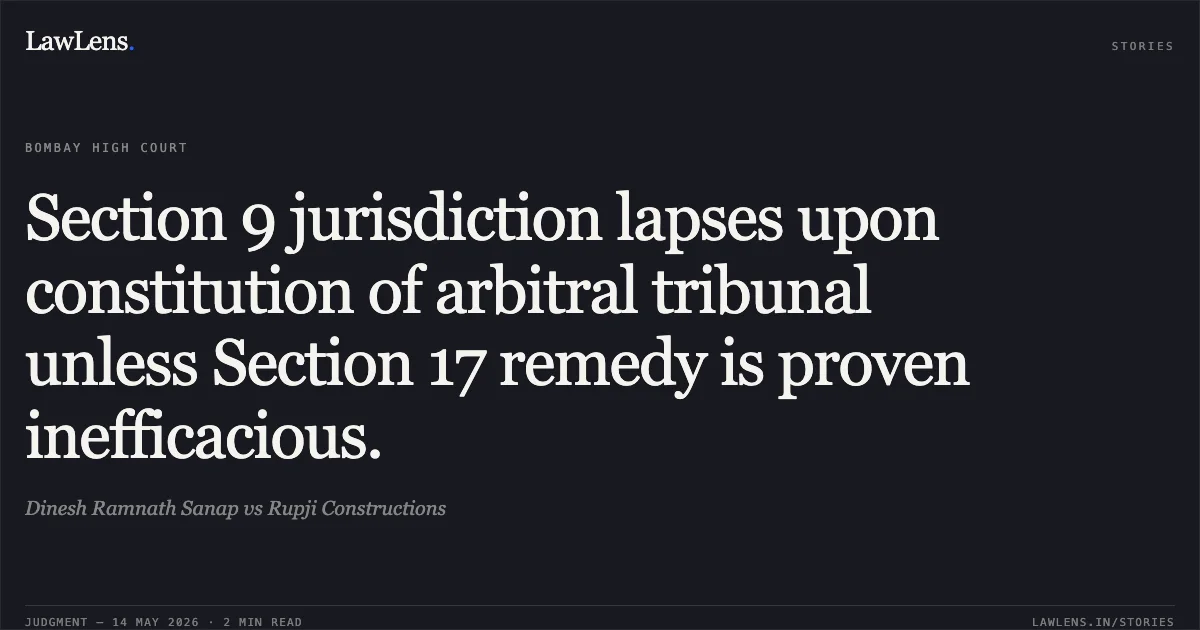
Source reference: p.14, para. 19Per Section 9(3), once a tribunal is constituted, the Court shall not entertain applications unless the Section 17 remedy is inefficacious
Source reference: p.16Regarding third parties, the court applied the "veritable party" doctrine established in Cox and Kings Ltd. v. SAP India (P) Ltd. and ASF Buildtech Pvt. Ltd. v. Shapoorji Pallonji, which requires a non-signatory to show proximity, consent, or a de facto connection to the dispute to be roped into arbitration
Source reference: p.20-21Reasoning
The Court reasoned that Section 9 is not a standalone equity jurisdiction but is limited by the contours of the arbitration agreement
Source reference: p.18, para. 24Since the Arbitral Tribunal was now functional and had already passed a Section 17 Order, the Rule of Law dictated that the Section 9 proceedings merge into the Section 17 jurisdiction
Source reference: p.25, para. 35The Court found that the third-party applicants (allottees/creditors from other projects) lacked privity to the DA and did not qualify as "veritable parties"
Source reference: p.30, para. 49Their claims, while perhaps valid, belonged in execution courts or other legal forums, not in a Section 9 petition intended solely to protect the Society’s interests
Source reference: p.27, para. 41; p.31, para. 51Consequently, the expansive injunctions from 2017 needed re-evaluation by the Tribunal to ensure they only protected the Society's specific claims rather than acting as a universal freeze for unrelated creditors
Source reference: p.26, para. 39Holding
The Court disposed of the Section 9 Petition and all 31 IAs
The Section 9 Court is no longer the appropriate forum once a Section 17 remedy is available
Source reference: p.30, para. 47Third-party interventions were rejected; they were granted liberty to approach appropriate forums with a limitation waiver for time spent here
Source reference: p.31-32The Arbitral Tribunal was directed to assess within three months what amount from the Court deposit is necessary to secure the Society's claim; any surplus funds are to be released to the Developer; the Developer must honor undertakings; and the private Court Commissioner was replaced by an official Court Commissioner
Source reference: p.40-41Acts & Sections Cited
7 provisions across 1 statute referred to in this judgment. Each provision opens on LawLens.
Arbitration and Conciliation Act, 19967
Original Court PDF
Dinesh Ramnath SanapvsRupji Constructions
Click to open original judgment
Original judgment, available to read, download and summarize on LawLens.in


