Facts
The Petitioner and Respondent entered into an agreement for sale of a flat on 31 March 2021.
Source reference: pp. 1–4After the Respondent did not provide possession by the agreed date, the parties executed and registered a Deed of Cancellation on 28 March 2026, under which the Respondent was to refund ₹58,97,600.
Source reference: pp. 1–4A post-dated cheque for that amount was dishonoured for “Funds Insufficient” on 1 July 2026.
Source reference: pp. 1–4The Petitioner applied under Section 9 of the Arbitration and Conciliation Act, 1996, seeking interim protection by way of a deposit. She relied, among other things, on the dishonoured cheque, the Respondent’s disputes and execution proceedings concerning redevelopment projects, and transfers of redevelopment rights. The Respondent disputed liability and the underlying transaction.
Source reference: pp. 5–9Issues
1. Whether the Petitioner established sufficient grounds under Section 9 of the Arbitration and Conciliation Act, 1996, for an interim direction requiring the Respondent to deposit ₹58,97,600 pending arbitral proceedings
Source reference: p. 9, para. 152. Whether the circumstances on record justified securing the claimed amount despite the Respondent’s denial of liability
Source reference: pp. 11–16, paras. 19–30Law Applied
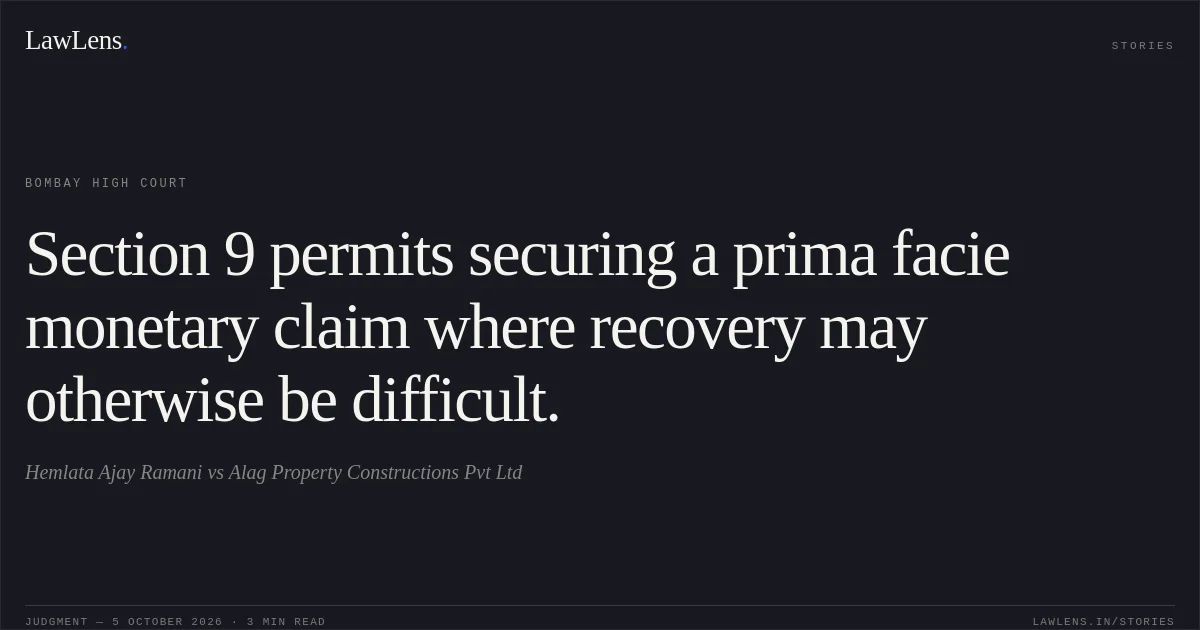
Section 9 of the Arbitration and Conciliation Act, 1996 empowers the Court to grant an interim measure to secure an amount in dispute in arbitration, but a disputed monetary claim alone does not justify such protection; the applicant must demonstrate circumstances showing that protection is necessary to prevent the eventual award from becoming difficult to enforce.
Source reference: pp. 11–12, paras. 21–22In applying Section 9, the Court relied on Essar House Private Limited v. Arcellor Mittal Nippon Steel India Limited, (2022) 20 SCC 178, which recognises the Court’s power to secure the amount in dispute and the relevance of procedural-law principles, while requiring the power to be exercised appropriately and carefully.
Source reference: p. 11, para. 21Reasoning
The registered Deed of Cancellation and the cheque issued for the same amount provided documentary support for the Petitioner’s claim; the dishonour for insufficient funds further showed that the anticipated payment had not been made. The Court did not treat the Respondent’s liability as admitted or finally established, leaving that dispute for the arbitral tribunal.
Source reference: pp. 10–12, paras. 16–20, 28The Court considered the Respondent’s other disputes, execution proceedings, the statement that funds in disclosed accounts were negligible, and the assignments of redevelopment rights. While none of these circumstances individually proved an intention to defeat the Petitioner’s claim, their combined effect, together with the dishonoured cheque and registered documents, gave rise to a genuine concern that recovery could become difficult.
Source reference: pp. 12–16, paras. 23–27A deposit would secure the amount without releasing it to the Petitioner or determining the parties’ rights, and the Respondent would retain the opportunity to contest liability in arbitration.
Source reference: p. 16, paras. 29–30Holding
The Court held that the Petitioner had made out a prima facie case for protection under Section 9 and that the balance of convenience favoured securing the claimed principal amount.
The petition was partly allowed: the Respondent was directed to deposit ₹58,97,600 within four weeks, with the sum to be placed in a fixed deposit and renewed until further orders. The amount was not to be released to the Petitioner at that stage; the parties’ rights and contentions, including the Petitioner’s claim to interest or other amounts, were left open for arbitration.
Source reference: pp. 17–19, para. 31Acts & Sections Cited
3 provisions across 2 statutes referred to in this judgment. Each provision opens on LawLens.
Arbitration and Conciliation Act, 19961
Original Court PDF
Hemlata Ajay RamanivsAlag Property Constructions Pvt Ltd
Click to open original judgment
Original judgment, available to read, download and summarize on LawLens.in