Facts
The respondent filed a complaint against the petitioner under Section 138 of the Negotiable Instruments Act, 1881, alleging that the petitioner issued a cheque for ₹3,00,000 towards repayment of a cash loan.
Source reference: para. 2–4The petitioner disputed the loan and claimed that the cheque had been given as security in connection with earlier dealings.
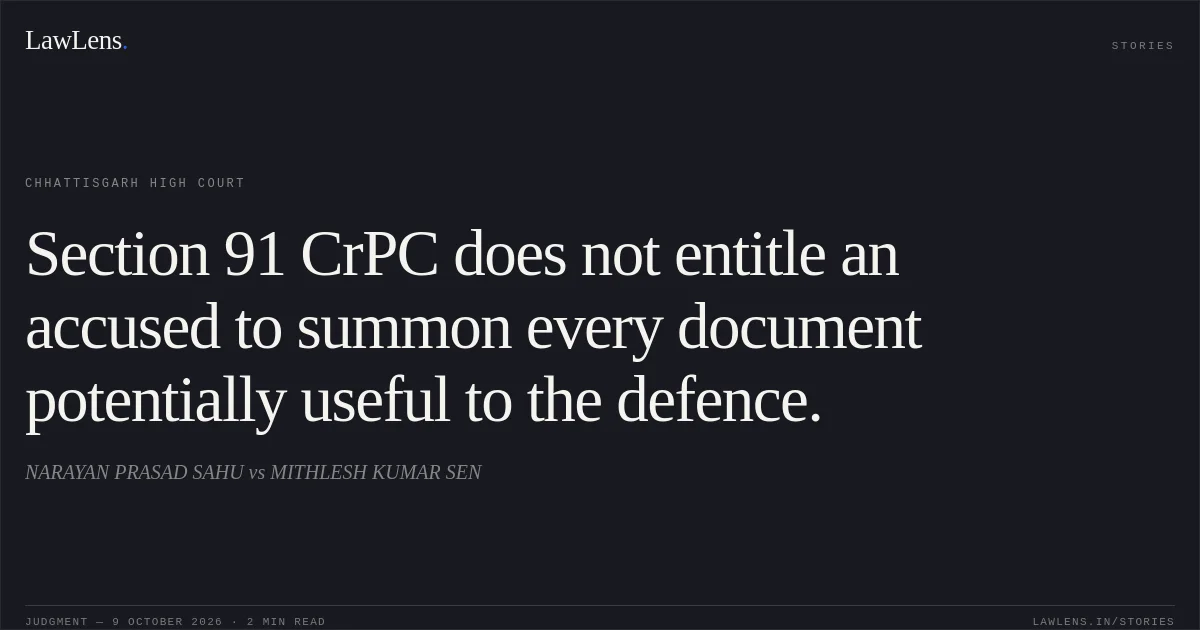
Source reference: para. 2–4During trial, the petitioner applied under Section 91 Cr.P.C. to summon the complainant’s money-lending licence, income-tax-related documents, and any writing concerning the alleged loan.
Source reference: para. 5–6The Magistrate rejected the application, noting, among other things, the complainant’s position that he did not carry on a money-lending business and did not possess such a licence.
Source reference: para. 5–6The Sessions Court dismissed the petitioner’s revision as barred by Section 397(2) Cr.P.C., treating the Magistrate’s order as interlocutory.
Source reference: para. 7The petitioner then invoked the High Court’s inherent jurisdiction under Section 528 BNSS.
Source reference: para. 1Issues
1. Whether the documents sought by the petitioner were necessary or desirable to be summoned under Section 91 Cr.P.C. for the purposes of the trial.
Source reference: para. 11–152. Whether the courts below committed such illegality, perversity, or failure of justice as to warrant interference under Section 528 BNSS.
Source reference: para. 10, 17–19Law Applied
Section 91 Cr.P.C. empowers a court to require production of a document or thing when it considers production necessary or desirable for an inquiry or trial; it does not give an accused an unrestricted right to summon every document that might be useful to the defence, and the court must assess relevance and necessity.
Source reference: para. 12–13Section 397(2) Cr.P.C. bars revision against interlocutory orders.
Source reference: para. 7The inherent jurisdiction under Section 528 BNSS is to prevent abuse of process and secure the ends of justice, not to substitute for appellate or revisional review merely because another view is possible.
Source reference: para. 10Reasoning
The High Court held that the complainant’s stated lack of a money-lending licence meant that the court could not direct production of a document said not to exist in his possession merely because the petitioner asserted that it should exist.
Source reference: para. 14The absence of a written loan document could be tested through evidence and did not, by itself, require a Section 91 summons.
Source reference: para. 15The petitioner’s security-cheque defence remained available for determination on the evidence at trial, and the court declined to conduct a mini-trial on the alleged loan at the document-production stage.
Source reference: para. 15Since the challenged order did not finally determine a substantive right or foreclose the petitioner’s defence, and the petitioner had not shown material prejudice or a miscarriage of justice, the conditions for inherent intervention were not met.
Source reference: para. 17–18Holding
The High Court found no ground to interfere with either the Magistrate’s order rejecting the Section 91 application or the Sessions Court’s revisional order.
The petition under Section 528 BNSS was dismissed at the admission stage.
Source reference: para. 20The Court clarified that its observations were limited to the document-production issue and should not influence the trial court’s determination of the Section 138 complaint on its merits.
Source reference: para. 21Acts & Sections Cited
5 provisions across 3 statutes referred to in this judgment. Each provision opens on LawLens.
Bharatiya Nagarik Suraksha Sanhita, 20231
Negotiable Instruments Act, 18811
Code of Criminal Procedure, 19733
Original Court PDF
NARAYAN PRASAD SAHUvsMITHLESH KUMAR SEN
Click to open original judgment
Original judgment, available to read, download and summarize on LawLens.in