Facts
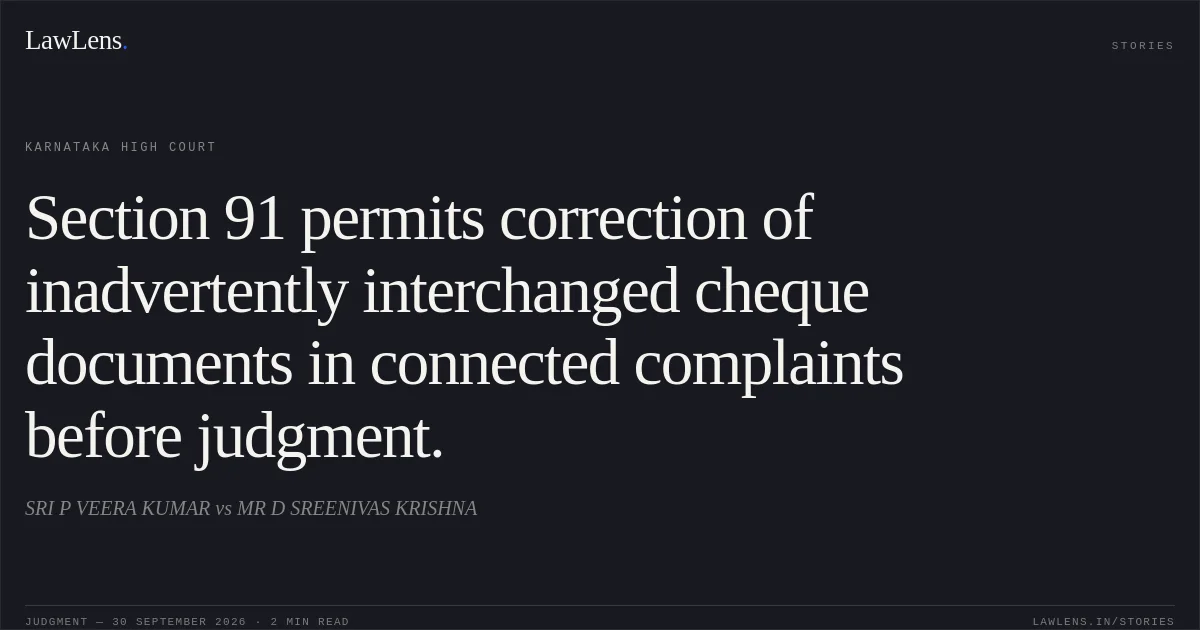
The complainant initiated two separate proceedings under Section 138 of the Negotiable Instruments Act, 1881, concerning two cheques issued by the accused for ₹20,00,000 and ₹20,14,000.
Source reference: para. 3.1–3.2, 8–9Although the complaints identified the respective cheques, the cheques and some accompanying materials were inadvertently interchanged when the complainant’s sworn statements were recorded.
Source reference: para. 3.1–3.2, 8–9The error came to light after both trials had concluded, arguments had been heard, and the cases were awaiting judgment.
Source reference: para. 3.1–3.2, 8–9The complainant then applied under Section 91 CrPC to correct the interchange.
Source reference: para. 3.1–3.2, 8–9The Magistrate allowed the applications, finding the error inadvertent and curable.
Source reference: para. 3.1–3.2, 8–9The accused challenged those orders under Section 482 CrPC/Section 528 BNSS.
Source reference: para. 3.1–3.2, 8–9Issues
Whether the Magistrate could permit correction of an inadvertent interchange of cheques and related materials in the two complaints under Section 91 CrPC
Source reference: para. 7Whether the applications could be allowed after the trials had concluded and the cases were awaiting judgment
Source reference: para. 3.1, 5–6, 9Law Applied
Section 91 CrPC permits the court to order production of a document or thing when it is necessary or desirable for proceedings under the Code; that necessity and desirability must be assessed in light of the stage of the proceeding and the circumstances of the request (State of Orissa v. Debendra Nath Padhi, (2005) 1 SCC 568).
Source reference: para. 10.1The Court also applied, by analogy with Section 311 CrPC, the principle that an inadvertent oversight in conducting a case is not necessarily an incurable lacuna and may be corrected where required for the just decision of the case (P. Chhaganlal Daga v. M. Sanjay Shaw, (2003) 11 SCC 486; Rajendra Prasad v. Narcotic Cell, (1999) 6 SCC 110).
Source reference: paras. 10.2–10.3A party should not ordinarily gain an advantage from a genuine, correctable mistake; however, the court’s discretion remains dependent on the facts and procedural stage.
Source reference: paras. 10.3–10.6Reasoning
The Court treated the mistake as an inadvertent exchange of documents between two complaints involving the same parties and transaction, rather than an attempt to introduce a new case or cure an inherent weakness in the prosecution.
Source reference: paras. 8–9, 10The complaints identified the respective cheques, and the error arose when the sworn statements and documents were placed in the two records.
Source reference: paras. 8–9, 10Given the common transaction and the accused’s admitted signature on the cheques, the Court held that correction would not cause prejudice and that the accused should not be permitted to rely on the clerical error as a technical defence.
Source reference: paras. 8–9, 10The Court accordingly found the Magistrate’s order tenable, notwithstanding that the matter had reached the stage of judgment.
Source reference: paras. 10.5–10.6Holding
The High Court answered the issue in the affirmative and rejected both petitions, finding no error in the Magistrate’s orders permitting correction of the interchange.
The interim orders staying the trial proceedings were dissolved.
Source reference: para. 11Acts & Sections Cited
15 provisions across 3 statutes referred to in this judgment. Each provision opens on LawLens.
Code of Criminal Procedure, 1973
Bharatiya Nagarik Suraksha Sanhita, 20232
Negotiable Instruments Act, 18813
Original Court PDF
SRI P VEERA KUMARvsMR D SREENIVAS KRISHNA
Click to open original judgment
Original judgment, available to read, download and summarize on LawLens.in