Facts
This bunch of six writ petitions (four filed by Union Bank of India and two by auction purchasers) challenged attachment orders, letters of intimation to societies, and the recording of encumbrances (boja) in revenue records by various departments of the State of Maharashtra.
Source reference: para. 3-4The Union Bank, as a secured creditor, had registered its security interests with CERSAI for various properties between 2007 and 2015.
Source reference: para. 20, 23, 27, 30The Respondent State authorities issued attachment orders and recorded encumbrances for statutory dues (MVAT, MGST, etc.), some of which were issued prior to the 2020 amendment of the SARFAESI Act, while others were issued later without registering a charge with CERSAI.
Source reference: para. 7, 12, 14Issues
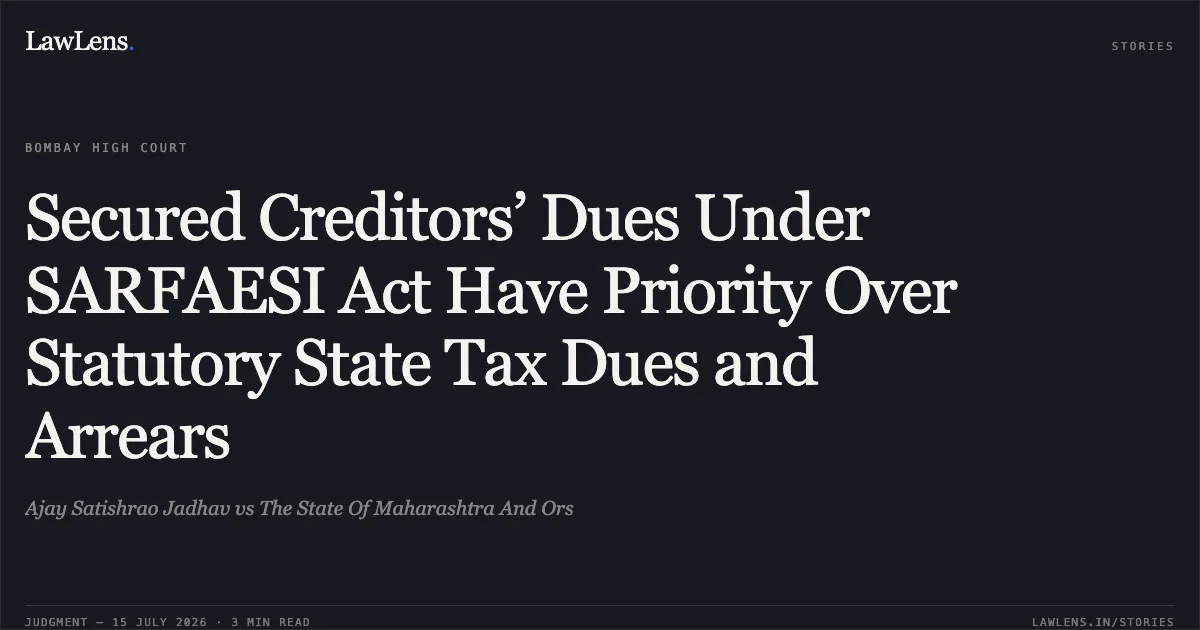
1. Whether the dues of a secured creditor under the SARFAESI Act have priority over the statutory dues (taxes, cesses, etc.) claimed by the State Government under MGST or MVAT Acts.
Source reference: para. 2, 92. Whether an attachment order issued by the State prior to the January 24, 2020, amendment of the SARFAESI Act takes precedence over the secured creditor’s rights if the State failed to issue a formal proclamation of sale.
Source reference: para. 123. Whether an auction purchaser who buys a property on an "as is where is" basis is entitled to have State-recorded encumbrances removed from revenue records.
Source reference: para. 16-17Law Applied
Section 26E of the SARFAESI Act and Section 31B of the Recovery of Debts and Overdue to Banks and Financial Institutions Act, 1993, which provide that debts due to secured creditors shall be paid in priority over all other debts and government dues.
Source reference: para. 10The Full Bench precedent in Jalgaon Janta Sahakari Bank Ltd. v. Joint Commissioner of Sales Tax [2022 SCC OnLine Bom 1767], which established that Central legislation creating "priority" offsets the "paramount charge" created by State laws like the Maharashtra Land Revenue Code and the MVAT/MGST Acts.
Source reference: para. 10, 14The principle from Indian Overseas Bank v. Deputy Commissioner of Sales Tax, holding that the State cannot "chase" an asset once it has been sold by a secured creditor to a third party.
Source reference: para. 18Reasoning
The Court reasoned that under the SARFAESI Act, "priority" means the right to enforce a claim in preference to all others, including the State.
Source reference: para. 10Regarding the MGST and MVAT Acts, the Court held that even with "non-obstante" clauses or "first charge" language in State laws, they remain subordinate to the Central SARFAESI Act.
Source reference: para. 10-11, 14For attachments made prior to 2020, the Court found the State’s claims unsustainable because the State failed to demonstrate compliance with the mandatory procedures under the Maharashtra Land Revenue Code—specifically, the issuance of a public proclamation of sale. Without such a proclamation, the mere issuance of an attachment order does not create a right that overrides the secured creditor’s statutory priority.
Source reference: para. 12-13For auction purchasers, the Court determined that they cannot be burdened by the State’s past dues, as allowing the State to maintain a boja (encumbrance) would render the concept of "priority" and the efficacy of the SARFAESI Act meaningless.
Source reference: para. 17-18Holding
The Court allowed all six writ petitions, holding that the secured creditor's dues have absolute priority over State statutory dues.
The Court quashed and set aside all impugned attachment orders, intimation letters, and notices issued by the State authorities and directed the removal of all boja (encumbrances) from the revenue records.
Source reference: para. 20, 25, 26, 29, 33, 37, 38Acts & Sections Cited
6 provisions across 4 statutes referred to in this judgment. Each provision opens on LawLens.
Maharashtra Goods and Services Tax Act, 20171
Maharashtra Value Added Tax Act, 2002.2
Maharashtra Land Revenue Code, 19662
Code of Civil Procedure, 19081
Original Court PDF
Ajay Satishrao JadhavvsThe State Of Maharashtra And Ors
Click to open original judgment
Original judgment, available to read, download and summarize on LawLens.in