Facts
Petitioner No. 1, a distributor for Respondent No. 1 (Sony India), provided blank security cheques at the inception of their business relationship in 2008
Source reference: p. 3In early 2017, the Respondent presented a cheque for ₹1,22,91,473 to recover outstanding dues, which was dishonoured with the remark "exceeds arrangement"
Source reference: p. 3Following a statutory notice, a complaint was filed under Section 138 read with Section 141 of the Negotiable Instruments (NI) Act, 1881.
Source reference: p. 3-6The Petitioners (the company and its two directors) challenged the summoning order dated 10.04.2017, contending that: (i) the cheque was a security instrument for which no legally enforceable debt existed due to pending counterclaims; (ii) the dispute was purely civil; and (iii) the directors were mechanically impleaded without specific roles
Source reference: p. 3-6Issues
Whether a security cheque can form the basis of a complaint under Section 138 of the NI Act if the underlying liability crystallizes after the issuance of the cheque
Source reference: p. 13 / para. 48Whether the Managing Director and Director can be held vicariously liable under Section 141 of the NI Act based on the averments made in the complaint
Source reference: p. 16-17 / para. 63Law Applied
The court primarily applied Sections 138, 139, and 141 of the NI Act
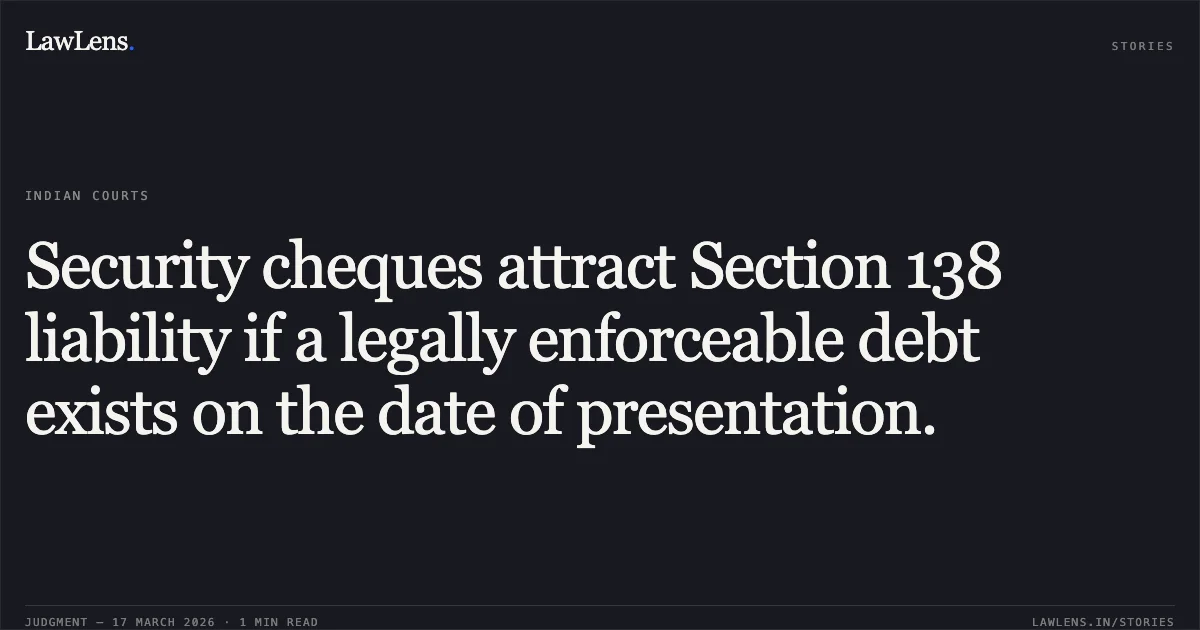
Source reference: p. 13, 17It relied on Sampelly Satyanarayana Rao v. Indian Renewable Energy Development Agency Ltd., which established that a security cheque attracts Section 138 if a legally enforceable debt subsists on the date of presentation
Source reference: p. 14Sripati Singh v. State of Jharkhand affirmed that security cheques mature for presentation if the obligation is not fulfilled
Source reference: p. 14Per Bir Singh v. Mukesh Kumar, a signatory of a blank cheque is liable under Section 139 unless they rebut the presumption of debt
Source reference: p. 15Regarding vicarious liability, the court applied S.M.S. Pharmaceuticals Ltd. v. Neeta Bhalla, holding that Managing Directors are inherently responsible for a company's conduct, while other directors require specific averments of involvement
Source reference: p. 18Reasoning
The court reasoned that while the cheque might have been issued as "security" in 2008, the critical factor is the subsistence of debt at the time of presentation in 2017
Source reference: p. 15Email correspondence from 2015 to 2017 showed the Petitioners acknowledging outstanding dues and proposing repayment, which indicated that the liability had crystallized
Source reference: p. 15-16Regarding the blank nature of the cheque, the court noted that under Section 139, once execution is admitted, the burden shifts to the accused to prove the absence of debt during the trial
Source reference: p. 16On the issue of vicarious liability, the court observed that Petitioner No. 2 was both the Managing Director and the signatory, making his liability direct
Source reference: p. 19For Petitioner No. 3 (Director), the court held that since the company was a small, closely-held private entity with only two directors, the complaint’s specific allegations regarding his active involvement in day-to-day financial affairs were sufficient to proceed at the summoning stage
Source reference: p. 18-19The court further held that disputed counterclaims and civil suits are matters of evidence and do not warrant quashing under Section 482 CrPC
Source reference: p. 20Holding
The High Court dismissed the petition, holding that the criminal proceedings were maintainable
The court concluded that a security cheque matures into a regular cheque once debt crystallizes
Source reference: p. 16The averments in the complaint sufficiently satisfied the requirements of Section 141 of the NI Act for both directors
Source reference: p. 20The summoning order was upheld, and the parties were directed to proceed with the trial
Source reference: p. 20Acts & Sections Cited
9 provisions across 4 statutes referred to in this judgment. Each provision opens on LawLens.
Companies Act, 20131
Indian Contract Act, 18721
Code of Criminal Procedure, 19731
Negotiable Instruments Act, 18816
Original Court PDF
Madhuri Commodities Private Ltd & OrsvsM/S Sony India Pvt Ltd
Click to open original judgment
Original judgment, available to read, download and summarize on LawLens.in