Facts
Respondent No. 2 complained that Somashekar had failed to transfer to him a vehicle after receiving payments towards its finance and purchase.
Source reference: p. 3–4During the investigation, police seized the vehicle and registered it under PF No. 207/2019.
Source reference: p. 3–4Respondent No. 2 and the petitioner each applied under Section 457 CrPC for custody of the vehicle. The Trial Court allowed respondent No. 2’s application and rejected the petitioner’s; the Sessions Court dismissed the petitioner’s revision, leaving him liberty to pursue ownership remedies in an appropriate proceeding.
Source reference: p. 4–5In the present petition, the petitioner argued that the registration certificate and permit remained in his name and that the vehicle was deteriorating.
Source reference: p. 5Issues
1. Whether the orders granting interim custody of the seized vehicle to respondent No. 2 and rejecting the petitioner’s application required interference.
Source reference: p. 5–72. Whether the Trial Court should determine the disposal of the seized vehicle after concluding the criminal proceedings.
Source reference: p. 7Law Applied
The applications for interim custody were made under Section 457 of the Code of Criminal Procedure, which concerns property seized by police and reported to a criminal court.
Source reference: p. 2The petition invoked the High Court’s inherent jurisdiction under Section 482 CrPC (stated in the petition as filed under Section 528 BNSS).
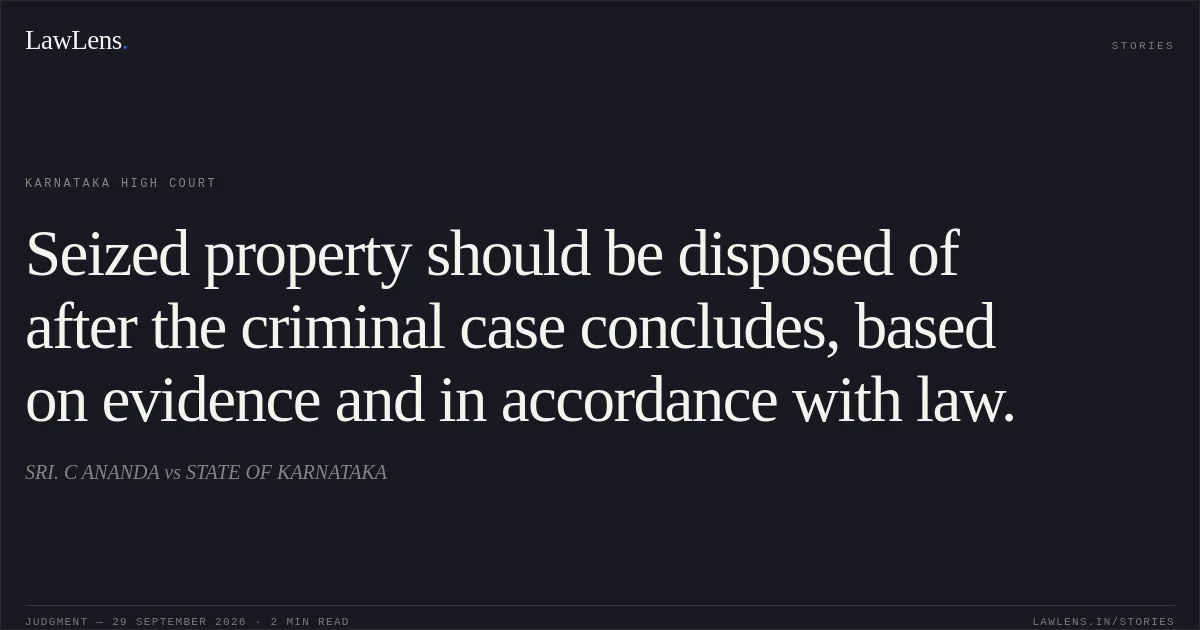
Source reference: p. 2The High Court directed that disposal of the seized property be addressed by the Trial Court on the evidence and in accordance with law.
Source reference: p. 7The judgment cited no precedent and did not state a broader legal test for deciding competing claims to interim custody.
Source reference: no citationReasoning
Rather than deciding the parties’ competing claims to the vehicle on their merits, the High Court considered it appropriate for the Trial Court to conclude the criminal case and then pass orders concerning the seized property based on the evidence and in accordance with law.
Source reference: p. 7The petitioner’s concern about the vehicle’s condition and the continued registration documents did not lead the High Court to determine ownership or alter the existing interim-custody order; the Sessions Court had already left ownership remedies open to the petitioner.
Source reference: p. 5–7Holding
The petition was disposed of.
The High Court directed the IV Additional Chief Metropolitan Magistrate, Bengaluru, to dispose of the criminal case at the earliest, preferably within six months of receiving the order, and thereafter to pass appropriate orders for disposal of the seized property based on the evidence and in accordance with law.
Source reference: p. 7The order refers to the pending case as C.C. No. 23434/2021 in its reasoning but as C.C. No. 23424/2021 in the operative direction.
Source reference: p. 6–7Acts & Sections Cited
9 provisions across 3 statutes referred to in this judgment. Each provision opens on LawLens.
Code of Criminal Procedure, 19733
Bharatiya Nagarik Suraksha Sanhita, 20231
Indian Penal Code, 18605
Original Court PDF
SRI. C ANANDAvsSTATE OF KARNATAKA
Click to open original judgment
Original judgment, available to read, download and summarize on LawLens.in