Facts
Chaudhary Bansi Lal University issued Advertisement No. 2/2017 for eight posts of Assistant, including one post reserved for the BC-B category, with 16.03.2017 as the last date for applications.
Source reference: p. 2, para 2The petitioner possessed the prescribed graduation qualification and ten years’ experience, although five years’ experience was required.
Source reference: p. 2, para 2He participated in the selection process and secured 35.55 marks under Criteria A to D—Computer Typing, General Aptitude Test, Academic Qualifications and Work Experience—and claimed to be the most meritorious BC-B candidate.
Source reference: p. 2, paras 2.1–2.2Under the notified scheme, 80 marks were allocated to Criteria A to D, while 8 marks were assigned to Domain Knowledge and 12 marks to Interview.
Source reference: pp. 4–6, para 4Three BC-B candidates were called for interview; however, the petitioner received zero marks in Domain Knowledge and Interview and was declared “Not Found Suitable”.
Source reference: p. 3, para 2.2The BC-B post remained vacant because none of the candidates was recommended.
Source reference: p. 3, para 3The petitioner challenged the result/order and sought consideration for appointment.
Source reference: no citationIssues
1. Whether the Selection Committee could declare the petitioner “Not Found Suitable” and exclude him from appointment by awarding zero marks in Domain Knowledge and Interview when the advertisement prescribed no minimum qualifying marks for those components.
Source reference: pp. 6–8, paras 4.1–4.22. Whether the respondents could effectively give predominance or qualifying status to Domain Knowledge and Interview contrary to the notified composite selection criteria and disregard the petitioner’s merit under Criteria A to D.
Source reference: pp. 8–10, paras 4.3–4.53. Whether the petitioner was entitled to consideration for appointment against the vacant BC-B post of Assistant.
Source reference: p. 11, para 5Law Applied
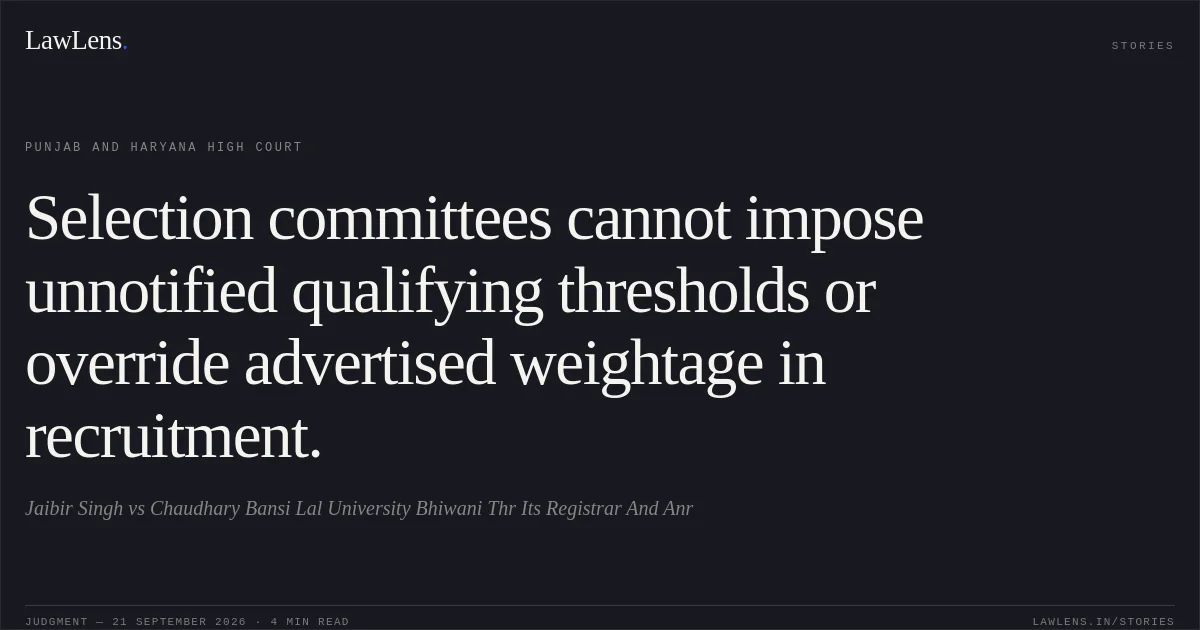
The Court applied the principle that a recruiting authority is bound by the selection criteria notified in the advertisement and cannot alter or supplement those criteria after the selection process has commenced.
Source reference: no citationRelying on Manoj Manu v. Union of India, (2013) 12 SCC 171, the Court held that a Selection Committee’s power to assess suitability does not authorise it to disregard the prescribed weightage or introduce an undisclosed disqualifying threshold.
Source reference: pp. 7–8, para 4.2The Court also relied on S.S. Balu v. State of Kerala, (2009) 2 SCC 479, concerning the impermissibility of unjustifiably keeping an advertised post vacant when the selection process and comparative merit require proper consideration.
Source reference: p. 8, para 4.2Referring to K. Manjushree v. State of Andhra Pradesh, (2008) 3 SCC 512, Hemani Malhotra v. High Court of Delhi, 2008 (2) SCT 736, Tej Prakash Pathak v. Rajasthan High Court, 2024 INSC 847, Salam Samarjeet Singh v. High Court of Manipur at Imphal, 2024 INSC 632, Rojer Mathew v. South Indian Bank Ltd., (2020) 6 SCC 1, and Dr. Surender Singh v. State of Haryana, CWP-751-2023, the Court distinguished between marks allotted to a selection stage and a minimum qualifying threshold: the latter cannot be introduced unless expressly authorised by the advertisement.
Source reference: pp. 8–9, para 4.3Such an undisclosed and arbitrary departure also violates Article 14 of the Constitution.
Source reference: p. 10, para 4.6Reasoning
The notified scheme allocated 80 marks to objective or specified components under Criteria A to D and only 20 marks collectively to Domain Knowledge and Interview.
Source reference: pp. 4–6, para 4Although the petitioner could be assessed on the latter components, the advertisement neither prescribed minimum qualifying marks for them nor empowered the Selection Committee to treat failure at that stage as an absolute disqualification.
Source reference: p. 7, para 4.1By awarding the petitioner zero marks in Domain Knowledge and Interview and declaring him “Not Found Suitable,” the Committee effectively converted those components into a veto or qualifying stage, thereby rendering his 35.55 marks under Criteria A to D immaterial.
Source reference: pp. 9–10, paras 4.4–4.5This amounted to a material departure from the notified selection procedure and an arbitrary exercise of power under Article 14, particularly since the petitioner asserted that he was the highest-ranked BC-B candidate and the reserved post remained vacant.
Source reference: pp. 8–10, paras 4.2, 4.4 and 4.6The Court clarified that it was not substituting its assessment for that of the Selection Committee; rather, it was requiring the Committee to assess the petitioner within the limits of the criteria it had itself prescribed.
Source reference: p. 9, para 4.5Holding
The Court allowed the writ petition and held that the petitioner could not lawfully be excluded by applying an unnotified qualifying threshold in Domain Knowledge or Interview.
The University was directed to reconsider the petitioner for appointment to the post of Assistant in accordance with the notified selection criteria and to pass an appropriate order within six weeks of receiving a certified copy of the judgment.
Source reference: p. 11, para 5If appointed, the petitioner would receive notional benefits from the date on which the other selected candidates joined, but remuneration only from the date of his actual joining.
Source reference: p. 11, para 5Pending miscellaneous applications were also disposed of.
Source reference: p. 11, para 6Original Court PDF
Jaibir SinghvsChaudhary Bansi Lal University Bhiwani Thr Its Registrar And Anr
Click to open original judgment
Original judgment, available to read, download and summarize on LawLens.in