01Facts
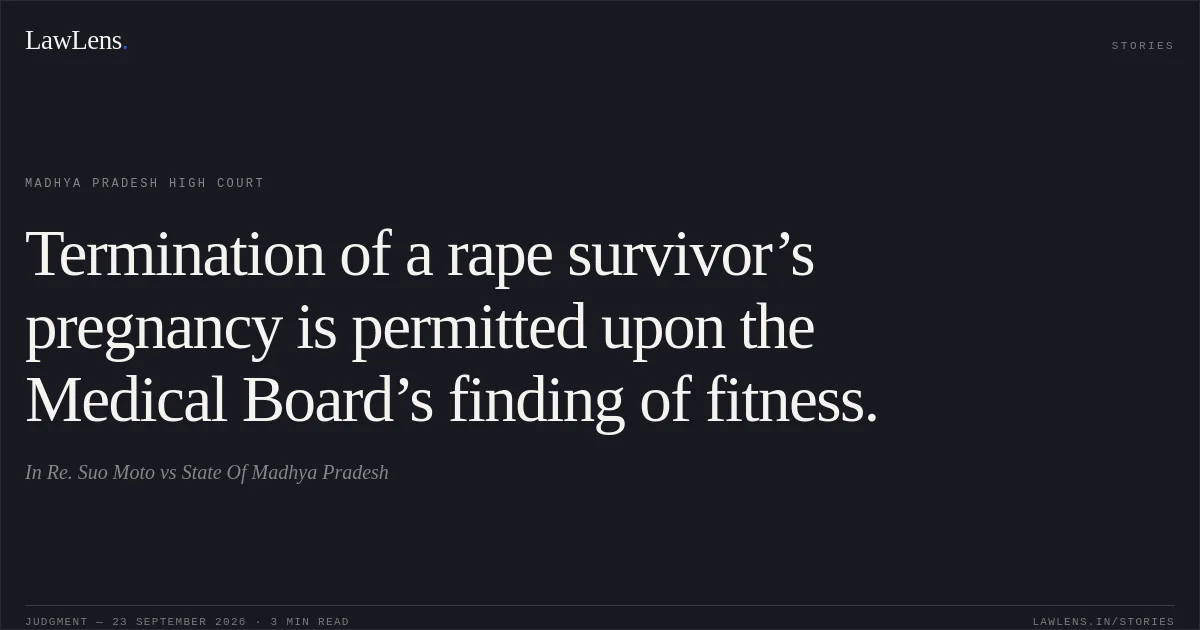
The matter arose as a suo motu writ petition concerning the termination of the pregnancy of a victim of sexual assault.
Pursuant to the High Court’s earlier order dated 19 September 2026, the Medical Board/Civil Surgeon, District Hospital, Alirajpur, submitted a report dated 20 September 2026 stating that the pregnancy could be terminated and that the procedure was medically feasible.
¶ 2–4The Court considered the applicable procedure prescribed by the Division Bench in In Ref. (Suo Motu) v. State of Madhya Pradesh, W.P. No. 5184 of 2025, particularly for pregnancies exceeding 24 weeks in cases involving sexual assault or rape.
¶ 502Issues
i.Whether, on the basis of the Medical Board’s report, permission ought to be granted for termination of the victim’s pregnancy?
¶ 2–4, 9ii.Whether the termination procedure should be conducted subject to medical verification, preservation of forensic material, and compliance with the safeguards prescribed in the earlier suo motu decision?
¶ 5, 9–1003Law Applied
The Court applied Section 3(2) of the Medical Termination of Pregnancy Act, 1971, governing termination by registered medical practitioners, along with Sections 3(2B), 5(1), and 5A concerning medically necessary termination, exceptional circumstances, and confidentiality.
¶ 6, 7, 15–16The Court relied on Rule 3B of the Medical Termination of Pregnancy Rules, 2003, which recognises survivors of sexual assault or rape, minors, and other specified categories as eligible for termination up to 24 weeks.
¶ 7The Court also followed the Standard Operating Procedures laid down in In Ref. (Suo Motu) v. State of Madhya Pradesh, W.P. No. 5184 of 2025, requiring medical assessment, expert supervision, preservation of fetal material for DNA examination, post-operative care, and strict protection of the victim’s privacy.
¶ 5Further, relying on X v. Principal Secretary, Health and Family Welfare Department, (2023) 9 SCC 433, the Court recognised reproductive autonomy and the constitutional protection under Article 21 of a woman’s right to decide whether to continue or terminate an unwanted pregnancy, subject to the statutory framework.
¶ 804Reasoning
The Medical Board had expressly opined that termination of the pregnancy was possible and medically appropriate.
¶ 2–4On that basis, and having regard to the victim’s status as a survivor of sexual assault and the applicable statutory and judicial framework, the Court found no necessity for any further medical report.
¶ 4The Court nevertheless directed that the procedure be undertaken only after fresh verification of the victim’s physical and mental fitness and in accordance with the safeguards prescribed in the earlier Division Bench judgment.
¶ 9It specifically required the procedure to be performed expeditiously, preferably within one or two days, while ensuring preservation of DNA samples from the fetus and compliance with other investigative requirements connected with the pending criminal case.
¶ 1005Holding
The Court granted permission for termination of the victim’s pregnancy.
¶ 9, 11The concerned doctors were directed to conduct the procedure after fresh verification of the victim’s physical and mental fitness, while complying with the prescribed medical safeguards, preserving fetal material for DNA examination, and maintaining the victim’s privacy.
¶ 5, 9–10, 16The writ petition was accordingly disposed of, and a copy of the order was directed to be supplied to the State counsel for compliance.
¶ 11Original Court PDF
In Re Suo MotovsState Of Madhya Pradesh
Click to open original judgment
Original judgment, available to read, download and summarize on LawLens.in