Facts
This batch of 49 writ petitions involved over 350 petitioners claiming to be teachers and non-teaching staff appointed in various recognized aided Madrasahs in West Bengal.
Source reference: para. 2, 3The litigation followed a decade-long dispute over the West Bengal Madrasah Service Commission Act, 2008 (MSC Act). While the High Court initially declared Sections 8, 10-12 of the MSC Act ultra vires in 2014-2015, the Supreme Court stayed those orders on 14th March 2016 and eventually upheld the Act’s validity in Sk. Mohd. Rafique v. Managing Committee, Contai Rahamania High Madrasah (2020).
Source reference: para. 5(e-l)Post-2020, in contempt proceedings (Snehasis Giri v. Subhasis Mitra), the Court constituted a 3-member Committee headed by Justice Debi Prasad Dey (Retd.) to verify the validity of appointments made during the interregnum (2014-2020).
Source reference: para. 10The Committee rejected all claims. Petitioners challenged these findings, alleging arbitrariness and seeking approval of their services.
Source reference: para. 5(p), 10Issues
1. Whether the appointments made by Madrasah Managing Committees during the interregnum were valid and complied with the mandatory recruitment procedures laid down in Notification-I (2015) and Notification-II (2016)?
Source reference: para. 14, 182. Whether the "deeming" observation in paragraph 64 of Sk. Mohd. Rafique (2020) granted absolute validity to all interim appointments regardless of procedural compliance?
Source reference: para. 153. Whether appointments made after the Supreme Court’s stay order dated 14th March 2016, without express leave of the Court, are legally sustainable?
Source reference: para. 39Law Applied
The Court applied the mandatory recruitment procedures under Notification No. 93-SE/S/10R-14/2013 dated 09.02.2015 (Notification-I) and Notification No. 486-MD/O/2M-11/2016 dated 04.03.2016 (Notification-II), which required open advertisements in two State-level dailies and prior communication to the District Inspector of Schools (DIoS) to satisfy Article 16 of the Constitution.
Source reference: para. 20, 21The Court relied on the distinction between "quashing" and "stay of operation" as established in Shree Chamundi Mopeds Ltd. v. Church of South India Trust Association, holding that a stay does not wipe out the underlying law but renders the judgment inoperative.
Source reference: para. 40The Court also upheld the principles of public employment and merit-based selection as mandated in State of Karnataka v. Umadevi (3) and Official Liquidator v. Dayanand.
Source reference: para. 31(d)Reasoning
The Court conducted a "very special" review of 13 representative cases to test the Committee’s findings. It found that in every instance, the Managing Committees had bypassed mandatory safeguards.
Source reference: para. 13For example, some appointments were made by Ad hoc committees restricted to "day-to-day administration", others on non-existent/un-sanctioned posts, and many through "localized" or non-existent advertisements rather than the mandated two State-level dailies.
Source reference: para. 23(e), 24(c), 28(n), 30(d)The Court rejected the argument that the 2020 judgment’s "deeming clause" protected these appointees, noting that the subsequent Snehasis Giri order specifically required factual verification of procedural compliance.
Source reference: para. 17Crucially, the Court held that once the Supreme Court stayed the High Court’s judgment on 14th March 2016, a legal vacuum was created; any subsequent appointment made using the invalidated Notification-I or II without the Supreme Court's express leave was ex-facie illegal. In one case, the Court noted manifest fraud where documents appeared to be ante-dated to circumvent the 2020 ruling.
Source reference: para. 41, 32(j)Holding
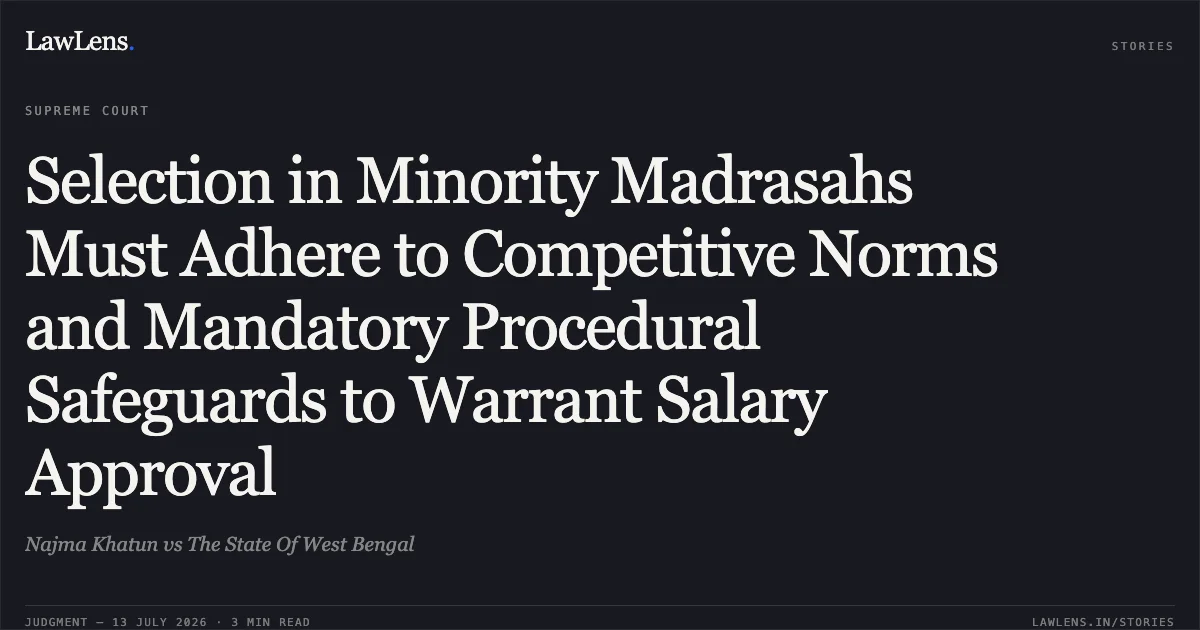
The Court dismissed all 49 writ petitions, holding that none of the petitioners had an enforceable legal right.
It held that (a) procedural non-compliance with Notifications I and II (lack of wide advertisement/DIoS intimation) is fatal to the validity of the appointment; (b) Clause 6 of Notification-I (10% Management Quota) is unconstitutional as it permits non-competitive, opaque appointments to posts funded by the public exchequer; and (c) all appointments made after 14th March 2016 without Supreme Court permission are null and void.
Source reference: para. 37, 35(h-j), 41The Court vacated all interim orders protecting the petitioners’ services or salaries and directed that the vacancies be filled via the Madrasah Service Commission.
Source reference: para. 42, 44Acts & Sections Cited
8 provisions across 3 statutes referred to in this judgment. Each provision opens on LawLens.
West Bengal Board Of Madrasah Education Act, 19941
West Bengal School Service Commission Act, 19972
West Bengal Madrasah Service Commission Act, 20085
Original Court PDF
Najma KhatunvsThe State Of West Bengal
Click to open original judgment
Original judgment, available to read, download and summarize on LawLens.in