Facts
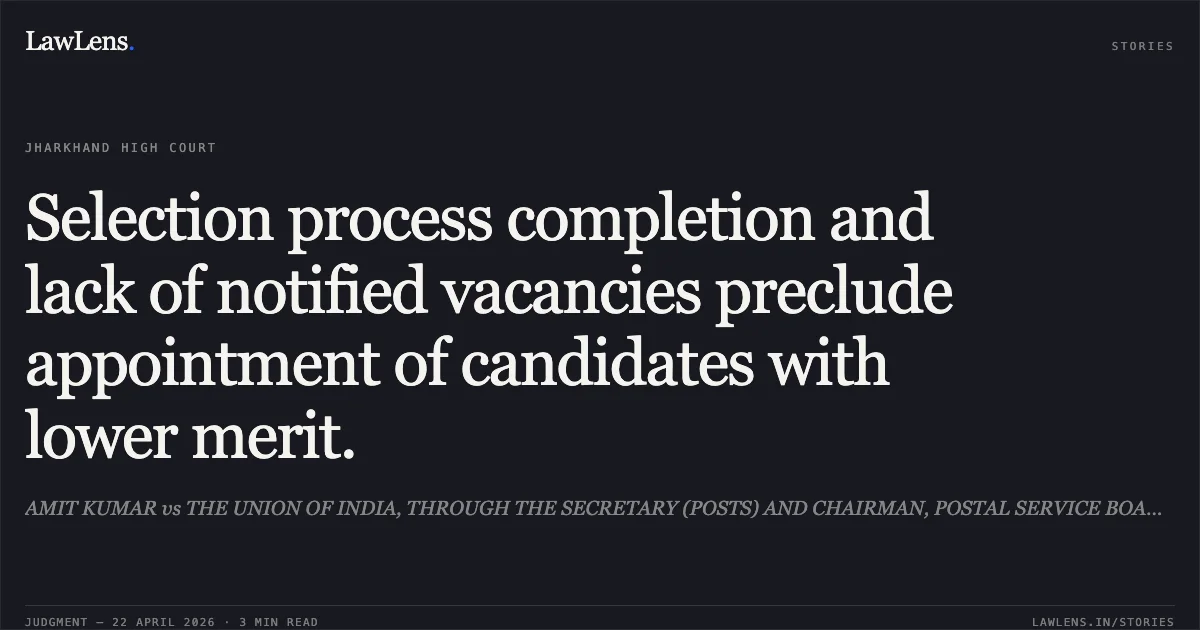
The petitioner appeared in the Limited Departmental Competitive Examination (LDCE) for promotion to the cadre of Inspector Posts for the year 2015-16. There were three notified unreserved (UR) vacancies in the Jharkhand Circle.
Source reference: para 3The petitioner obtained 786 marks and ranked 4th in the merit list; the last selected candidate (Uttam Kumar) obtained 792 marks. Consequently, the petitioner was not selected.
Source reference: para 4, 14, 30The petitioner contended that one candidate, Kumar Abhishek (ranked 2nd), was a candidate for the 2014 vacancy but was accommodated in the 2015-16 list. Following a Tribunal order in Kumar Abhishek v. UOI, Abhishek was shifted to a 2014 vacancy.
Source reference: para 6, 31The petitioner argued that this shifting created a vacancy in the 2015-16 cycle that he, being 4th (now effectively 3rd), should occupy. The Central Administrative Tribunal (CAT) dismissed his application on 29.10.2024.
Source reference: para 1, 12, 23, 32Issues
1. Whether the shifting of a candidate to a previous vacancy year creates an automatic right for the next candidate in the merit list to be appointed against the resulting vacancy.
Source reference: para 23, 34-352. Whether the respondent authorities were justified in reducing the notified vacancies for 2015-16 from three to two following the retrospective adjustment of a candidate.
Source reference: para 25, 35-36Law Applied
The Court relied on the principle that the completion of a selection process terminates the rights of the candidates, and any subsequent vacancy must be treated as a fresh vacancy.
Source reference: para 21The process ends once appointments are made, as established in Thrissur District Co-operative Bank Limited v. Delson Davis and State of Punjab v. Raghubir Chand Sharma.
Source reference: para 21-22A "vested right" is defined as an absolute, indefeasible right independent of contingency, as established in MGB Gramin Bank v. Chakrawarti Singh.
Source reference: para 48-53The scope of judicial review under Article 226, as established in L. Chandra Kumar v. Union of India, restricts interference to cases of patent error or perversity.
Source reference: para 39Reasoning
The Court examined the records and found that while three vacancies were initially notified, one UR vacancy was a "carried forward" post from 2014 added to the 2015-16 cycle due to previous litigation.
Source reference: para 34, 42When the Tribunal ordered the appointment of Kumar Abhishek specifically for the 2014 vacancy, the respondent department reduced the 2015-16 vacancy count from three back to two to prevent double-counting the same post.
Source reference: para 35-36, 42The Court observed that even though the petitioner moved up to rank 3 after Abhishek's shifting, there were only two actual vacancies available for that cycle.
Source reference: para 43-44Applying the 'vested right' doctrine, the Court reasoned that the petitioner had no absolute right to appointment simply by being on a merit list, especially since he ranked lower than the two candidates (Subhash Chandra Pandey and Uttam Kumar) who filled the available slots.
Source reference: para 44-53The Court also justified the consideration of administrative documents not produced before the CAT, stating that under Article 226, it can review the entire record to ensure substantial justice and prevent miscarriage of justice.
Source reference: para 40-41Holding
The reduction of vacancies from three to two was a valid administrative adjustment necessitated by the compliance with a judicial order regarding the 2014 vacancy year.
The High Court dismissed the writ petition, holding that the petitioner failed to establish a vested right to appointment and the order of the Central Administrative Tribunal was upheld.
Source reference: para 57-58Acts & Sections Cited
2 provisions across 1 statute referred to in this judgment. Each provision opens on LawLens.
Administrative Tribunals Act, 19852
Original Court PDF
AMIT KUMARvsTHE UNION OF INDIA, THROUGH THE SECRETARY (POSTS) AND CHAIRMAN, POSTAL SERVICE BOARD,
Click to open original judgment
Original judgment, available to read, download and summarize on LawLens.in