Facts
The appellants, serving as Patwaris, filed an intra-court appeal challenging the order dated January 2, 2026, passed by a Single Judge in WPS No. 1206 of 2025.
Source reference: para. 2The Single Judge had dismissed the appellants' writ petition, which sought directions to send them for training following a departmental examination conducted in 2023–2024 for promotion to the post of Revenue Inspector.
Source reference: para. 3The State had resisted the promotion process based on a report dated November 29, 2024, which highlighted systemic irregularities in the examination.
Source reference: para. 3Both the appellants and respondents conceded that the facts and legal issues in this matter were identical to those in Satish Kumar Das & Others v. State of Chhattisgarh & Others (WA No. 149 of 2026), which was dismissed by the same Division Bench on February 26, 2026.
Source reference: para. 3, 5Issues
1. Whether the departmental examination for promotion from Patwari to Revenue Inspector was conducted in a fair and transparent manner, or whether systemic irregularities justified its cancellation.
Source reference: para. 32. Whether the findings of the Single Judge regarding favoritism and nepotism in the selection process warranted interference in an intra-court appeal.
Source reference: para. 3Law Applied
The Court applied the principle of "preponderance of probabilities" to evaluate the fairness of the examination process.
Source reference: para. 3It relied on the judicial standards set by the Supreme Court in Vanshika Yadav v. Union of India and State of West Bengal v. Baishakhi Bhattacharyya (Chatterjee) & Others, which mandate that the sanctity and integrity of competitive examinations must be preserved and that a "systemic compromise" justifies the cancellation of the entire process.
Source reference: para. 3The Court followed the settled principle governing intra-court appeals, which dictates that interference with a Single Judge’s order is only warranted if there are "palpable infirmities" or "perversities".
Source reference: para. 3Reasoning
The Court adopted the reasoning from its prior judgment in Satish Kumar Das (WA No. 149 of 2026), noting that the examination was fundamentally flawed.
Source reference: para. 4-5The analysis centered on several "circumstances giving rise to doubt": first, the requirement for candidates to mention mobile numbers on OMR sheets, which compromised anonymity and enabled identification.
Source reference: para. 3Second, the suspicious increase in the number of questions (from 50 to 100) within the same 90-minute duration, making high scores practically unfeasible for genuine candidates.
Source reference: para. 3Third, the allotment of consecutive roll numbers to 22 close relatives posted across different districts, which strongly indicated nepotism.
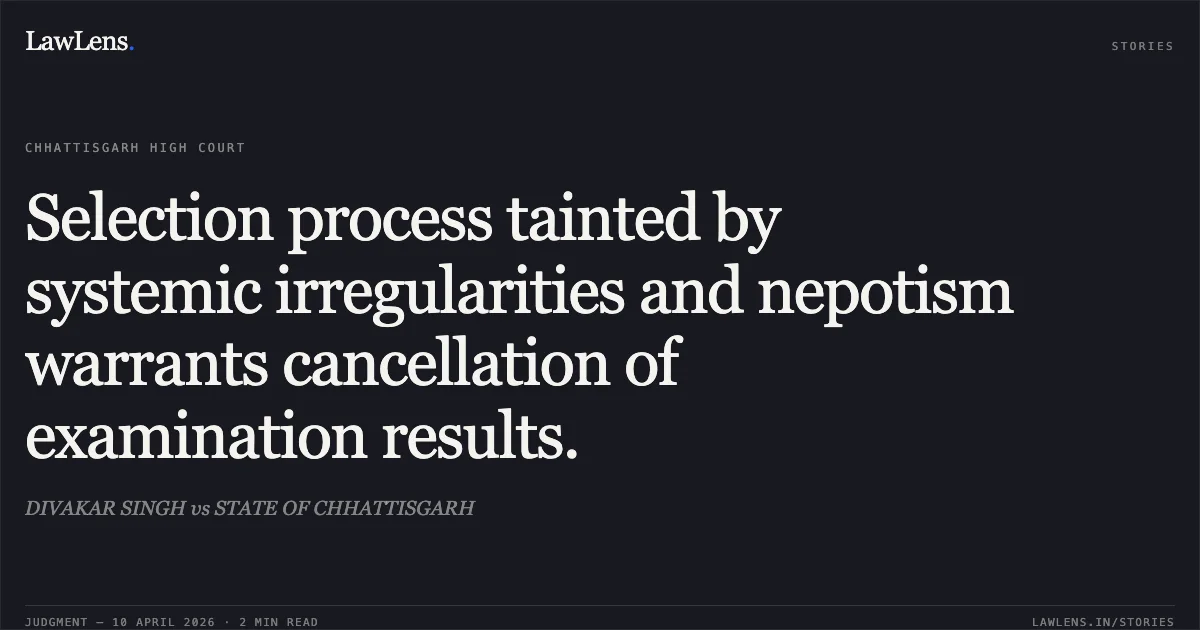
Source reference: para. 3The Court determined that these factors collectively established that the selection process was "tainted with signs of favoritism and nepotism" and lacked transparency.
Source reference: para. 3Consequently, since the appellants could not demonstrate any palpable infirmity in the Single Judge’s reasoning, the Court found no grounds for interference.
Source reference: para. 3Holding
The High Court dismissed the appeal, holding that the departmental examination was not conducted in a fair or transparent manner.
The Court affirmed the Single Judge's decision, denying the request to send the successful candidates for training.
Source reference: para. 3The Court clarified that these observations would not prejudice pending criminal proceedings and granted the State liberty to conduct a fresh examination.
Source reference: para. 3No costs were awarded.
Source reference: para. 3Original Court PDF
DIVAKAR SINGHvsSTATE OF CHHATTISGARH
Click to open original judgment
Original judgment, available to read, download and summarize on LawLens.in