01Facts
M.M. Nagarajah Pillai and his wife owned several properties, including shops bearing Door Nos. 306 to 309 at Big Bazaar Street, Trichy.
pp. 6–8 · ¶ 4–4.1Out of love and affection, Nagarajah Pillai executed two gift settlement deeds dated 16 September 2013 in favour of his son, N. Muralidharan, concerning shops bearing Door Nos. 307 and 308.
pp. 6–8 · ¶ 4–4.1Muralidharan died on 4 December 2019, after which disputes arose between his widow, M. Vasanthi, and her father-in-law.
pp. 6–8 · ¶ 4–4.1Nagarajah Pillai alleged that Vasanthi had failed to maintain and care for him and his wife and had attempted to alienate or encumber the properties.
pp. 6–8 · ¶ 4–4.1He therefore initiated proceedings under Sections 3 and 5 of the Maintenance and Welfare of Parents and Senior Citizens Act, 2007 (“2007 Act”), seeking, inter alia, cancellation of the settlement deeds and possession of shops bearing Door Nos. 306 and 309.
pp. 7–9 · ¶ 4.1The Revenue Divisional Officer directed Vasanthi to hand over possession of those shops and imposed restrictions concerning alienation and enjoyment of the other properties.
pp. 7–9 · ¶ 4.1The District Collector, acting as the appellate tribunal under the 2007 Act, dismissed Nagarajah Pillai’s appeal and confirmed the Revenue Divisional Officer’s order dated 9 August 2021.
p. 9 · ¶ 5The parties challenged the orders in separate writ petitions.
pp. 9–10 · ¶ 5–6The learned Single Judge dismissed all three writ petitions and directed Vasanthi and her children to vacate and hand over shops bearing Door Nos. 306 and 309 within one month.
pp. 9–10 · ¶ 5–6Nagarajah Pillai died before pronouncement of the Single Judge’s order, and his legal representatives were brought on record in the appeals.
p. 6 · ¶ 302Issues
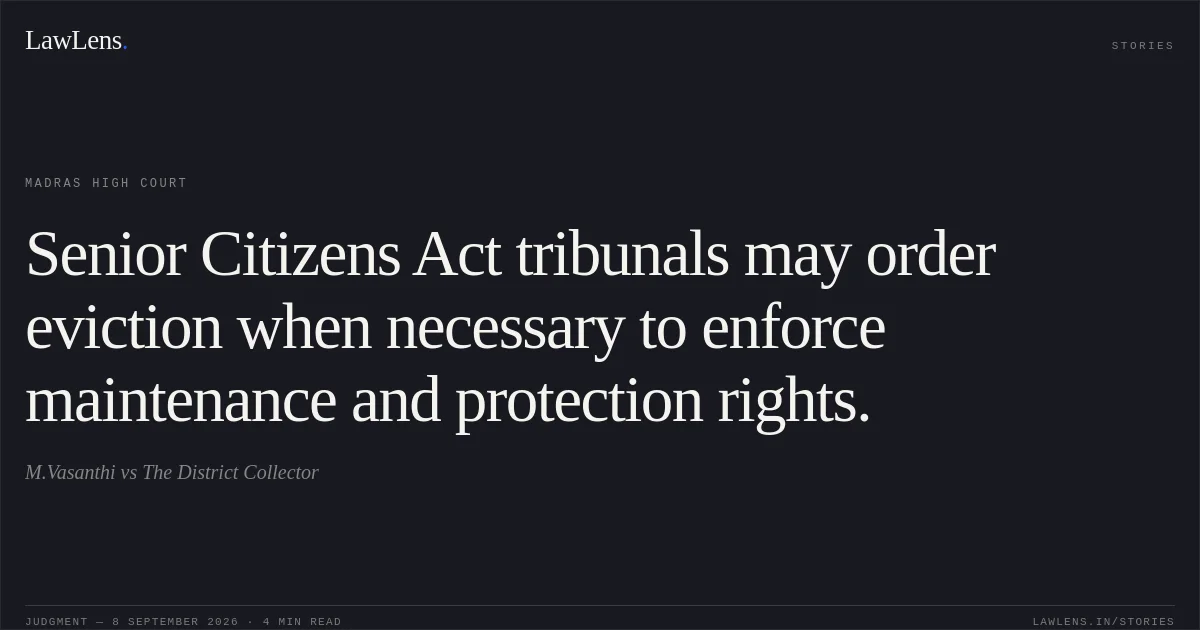
i.Whether authorities constituted under the 2007 Act possess the power to order eviction or delivery of possession as an incident of enforcing a senior citizen’s right to maintenance and protection?
pp. 13–15 · ¶ 11–12ii.Whether the direction to Vasanthi and her children to surrender possession of shops bearing Door Nos. 306 and 309 was sustainable notwithstanding the pending civil proceedings concerning the parties’ competing property rights?
pp. 10–12 · ¶ 7–9 · pp. 15–16 · ¶ 1303Law Applied
The Court applied Sections 3 and 5 of the Maintenance and Welfare of Parents and Senior Citizens Act, 2007, under which a senior citizen may seek maintenance and protection, and Section 16 concerning an appeal to the designated appellate tribunal.
pp. 7–9 · ¶ 4.1, 5It applied the settled principle that when a statute confers jurisdiction, it impliedly confers all ancillary powers necessary to exercise that jurisdiction effectively.
pp. 13–15 · ¶ 11–12On this basis, a tribunal under the 2007 Act may order eviction or delivery of possession where such relief is necessary to secure the maintenance or protection of a senior citizen.
pp. 13–15 · ¶ 11–12The Court relied particularly on the Supreme Court’s decision in Ravi Kant Gupta v. State of Uttar Pradesh, SLP (C) Diary No. 22768 of 2024, judgment dated 4 August 2026, as well as the earlier Supreme Court authorities referred to therein, recognising eviction as an incident of enforcing the right to maintenance and protection.
p. 13 · ¶ 11Provisions in the judgment · 3 · Linked ones open on LawLens
Maintenance and Welfare of Parents and Senior Citizens Act, 2007 Section 3Section 5Section 16
04Reasoning
The Court held that the power to order delivery of possession was ancillary to the statutory jurisdiction to protect and maintain a senior citizen.
pp. 13–15 · ¶ 11–12Nagarajah Pillai’s claim was not treated as an independent adjudication of final title, but as a protective measure connected with the maintenance rights of himself and his wife.
p. 15 · ¶ 12Since Vasanthi and her children were already enjoying shops bearing Door Nos. 307 and 308 under the settlement deeds, the Court considered it unjustified for them to retain shops bearing Door Nos. 306 and 309 as well while the senior citizen sought enforcement of his maintenance rights.
p. 15 · ¶ 12The pendency of the partition and injunction suits did not invalidate the interim protective arrangement.
pp. 15–16 · ¶ 13The Court clarified that the civil court would remain free to determine the parties’ ultimate rights on title, possession and partition, uninfluenced by the writ proceedings.
pp. 15–16 · ¶ 13The direction to hand over possession was therefore treated as an interim arrangement for protecting the maintenance rights of Nagarajah Pillai’s widow, rather than a final determination of ownership.
pp. 15–16 · ¶ 1305Holding
The Court answered the principal issue in the affirmative: authorities under the 2007 Act possess the incidental power to order eviction or delivery of possession when necessary to secure the maintenance and protection of a senior citizen.
pp. 13–15 · ¶ 11–12It dismissed both writ appeals and upheld the Single Judge’s direction requiring Vasanthi and her children to vacate and surrender shops bearing Door Nos. 306 and 309.
pp. 15–16 · ¶ 13–14Following Nagarajah Pillai’s death, his wife, N. Manorama Devi, was held entitled to the benefit of the order as a maintenance holder.
p. 15 · ¶ 12The arrangement was declared temporary and subject to the final adjudication in the pending civil partition suit; the appeals were dismissed without costs, and the stay petitions were closed.
pp. 15–16 · ¶ 13–14Original Court PDF
M.VasanthivsThe District Collector
Click to open original judgment
Original judgment, available to read, download and summarize on LawLens.in