Facts
The Petitioner (daughter-in-law) challenged an eviction order passed by the Maintenance Tribunal (19.05.2025) and upheld by the Appellate Authority, which directed her to vacate the property of Respondent Nos. 3 and 4 (senior citizen in-laws).
Source reference: para. 1-3The Respondents filed for eviction under Rule 22(3) of the Delhi Maintenance and Welfare of Senior Citizens Rules, 2009, alleging physical and verbal ill-treatment by the Petitioner.
Source reference: para. 2, 10, 12The Petitioner contended that the property was her matrimonial home and that she has a minor child with 50% permanent disability (Autism Spectrum Disorder) whose medical and educational needs are tied to the current residence.
Source reference: para. 4, 6Conversely, the Respondents argued they had already purchased an independent house in Gurugram for the Petitioner and that she rarely stayed at the suit property.
Source reference: para. 7-8Issues
1. Whether the authorities failed to harmonize the Petitioner’s residence rights under the DV Act with the Respondents' rights under the Senior Citizens Act
Source reference: para. 4, 152. Whether the welfare and medical needs of a disabled minor child can permanently negate the statutory right of senior citizens to seek eviction from their self-acquired property
Source reference: para. 6, 13Law Applied
The court primarily applied Rule 22(3)(1) of the Delhi Maintenance and Welfare of Senior Citizens Rules, 2009, which entitles a senior citizen to seek eviction on grounds of non-maintenance or ill-treatment.
Source reference: para. 10It relied extensively on the Supreme Court precedent in S. Vanitha v. Deputy Commissioner, Bengaluru Urban District, which mandates a balancing act between a woman’s right to a "shared household" under Section 17 of the Protection of Women from Domestic Violence Act, 2005 (DV Act) and the protections for senior citizens under the Senior Citizens Act, 2007.
Source reference: para. 15The court also noted Section 2(b) of the Senior Citizens Act regarding maintenance and the summary nature of Tribunal proceedings under Section 8.
Source reference: para. 15Reasoning
The court found that the property was the self-acquired asset of Respondent No. 3 and that factual findings of "ill-treatment" had been established by the lower authorities, which the Petitioner failed to successfully rebut during the appeal.
Source reference: para. 11-13Applying the S. Vanitha principle, the court reasoned that while the Petitioner has a right to residence, it is not an absolute right to insist on a specific property belonging to the in-laws, especially when the relationship has turned acrimonious.
Source reference: para. 13, 17Regarding the disabled child, the court held that while medical stability is crucial, the primary obligation to provide accommodation rests with the parents, not the grandparents.
Source reference: para. 13To balance the competing interests, the court determined that the senior citizens’ right to peaceful enjoyment could be preserved by requiring them to provide financial assistance for alternative accommodation, thereby ensuring the Petitioner and child are not rendered homeless.
Source reference: para. 16-18Holding
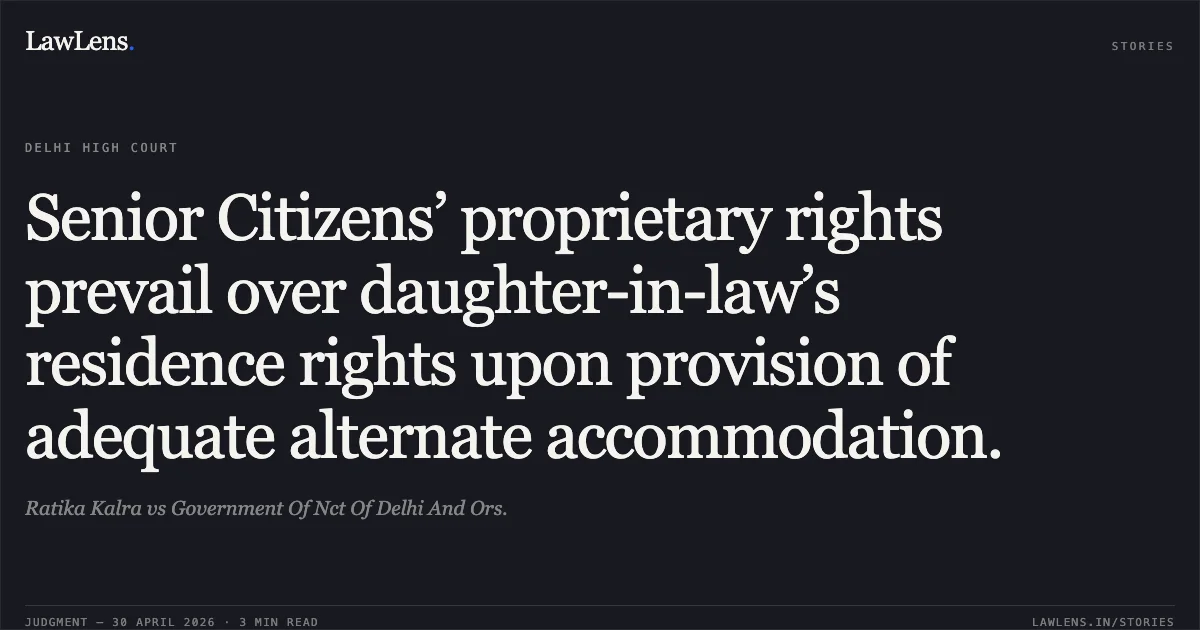
The Court held that the daughter-in-law cannot be permitted to continue residing with the in-laws if ill-treatment is proven and alternative support is offered.
The Court ordered: (i) the Respondents to pay ₹30,000 as rent and ₹5,000 as maintenance (total ₹35,000/month) to the Petitioner [para. 18]; (ii) six months of rent to be deposited in advance within one month [para. 19]; (iii) the Petitioner to vacate within 60 days of receiving the advance [para. 20]; and (iv) restricted the Respondents from creating third-party interests in the property without court permission [para. 23].
Source reference: para. 18, 19, 20, 23Acts & Sections Cited
7 provisions across 2 statutes referred to in this judgment. Each provision opens on LawLens.
Maintenance and Welfare of Parents and Senior Citizens Act, 20075
Protection of Women from Domestic Violence Act, 20052
Original Court PDF
Ratika KalravsGovernment Of Nct Of Delhi And Ors.
Click to open original judgment
Original judgment, available to read, download and summarize on LawLens.in