Facts
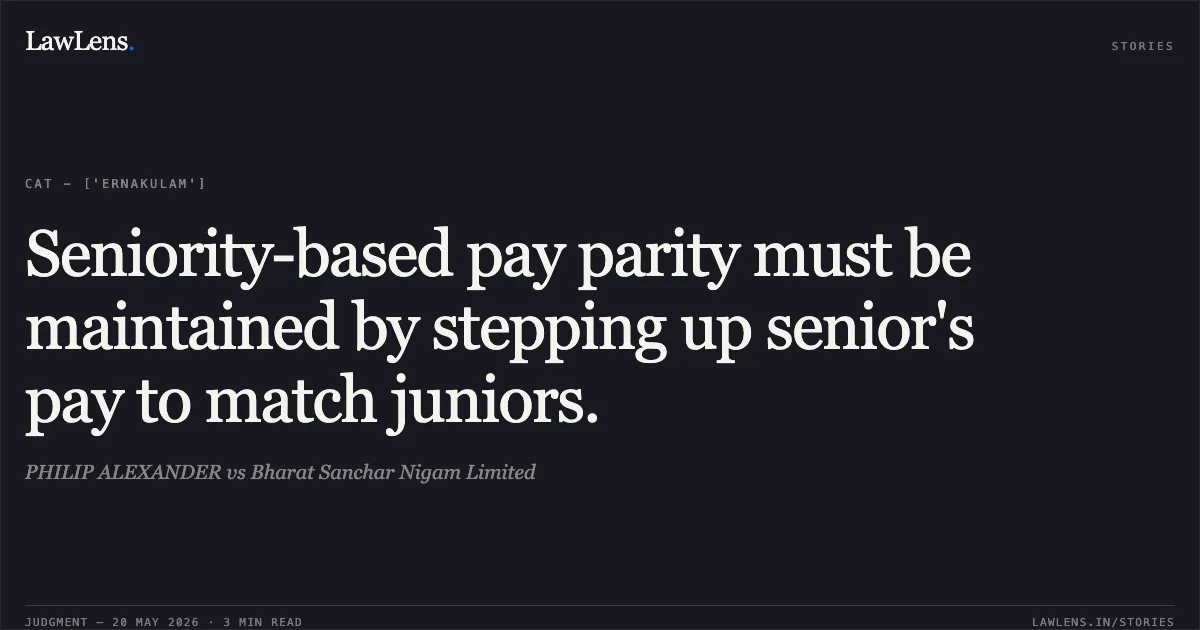
The applicant, a retired Divisional Engineer (DE) of BSNL who retired on 31.05.2011, challenged the denial of his 2nd time-bound financial upgradation under the Executive Promotion Policy (EPP)
Source reference: p. 2While the applicant was holding the substantive post of Sub Divisional Engineer (SDE), he received an ad hoc promotion (and later regular promotion) to the post of DE. Because of this functional promotion, BSNL denied him the 2nd time-bound financial upgradation, which led to a salary anomaly where his juniors (e.g., Smt. Mydhili and others), who were promoted later, drew a higher pay scale than him
Source reference: p. 3The applicant previously filed O.A. 662/2015, resulting in a direction to BSNL to consider his representation; BSNL rejected said representation via Annexure-A5 on 22.10.2016
Source reference: p. 2The applicant sought to quash the rejection and requested pay parity with his juniors based on prior judicial precedents
Source reference: p. 2Issues
1. Whether the denial of the 2nd time-bound financial upgradation to a senior officer, resulting in juniors drawing higher pay, constitutes an arbitrary and discriminatory pay anomaly
Source reference: p. 10 / para. 212. Whether the restrictive clauses of the Executive Promotion Policy (EPP), which preclude comparisons based on seniority for time-bound upgradations, can override the general principle of stepping up pay to rectify senior-junior anomalies
Source reference: p. 10 / para. 22-23Law Applied
The Tribunal applied the fundamental service jurisprudence principle that a senior employee is entitled to at least the same pay as a junior, provided there are no justifiable exceptions, a concept rooted in the principle of "equal pay for equal work"
Source reference: p. 10 / para. 22It relied heavily on the precedent set by its own earlier order in O.A. Nos. 109/2011, 110/2011, and 236/2011, which held that pay anomalies arising from the interplay of time-bound upgradations and functional promotions must be rectified by "stepping up" the senior's pay
Source reference: p. 11 / para. 24This rule was further fortified by the Kerala High Court's judgment in OP(CAT) 1592/2012, which dismissed BSNL's challenge to the aforementioned order
Source reference: p. 13 / para. 26Reasoning
The Tribunal rejected the respondents' argument that Clause 6 of the EPP (which makes financial upgradation "personal" to the executive and precludes seniority comparisons) justifies the pay disparity
Source reference: p. 5, 10The Court reasoned that the root cause of the anomaly was BSNL's policy allowing juniors to benefit from both a 2nd time-bound upgradation and a subsequent ad hoc promotion within a short span, while seniors—who were promoted earlier due to their merit/seniority—missed out on the upgradation benefit
Source reference: p. 11 / para. 24The Tribunal noted that BSNL did not dispute that juniors were drawing higher pay
Source reference: p. 10 / para. 22It held that granting double pay fixation benefits to juniors while denying them to seniors amounts to "supersession of the seniors for no reason other than that they are seniors"
Source reference: p. 12 / para. 24Following the consistent line of judgments from the Kerala High Court and the Supreme Court's dismissal of BSNL's SLPs, the Tribunal concluded that the anomaly was discriminatory and must be rectified regardless of the EPP's restrictive wording
Source reference: p. 14 / para. 29Holding
The Tribunal allowed the O.A. and quashed the rejection order
It held that the respondents are legally bound to rectify the anomaly where a senior draws less pay than a junior
Source reference: p. 15 / para. 31The Tribunal directed BSNL to step up the applicant’s pay to be at par with his juniors and to pay all consequential benefits within 90 days of the receipt of the order
Source reference: p. 15 / para. 31Original Court PDF
PHILIP ALEXANDERvsBharat Sanchar Nigam Limited
Click to open original judgment
Original judgment, available to read, download and summarize on LawLens.in