Facts
The 23 applicants were recruited through the Staff Selection Commission (SSC) in 1998 for the post of Section Officer (Accounts) in the Defence Accounts Department.
Source reference: p. 5Upon appointment in 1998-1999, they were designated as "SAS Apprentices" and placed on probation.
Source reference: p. 5-6, 14A mandatory condition of their recruitment was to pass the Departmental Subordinate Accounts Service (SAS) Examination (Parts I II) within two chances, failing which they faced discharge.
Source reference: p. 5-6, 14The applicants challenged the respondents' decision to reckon their seniority from the date of passing the SAS exam/confirmation rather than the date of their initial appointment as apprentices.
Source reference: p. 6They sought to quash the orders dated 08.04.2016 and 11.11.2016 which denied the counting of probationary service for seniority and promotion.
Source reference: p. 6Issues
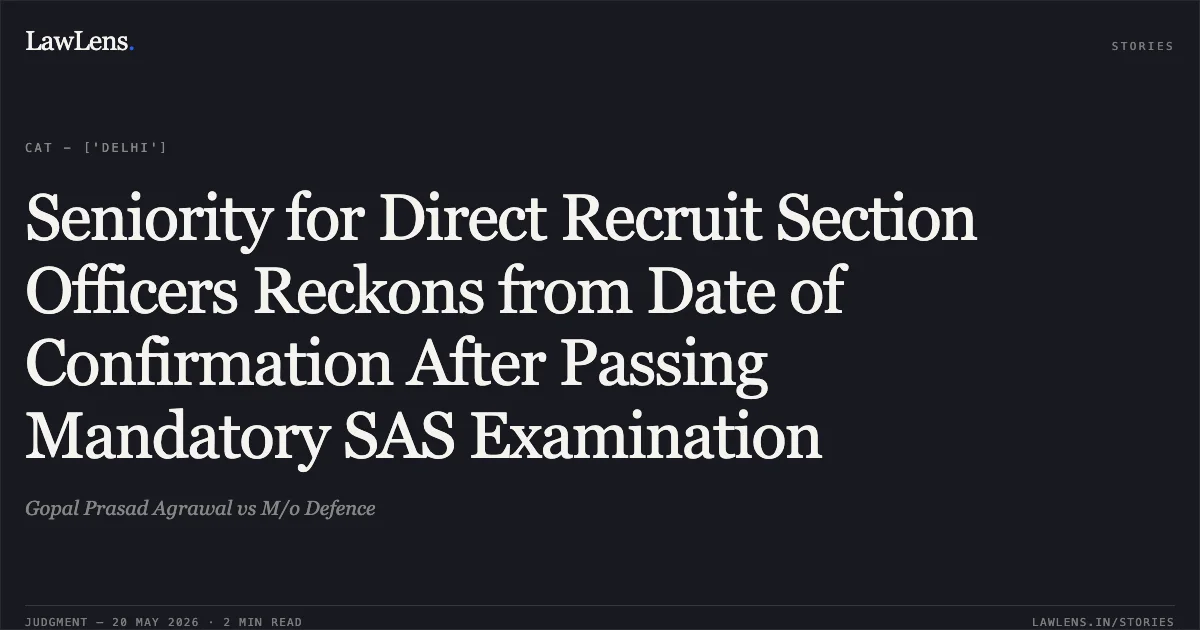
1. Whether the seniority of the applicants should be reckoned from the date of their initial appointment as SAS Apprentices or from the date of their confirmation after passing the mandatory SAS Examination.
Source reference: p. 13Law Applied
The Tribunal applied the recruitment rules of the Defence Accounts Department which stipulate that apprentices must pass the SAS Examination to be eligible for confirmation.
Source reference: p. 7-8It relied on the precedent set by the Hon'ble Supreme Court in P. U. Joshi v. Accountant General (2003), which established that the State has the exclusive jurisdiction to prescribe qualifications and conditions of service, and employees have no vested right to claim that service rules remain unchanged.
Source reference: p. 9-10The Tribunal also followed the coordinate bench decisions in Ranjit Kumar v. Union of India (Jabalpur Bench) and S. Semmel v. UOI (Chennai Bench), which held that a direct recruit Section Officer ranks below the last departmental candidate passing the SAS exam on the date the direct recruit takes regular charge.
Source reference: p. 11, 14Reasoning
The Tribunal reasoned that the recruitment process for Section Officers (Accounts) was conditional. The designation "SAS Apprentice" during the two-year probation period was a prerequisite stage where candidates had to demonstrate specialized proficiency in accounting.
Source reference: p. 14The court found that because the failure to pass the SAS Examination resulted in discharge from service, the appointment was not "regular" until the examination was cleared. Thus, the period spent as an apprentice could not be counted toward seniority in the cadre of Section Officers.
Source reference: p. 8The Tribunal distinguished the applicants' reliance on Deepak Sharma v. CAG, noting that the rules governing the Audit Department differ from those of the Defence Accounts Department.
Source reference: p. 8It concluded that specialized knowledge of accounting principles is essential for the role, and seniority must follow the acquisition of such qualifications as per the specific recruitment conditions accepted by the applicants at the time of joining.
Source reference: p. 14Holding
The Tribunal answered the issue by holding that seniority must be reckoned from the date of confirmation in service (post-passing the SAS Examination) and not from the date of initial appointment as an apprentice.
The court found no illegality in the impugned orders and dismissed the Original Application (OA), stating it was devoid of merit.
Source reference: p. 15No order as to costs was made.
Source reference: p. 15Acts & Sections Cited
3 provisions across 1 statute referred to in this judgment. Each provision opens on LawLens.
Administrative Tribunals Act, 19853
Original Court PDF
Gopal Prasad AgrawalvsM/o Defence
Click to open original judgment
Original judgment, available to read, download and summarize on LawLens.in