Facts
The three applicants, originally appointed as Trackmen, were promoted to the post of "Mate" between 2014 and 2016.
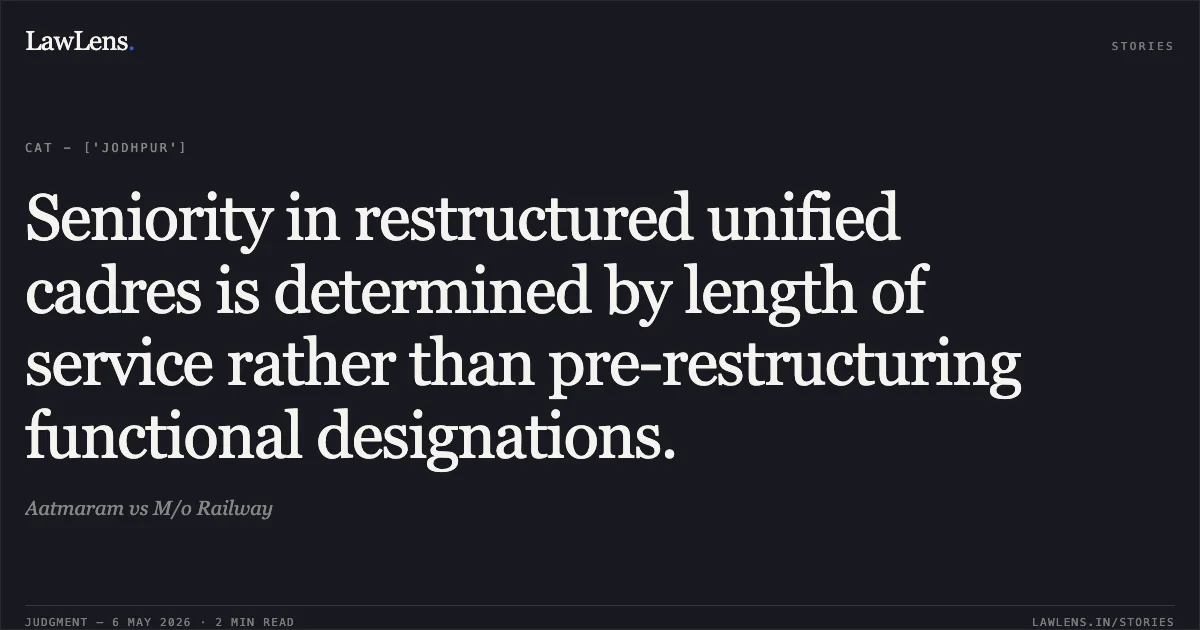
Source reference: p. 2Following the implementation of a unified cadre restructuring of Track Maintainers per RBE No. 91/2012, the categories of Trackman, Gateman, and Mate were reorganized into Track Maintainer Grades I, II, III, and IV.
Source reference: p. 3The applicants challenged a Joint Seniority List dated 20.12.2018 (Annexure-A/1), wherein they were placed junior (Sr. Nos. 19, 20, and 37) to certain individuals (Sr. Nos. 4 to 15) who had never been formally selected as "Mates" in the pre-restructured setup.
Source reference: p. 4-5They further challenged a 2014 corrigendum regarding the assignment of duties, which allegedly required them to perform the duties of "Keyman" (junior to Mate) despite their prior promotions.
Source reference: p. 4Issues
1. Whether the applicants could claim seniority over senior employees in the restructured cadre based solely on their prior promotion to the erstwhile post of Mate.
Source reference: p. 7/82. Whether the challenge to the Railway Board Corrigendum dated 22.09.2014 regarding duty assignment was barred by limitation.
Source reference: p. 6/93. Whether the Original Application was maintainable despite the non-joinder of the third parties whose seniority was specifically challenged.
Source reference: p. 6/9Law Applied
The Tribunal applied the restructuring framework established by the Ministry of Railways under RBE No. 91/2012 dated 17.08.2012, which unified various track categories into a four-tier structure (Grades I-IV).
Source reference: p. 8Railway Board Estt. No. 8/2013 dated 13.08.2013, which mandated specific modes of promotion—seniority for Grade III, seniority-cum-suitability for Grade II, and selection via trade test for Grade I.
Source reference: p. 8Limitation under Section 21 of the Administrative Tribunals Act, 1985.
Source reference: p. 6, 9Procedural rule regarding the Non-joinder of Necessary Parties, which mandates that no order affecting seniority can be passed without hearing the affected parties.
Source reference: p. 6, 9Reasoning
The Tribunal found that the applicants had accepted the benefits of the restructuring (higher pay grades of Rs. 2400 and Rs. 2800) and therefore could not selectively revert to the pre-restructured hierarchy to claim seniority.
Source reference: p. 7, 9The respondents followed the Railway Board's mandate where Track Maintainer Grade II is filled primarily based on seniority, and Grade I requires a trade test; thus, no illegality was found in the Joint Seniority List.
Source reference: p. 9The Tribunal noted that the applicants failed to implead the individuals (Sr. Nos. 4-15) whose seniority they sought to displace, rendering the plea for restructuring the seniority list legally unsustainable.
Source reference: p. 9Regarding the 2014 corrigendum on duty assignments, the Tribunal held the challenge was stale and time-barred as it was raised several years late.
Source reference: p. 9Holding
The Tribunal answered all issues in the negative and dismissed the Original Application.
It held that the seniority list was prepared in accordance with restructuring norms focusing on length of service and statutory promotion criteria. The applicants' request to be re-designated as Track Maintainer Grade-I solely based on their previous status as Mates was denied. No orders as to costs were made.
Source reference: p. 5, 9Acts & Sections Cited
1 provisions across 1 statute referred to in this judgment. Each provision opens on LawLens.
Administrative Tribunals Act, 19851
Original Court PDF
AatmaramvsM/o Railway
Click to open original judgment
Original judgment, available to read, download and summarize on LawLens.in