Facts
The Appellant (Parle) and Respondent No. 2 applied for the trademark "20-20" in Class 30 on a "proposed to be used" basis in 2007.
Source reference: no citationRespondent No. 2 filed its application on 27.09.2007
Source reference: para. 3while the Appellant filed on 04.10.2007
Source reference: para. 3The Appellant began commercial use in 2008-09 and obtained registration in 2017
Source reference: para. 4-5Meanwhile, Respondent No. 2’s application faced a 17-year delay due to Registry errors and litigation, including an appeal to the IPAB which eventually directed the mark’s publication in 2020
Source reference: para. 22The Appellant opposed the registration, but the Registrar dismissed the opposition on 29.04.2025, holding Respondent No. 2 to be the senior adopter
Source reference: para. 5The Appellant challenged this order, alleging non-use and abandonment by the Respondent.
Source reference: no citationIssues
1. Whether commercial use of a trademark by a junior adopter during the pendency of a senior adopter's "proposed to be used" application grants the junior adopter priority for registration
Source reference: para. 352. Whether the Appellant is estopped from challenging the Respondent’s mark after previously stating to the Registry that the marks were distinct to overcome examination objections
Source reference: para. 493. Whether the "first in the market" test from Neon Laboratories applies to registration proceedings where no commercial use has commenced by the senior adopter
Source reference: para. 37Law Applied
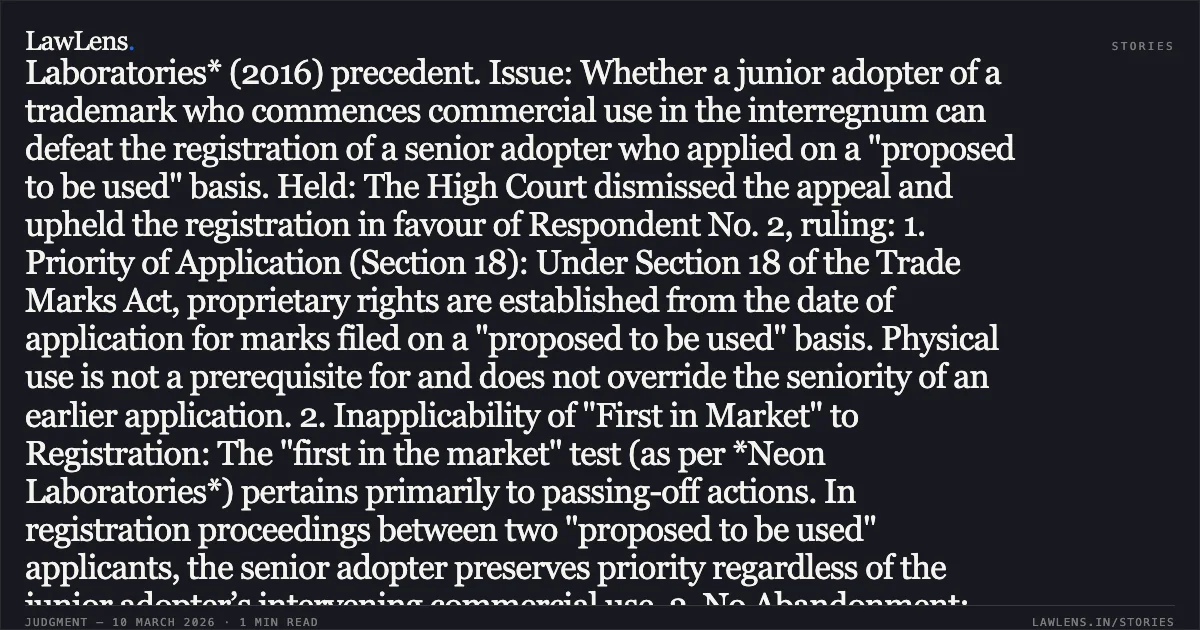
The Court primarily applied Section 18 of the Trade Marks Act, 1999, which allows registration based on a "proposed to be used" basis, establishing that physical use is not a prerequisite for proprietary rights
Source reference: para. 41, 44It relied on the principle from Mohan Goldwater Breweries Pvt. Ltd. v. Khoday Distilleries, which holds that for registration purposes, rights are determined as of the date of application, and subsequent use by a rival does not defeat a prior applicant's rights
Source reference: para. 38-39The Court further distinguished Neon Laboratories Ltd. v. Medical Technologies Ltd., noting it pertains to passing off actions and not to the statutory priority of registration under Section 18
Source reference: para. 37The doctrine of "approbate and reprobate" was applied to prevent a party from taking inconsistent stands before the Registry
Source reference: para. 49Reasoning
The Court reasoned that since both parties applied on a "proposed to be used" basis, Respondent No. 2—having filed one week earlier—is the senior adopter
Source reference: para. 34, 46Under Section 18, the date of application is the "deemed date of registration" once granted; thus, the Appellant’s intervening use since 2009 is "inconsequential" to the statutory priority established in 2007
Source reference: para. 46-47The Court found that Respondent No. 2 was "vigilant" and "consistent" in pursuing its application despite a 17-year administrative delay, negating any claim of abandonment
Source reference: para. 51Furthermore, the Court highlighted the Appellant’s 2008 reply to the Registry’s Examination Report, where the Appellant specifically restricted its goods to "Biscuits" and claimed the marks were "visually, phonetically and conceptually different" to avoid a Section 11 conflict with Respondent No. 2's pending mark
Source reference: para. 48-49Consequently, the Appellant was legally barred from now asserting that the marks are deceptively similar
Source reference: para. 49Holding
The Court dismissed the appeal and upheld the Registrar’s order
It held that in "proposed to be used" applications, the "first to file" (senior adopter) has priority over a junior adopter, regardless of the junior adopter’s intervening commercial use
Source reference: para. 45-47The Court concluded that the Appellant could not benefit from its own intervening use when it had prior knowledge of the Respondent’s senior application
Source reference: para. 33(d), 51The registration of the mark "20-20" in favour of Respondent No. 2 was affirmed
Source reference: para. 53Acts & Sections Cited
13 provisions across 2 statutes referred to in this judgment. Each provision opens on LawLens.
Trade Marks Act, 1999
Code of Civil Procedure, 19082
Original Court PDF
Parle Products Private Limited v. The Registrar of Trade Marks & Anr. C.A.(COMM.IPD-TM) 49/2025
Click to open original judgment
Original judgment, available to read, download and summarize on LawLens.in


