Facts
The eight applicants were appointed to the Uttar Pradesh Provincial State Police Service (PPS) in 1998.
Source reference: p. 2They were promoted to the Indian Police Service (IPS) via the Select List of 2021 under the IPS (Appointment by Promotion) Regulations, 1955.
Source reference: p. 2-3Despite rendering 24 years of service, the applicants were assigned 2016 as their "year of allotment," while private respondents no. 6 and 7, who had rendered only 22 years of service, were given seniority over them.
Source reference: p. 3This restriction was based on the proviso to Rule 3(3)(ii) of the IPS (Regulation of Seniority) Rules, 1988, which stipulates that a junior officer cannot be assigned a higher batch year than their senior.
Source reference: p. 4The applicants challenged the orders dated 23.10.2024, 16.05.2025, and 08.09.2025, which rejected their representations for the year of allotment to be fixed at 2015.
Source reference: p. 2, 4Issues
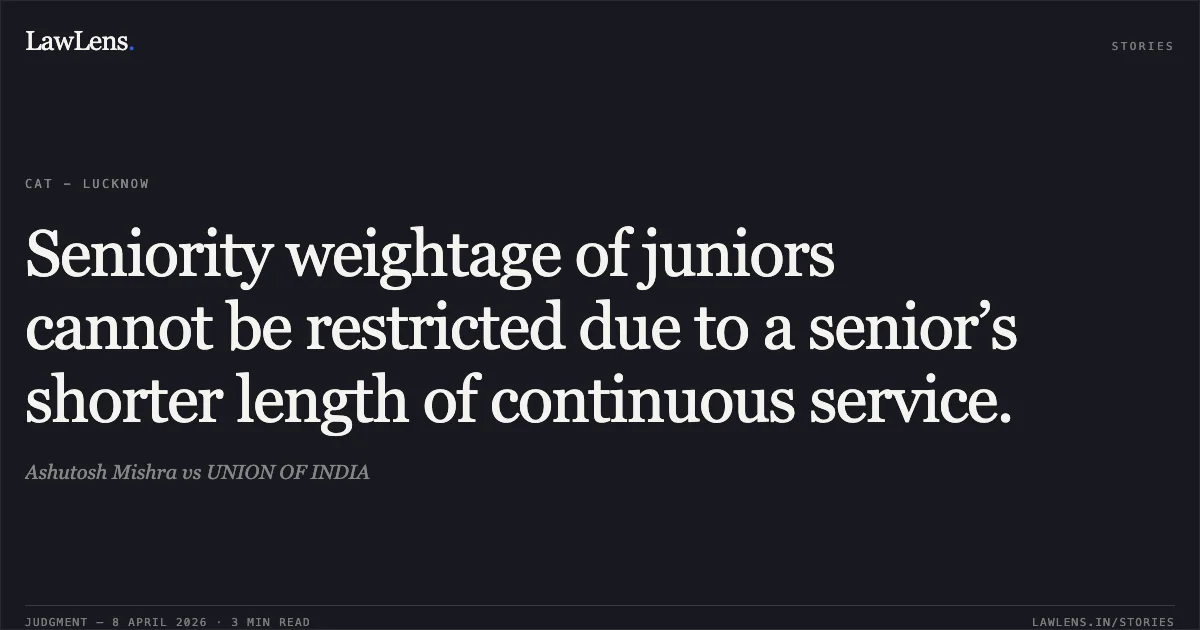
Whether the seniority and year of allotment of the applicants, based on their continuous service, could be restricted by the proviso to Rule 3(3)(ii) of the Seniority Rules because a senior officer had less continuous service.
Source reference: p. 4-5Whether the resulting anomaly constitutes "undue hardship" warranting relaxation of rules under the All India Services (Service Conditions of Residuary Matters) Rules, 1960.
Source reference: p. 3, 5Law Applied
Rule 3(3)(ii) of the IPS (Regulation of Seniority) Rules, 1988 (as amended in 2012), which governs the assignment of the year of allotment based on weightage for continuous service in the State Police Service.
Source reference: p. 3All India Services (Service Conditions of Residuary Matters) Rules, 1960, which allow for the relaxation of rules in cases of manifest injustice or extreme hardship.
Source reference: p. 3, 5Precedent established in Kavindra Pratap Singh & Ors vs Union of India & Ors (OA No. 463 of 2016), which held that a senior’s "handicap" (shorter service length) cannot be transmitted to juniors as a negative burden.
Source reference: p. 5Reasoning
The Tribunal observed that the facts of the present case were identical to the Kavindra Pratap Singh case.
Source reference: p. 5-6It reasoned that the proviso to Rule 3(3)(ii) must be given a "positive interpretation" and should not impose an encumbrance on juniors whose continuous service entitles them to a higher weightage.
Source reference: p. 5The court noted that the applicants had rendered 24 years of service compared to the 22 years of their seniors (Respondents 6 and 7), yet their seniority was capped to match the seniors' 2016 allotment.
Source reference: p. 3, 4Following the reasoning in Kavindra Pratap Singh, the Tribunal held that rather than eclipsing the legitimate seniority of the juniors, the respondents should consider invoking the Residuary Rules 1960 to provide notional weightage to the seniors.
Source reference: p. 5The court dismissed the respondents' argument that the matter was still under judicial scrutiny in the High Court, noting that in the absence of a stay order, the existing precedent in Kavindra Pratap Singh remains binding.
Source reference: p. 5-6Holding
The restriction of the applicants' seniority was a miscarriage of justice.
The Tribunal allowed the Original Application and quashed the impugned orders dated 23.10.2024, 16.05.2025, and 08.09.2025.
Source reference: p. 6The respondents (No. 1 to 5) were directed to re-decide the applicants' case in alignment with the directions given in the Kavindra Pratap Singh judgment within three months of receiving the order.
Source reference: p. 6Original Court PDF
Ashutosh MishravsUNION OF INDIA
Click to open original judgment
Original judgment, available to read, download and summarize on LawLens.in