Facts
On April 6, 2014, the appellants, under the pretext of performing a ritual to exorcise an "evil spirit," forcibly placed the palm of the complainant’s daughter into a burning havan kund.
Source reference: para. 2The victim suffered severe burn injuries leading to an infection that necessitated the surgical amputation of her hand at the wrist, resulting in permanent disability.
Source reference: para. 2The trial court (Additional Sessions Judge, Teonthar) convicted the appellants on July 4, 2017, under Sections 326, 506-II, and 190/34 of the IPC, sentencing them to five years of rigorous imprisonment (RI) and a fine of ₹5,000 each.
Source reference: para. 1, 5The appellants challenged this judgment, though during the appellate proceedings, their counsel contested only the quantum of the sentence, not the conviction.
Source reference: para. 6Issues
1. Whether the conviction of the appellants under Section 326 of the Indian Penal Code (IPC) for causing grievous hurt is legally sustainable.
Source reference: para. 92. Whether the substantive jail sentence should be reduced to the period already undergone in light of the appellants' conduct, age, and the 12-year duration of the legal proceedings.
Source reference: para. 10Law Applied
Section 326 of the IPC, which pertains to voluntarily causing grievous hurt by dangerous weapons or means.
Source reference: para. 1, 9The court considered the sentencing powers under Section 374(2) of the Code of Criminal Procedure (Cr.P.C.).
Source reference: para. 1The court utilized Section 357 of the Cr.P.C. to direct that the fine amount be paid to the victim as compensation for the injuries sustained.
Source reference: para. 11Reasoning
The High Court concurred with the trial court’s marshalling of evidence, finding no grounds to interfere with the conviction under Section 326 IPC as the injuries and the act were clearly established.
Source reference: para. 9In evaluating the sentence, the Court adopted a compensatory and rehabilitative approach. It noted that the incident occurred in 2014, and the appellants had been facing trial for approximately 12 years.
Source reference: para. 6, 10The Court took into account that Ramakant had served approximately five years in custody and Praveen had served one year and eight months.
Source reference: para. 10Given that the appellants were first-time offenders, were cooperative during the trial, and were of relatively young age at the time of the offence, the Court reasoned that the ends of justice would be served by reducing the substantive sentence to the period already served while increasing the fine amount to provide better compensation to the victim.
Source reference: para. 10, 11Holding
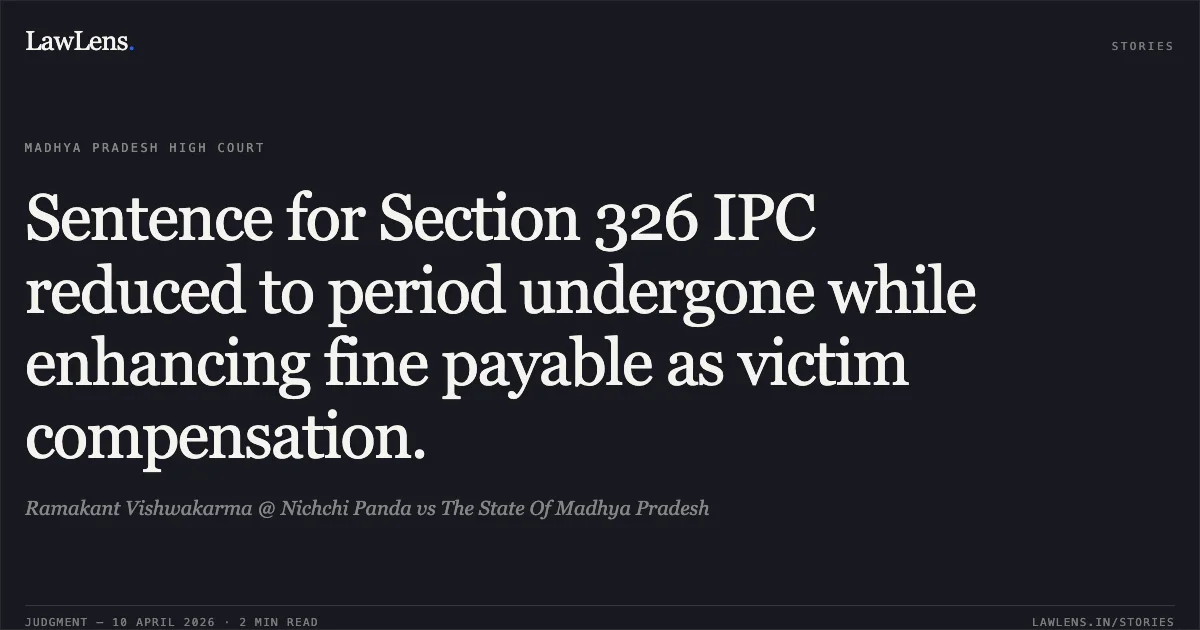
The High Court affirmed the conviction of the appellants under Section 326 of the IPC but modified the sentence.
The substantive jail sentence was reduced to the period already undergone by each appellant.
Source reference: para. 11The fine was enhanced from ₹5,000 to ₹8,000 each, with the stipulation that the total fine amount be paid to the victim as compensation under Section 357 of the Cr.P.C.
Source reference: para. 11The appellants’ bail bonds were discharged, subject to the payment of the enhanced fine within two months.
Source reference: para. 11, 12Acts & Sections Cited
6 provisions across 2 statutes referred to in this judgment. Each provision opens on LawLens.
Indian Penal Code, 18604
Code of Criminal Procedure, 19732
Original Court PDF
Ramakant Vishwakarma @ Nichchi PandavsThe State Of Madhya Pradesh
Click to open original judgment
Original judgment, available to read, download and summarize on LawLens.in


