01Facts
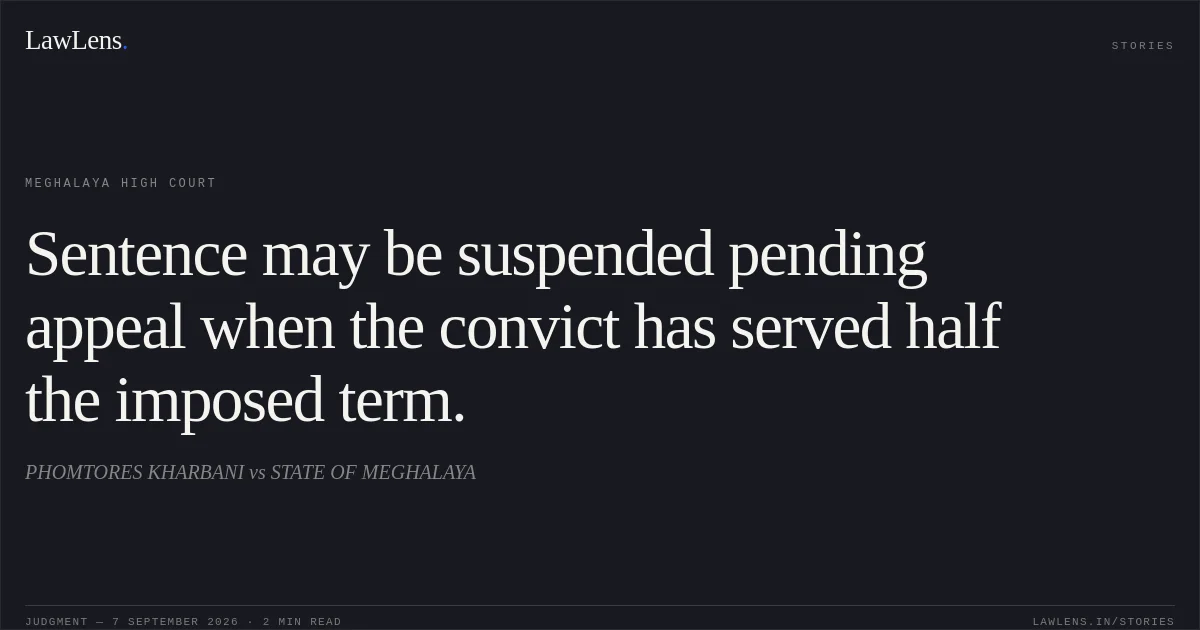
The applicant was convicted by the Trial Court under Section 304 Part II of the Indian Penal Code and sentenced to rigorous imprisonment for three years with a fine of ₹3,000.
¶ 2The conviction arose from the judgment dated 20.03.2025 and the order on sentence dated 09.04.2025.
¶ 2The applicant challenged the conviction and sentence in Crl.A. No. 78 of 2026 and sought suspension of sentence pending disposal of the appeal.
¶ 2It was submitted that he had already undergone more than half of the sentence and that the appeal was unlikely to be heard finally in the near future.
¶ 2The State defended the conviction but left the question of suspension of sentence to the Court’s discretion.
¶ 302Issues
i.Whether the applicant’s sentence should be suspended pending disposal of his criminal appeal, particularly when he had undergone more than half of the imposed sentence?
¶ 1–4ii.Whether the applicant should be released on bail subject to appropriate conditions during the pendency of the appeal?
¶ 4–503Law Applied
The Court considered the applicant’s conviction under Section 304 Part II IPC, which relates to culpable homicide not amounting to murder committed with knowledge that the act was likely to cause death.
The application concerned suspension of sentence pending appeal under the appellate court’s power contemplated by Section 389 of the Code of Criminal Procedure, 1973.
The Court relied on Atul alias Ashutosh v. State of Madhya Pradesh, (2024) 3 SCC 663, wherein the Supreme Court approved suspension of sentence pending appeal where the convict had undergone half of the sentence and the appeal was not likely to be heard shortly.
¶ 4At the stage of considering suspension of sentence, the appellate court is not required to undertake a detailed examination of the merits of the conviction.
¶ 4Provisions in the judgment · 1 · Linked ones open on LawLens
Indian Penal Code, 1860 Section 304
04Reasoning
The Court noted that the applicant had preferred an appeal against the conviction and sentence but had already served more than half of the three-year term.
¶ 4Since the appeal was not likely to be concluded in the immediate future, the circumstance of prolonged incarceration pending appellate adjudication attracted the principle stated in Atul alias Ashutosh.
¶ 4The Court expressly refrained from examining the merits of the conviction at this interlocutory stage.
¶ 4Considering these circumstances, it found the case fit for suspension of sentence and release on bail.
¶ 405Holding
The Court allowed the application and suspended the applicant’s sentence pending disposal of the criminal appeal.
¶ 5The applicant was directed to be released on bail subject to the conditions that he: (i) not abscond; (ii) diligently pursue the appeal; (iii) not leave Meghalaya without prior permission of the Court; and (iv) execute a personal bond of ₹10,000 with one surety for the like amount to the satisfaction of the Trial Court.
¶ 5A copy of the order was directed to be sent to the Trial Court for compliance, and the criminal miscellaneous case was disposed of.
¶ 6–7Original Court PDF
PHOMTORES KHARBANIvsSTATE OF MEGHALAYA
Click to open original judgment
Original judgment, available to read, download and summarize on LawLens.in