Facts
The Appellants challenged the acquittal of the Respondent for offenses under Section 138 of the Negotiable Instruments Act, 1881.
Source reference: p. 1-2The High Court, vide judgment dated 19th September 2024, set aside the Trial Court’s acquittal, finding that the Respondent admitted to issuing ten cheques (totaling Rs. 2.60 Crores) and failed to rebut the statutory presumption that the cheques for the outstanding balance of Rs. 85 Lakhs were issued toward a legally enforceable debt.
Source reference: para. 1-3Following the conviction, the Respondent approached the Supreme Court, which, via order dated 21st November 2025, permitted the High Court to determine the sentence but requested it be kept in abeyance pending the SLP.
Source reference: para. 5Issues
1. What is the appropriate quantum of sentence and compensation to be awarded to the Appellants following the conviction of the Respondent under Section 138 of the NI Act?
Source reference: para. 6Law Applied
Section 138 of the Negotiable Instruments Act, 1881, regarding the dishonor of cheques, and Section 357(1)(b) of the Cr.P.C. concerning the award of compensation.
Source reference: para. 1, 14R. Vijayan v. Baby (2012), which establishes that compensation should be realistic, adequate, and may include interest to restitute the complainant.
Source reference: para. 7, 12Meters and Instruments (P) Ltd. v. Kanchan Mehta (2018), which posits that Section 138 proceedings are primarily compensatory in nature, with punitive elements serving to ensure compliance.
Source reference: para. 12Reasoning
The Court observed that the Respondent’s defense—that the cheques were merely security—was unsubstantiated and failed to rebut the statutory presumption under Section 139 of the NI Act.
Source reference: para. 10In determining the sentence, the Court noted the commercial nature of the transaction and the Respondent's conduct, including the adoption of inconsistent defenses and a lack of bona fide efforts to settle the debt since 2007.
Source reference: para. 11Rejecting the Respondent’s plea for leniency based on the claim that the amount represented only "profit/interest," the Court found that the prolonged deprivation of funds justified a significant financial penalty.
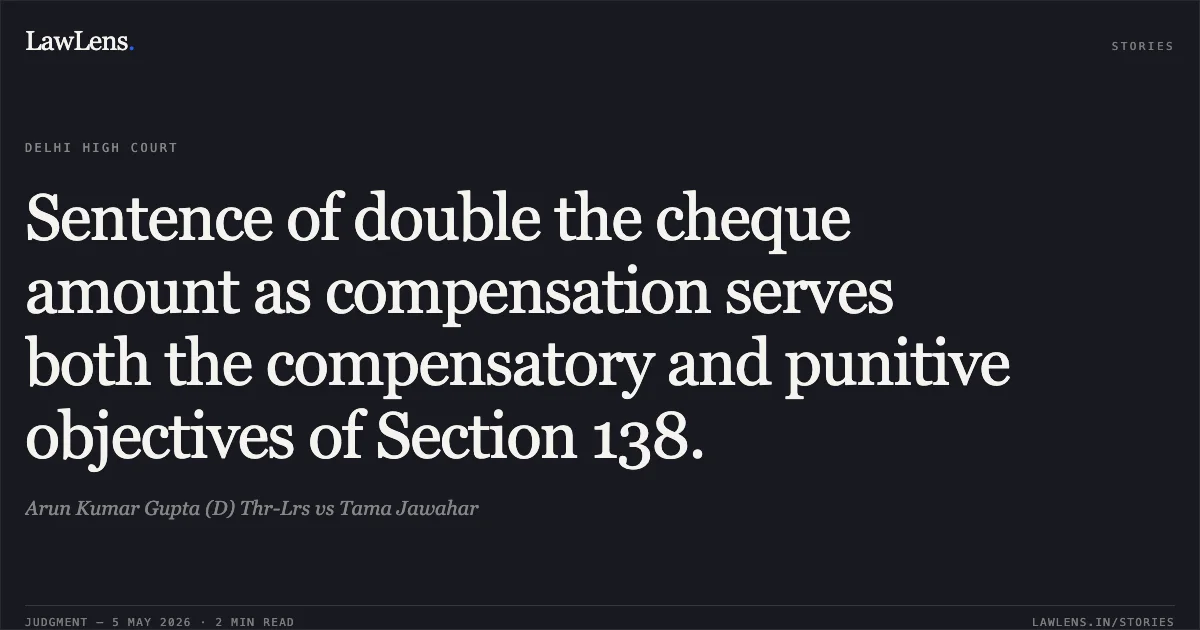
Source reference: para. 11, 13The Court reasoned that a fine equivalent to twice the cheque amount would sufficiently balance equities and meet the compensatory objectives of the Act without requiring a separate interest calculation.
Source reference: para. 13Holding
The Court sentenced the Respondent to pay a fine of Rs. 1,70,00,000/- (twice the cheque amount of Rs. 85 Lakhs), to be paid to the Appellants as compensation under Section 357(1)(b) Cr.P.C.
The Respondent is directed to deposit the amount within six months, failing which he shall undergo three months of simple imprisonment.
Source reference: para. 15Pursuant to the Supreme Court's directions in SLP (Crl.) No. 13799–13800/2024, the execution of this sentence is held in abeyance pending further orders from the Apex Court.
Source reference: para. 17-18Acts & Sections Cited
5 provisions across 2 statutes referred to in this judgment. Each provision opens on LawLens.
Negotiable Instruments Act, 18813
Code of Criminal Procedure, 19732
Original Court PDF
Arun Kumar Gupta (D) Thr-LrsvsTama Jawahar
Click to open original judgment
Original judgment, available to read, download and summarize on LawLens.in