Facts
In September 2014, the appellant appeared before a Judicial Magistrate in Rewa to furnish surety for an accused, presenting a Land Rights and Loan Book (Bhu Adhikar Rin Pustika).
Source reference: p. 2The Magistrate noticed pagination irregularities (page 10 following page 2), leading to an investigation that revealed the document was forged.
Source reference: p. 2-3The appellant was convicted by the Trial Court for offences under Sections 420, 467, 468, and 471 of the IPC and sentenced to five years of rigorous imprisonment on each count.
Source reference: p. 1-2The High Court of Madhya Pradesh affirmed the conviction and sentence on April 30, 2025.
Source reference: p. 4Historically, the appellant was in custody briefly in 2014 and continuously since January 6, 2024, totaling over two years of incarceration.
Source reference: p. 8Issues
1. Whether the substantive sentence of five years of rigorous imprisonment is proportionate to the facts and circumstances of the case, justifying a reduction to the period already undergone.
Source reference: p. 2, 5Law Applied
Sections 420 (cheating), 467 (forgery of valuable security), 468 (forgery for purpose of cheating), and 471 (using a forged document as genuine) of the Indian Penal Code, 1860.
Source reference: p. 1, 6Principle of Proportionality in sentencing, asserting that punishment must balance the nature of the offence with mitigating factors such as the offender’s background and the lapse of time.
Source reference: p. 6Padum Kumar v. State of Uttar Pradesh (2020) 3 SCC 35, which established that a sentence may be reduced considering the age of the matter, incarceration already undergone, and absence of criminal antecedents.
Source reference: p. 7Reasoning
The Court observed that while using forged documents in judicial proceedings is a serious offence that "strikes at the purity of the administration of justice", sentencing must not be a "purely retributive exercise".
Source reference: p. 5-6The Court noted several mitigating factors: the occurrence dates back to 2014, making the litigation over a decade old; the appellant has no known criminal antecedents or history of organized crime; and the forgery was detected at the threshold, preventing any irreversible pecuniary loss.
Source reference: p. 6-7The Court determined that the two years already served by the appellant, coupled with the decade-long "shadow of criminal proceedings," rendered the original five-year sentence excessive.
Source reference: p. 8Holding
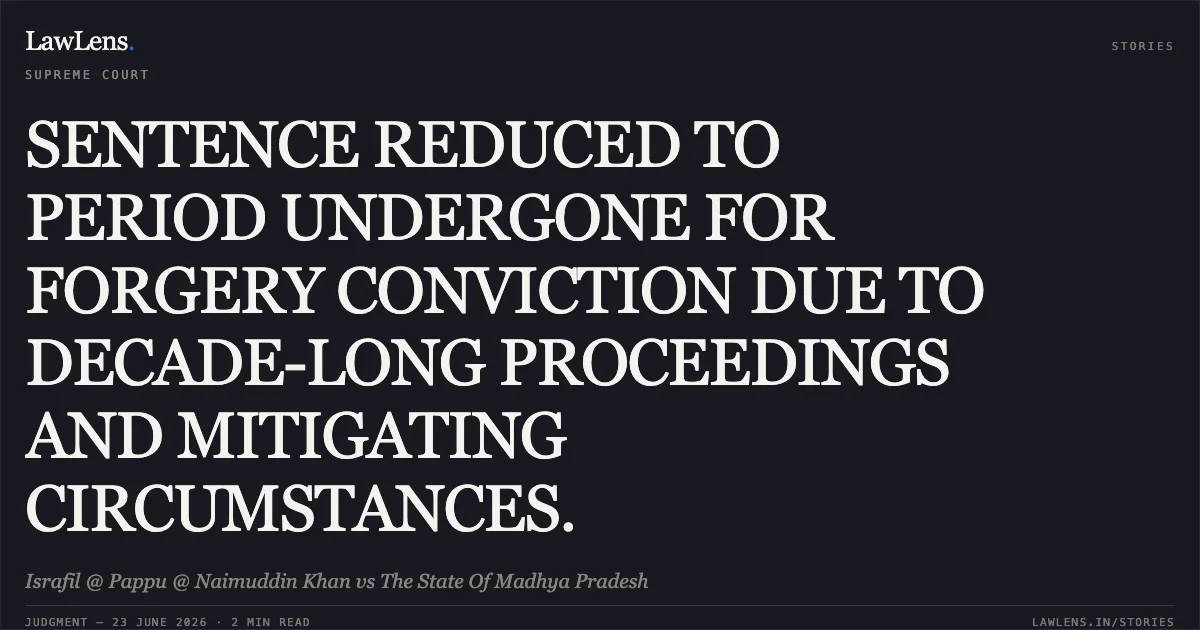
The Supreme Court maintained the conviction but reduced the substantive sentence to the period already undergone.
The Court answered the issue by holding that the ends of justice would be met by such modification given the lack of habitual offending and the long lapse of time.
Source reference: p. 8The appellant was ordered to be released forthwith, provided the fine imposed by the Trial Court is deposited; the appeal was partly allowed.
Source reference: p. 9Acts & Sections Cited
6 provisions across 2 statutes referred to in this judgment. Each provision opens on LawLens.
Indian Penal Code, 18605
Code of Criminal Procedure, 19731
Original Court PDF
Israfil @ Pappu @ Naimuddin KhanvsThe State Of Madhya Pradesh
Click to open original judgment
Original judgment, available to read, download and summarize on LawLens.in


