Facts
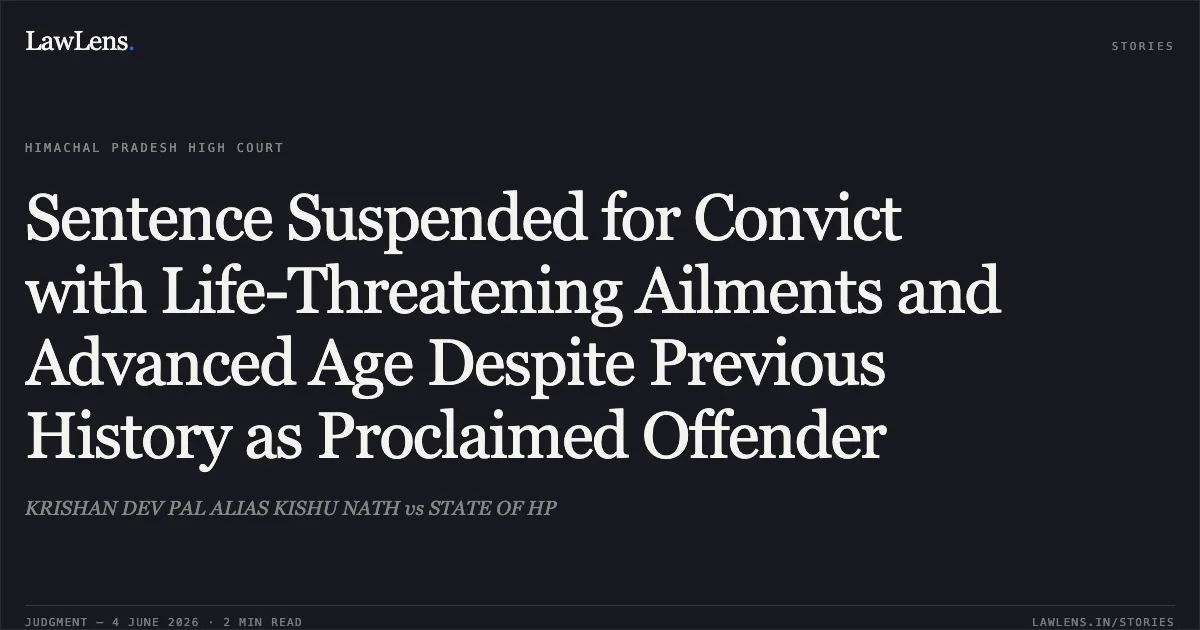
The applicant was convicted under Section 302 of the IPC for the 1984 murder of Shankar Prashad and sentenced to life imprisonment by the Additional Sessions Judge-I, Mandi, on April 1, 2024.
Source reference: para 1-2Following the incident, the applicant absconded and was declared a proclaimed offender in 1986; he was only apprehended 34 years later in 2020.
Source reference: para 7-8As of February 2026, he had undergone approximately 6 years and 6 months of his sentence.
Source reference: para 9The applicant sought suspension of sentence during the pendency of his appeal, citing his advanced age (70 years) and deteriorating health, specifically chronic obstructive pulmonary disease (COPD) and breathing issues requiring nebulization and oxygen.
Source reference: para 11-12, 15The State opposed the application, highlighting the applicant's 36-year period of absconding.
Source reference: para 16Issues
1. Whether the sentence of a convict for a heinous offense (murder) can be suspended during the pendency of an appeal solely on medical and humanitarian grounds despite a history of absconding.
Source reference: para 10-182. Whether the current medical condition of the applicant constitutes a "life-threatening" infirmity requiring specialized treatment outside of the prison environment.
Source reference: para 15/23Law Applied
Section 389 of the Code of Criminal Procedure (Cr.P.C.) regarding the suspension of sentence pending appeal.
Source reference: para 1The constitutional guarantee of the right to life and dignity under Article 21 of the Constitution of India, emphasizing the State's obligation to preserve a prisoner's health.
Source reference: para 21The doctrine derived from Vijay Agrawal v. Directorate of Enforcement and Naresh Goyal v. Directorate of Enforcement that "infirmity" includes disabilities incapacitating daily routine activities, and that "sick" or "infirm" conditions must be treated with a lenient, humanitarian approach.
Source reference: para 19-21Reasoning
The Court balanced the gravity of the offense and the applicant’s long history of absconding against his current critical health status.
Source reference: para 16-23The Court noted that during a previous 28-day parole in 2025, the applicant surrendered on time without adverse reports.
Source reference: para 17The Court placed heavy reliance on the medical opinion from the Jail Medical Officer, which confirmed the applicant suffers from COPD with "life-threatening" potential and requires "constant supervision" not fully available in jail.
Source reference: para 15Reasoning that a prisoner cannot be "left in the lurch" when facing serious ailment, the Court determined that humanitarian considerations and the right to health outweighed the risk of flight, provided stringent conditions and a limited duration of suspension were imposed.
Source reference: para 21-23Holding
The High Court allowed the application in part, granting a limited suspension of sentence for six months (from June 15, 2026, to December 15, 2026) to allow the applicant to seek specialized medical treatment.
The holding was conditioned upon the execution of a personal bond of Rs. 1,00,000, disclosure of the place of residence and medical institution, a mandate to surrender by 2:00 p.m. on December 15, 2026, and submission of periodic medical status reports.
Source reference: para 23-24Acts & Sections Cited
4 provisions across 3 statutes referred to in this judgment. Each provision opens on LawLens.
Indian Penal Code, 18601
Code of Criminal Procedure, 19732
Prevention of Money-Laundering Act, 20021
Original Court PDF
KRISHAN DEV PAL ALIAS KISHU NATHvsSTATE OF HP
Click to open original judgment
Original judgment, available to read, download and summarize on LawLens.in