Facts
The appellant was convicted by the Special Judge Rohru under Sections 21 and 29 of the NDPS Act for possession of 13 grams of Heroin
Source reference: para. 1-2The Trial Court sentenced him to 10 years of rigorous imprisonment and a fine of ₹1,00,000
Source reference: para. 2On appeal, the appellant did not contest the conviction on merits but challenged the quantum of sentence as disproportionate for an "intermediate quantity" of contraband
Source reference: para. 3The respondent argued that the appellant was involved in another similar case
Source reference: para. 8Issues
1. Whether the quantum of sentence imposed upon the appellant is proportionate to the quantity of contraband recovered and in consonance with settled sentencing principles
Source reference: para. 52. Whether the pendency of another criminal case against the accused can be a valid ground for determining or enhancing the quantum of sentence
Source reference: para. 9Law Applied
Section 21(b) of the NDPS Act, 1985, which prescribes punishment for "intermediate quantity" ranging from one day up to 10 years
Source reference: para. 12-14Section 49 of the Bharatiya Sakshya Adhiniyam, 2023 (formerly Section 54 of the Evidence Act), which stipulates that previous bad character is irrelevant in criminal proceedings unless in reply to evidence of good character
Source reference: para. 10Principle of Proportionality as established in Alister Anthony Pareira v. State of Maharashtra and Uggarsain v. State of Haryana, emphasizing that sentencing must balance deterrence with rehabilitation and be fact-dependent
Source reference: para. 20, 22Reasoning
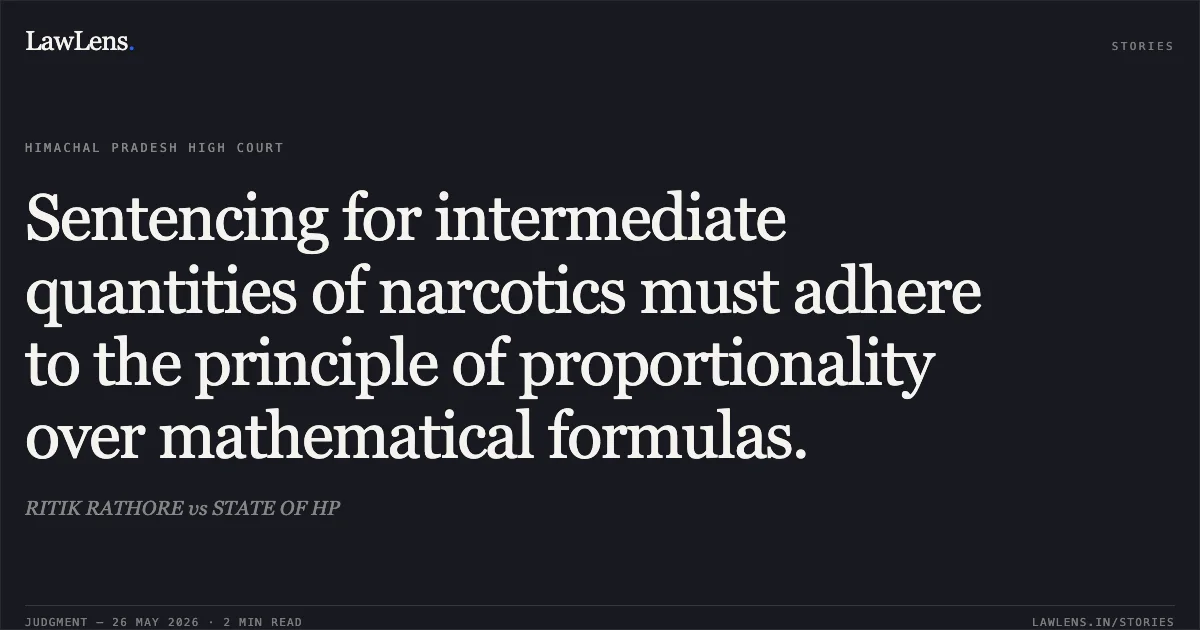
The court reasoned that while mathematical proportionality (dividing the sentence strictly by the gram) is not a rigid norm, a sentence of 10 years for 13 grams of heroin—where the intermediate range spans 6 to 250 grams—is excessively harsh
Source reference: para. 16-19The court noted that 10 years is the maximum possible sentence for this category, typically reserved for quantities closer to the commercial threshold (250g)
Source reference: para. 16Regarding the respondent's plea of the appellant's other pending cases, the court held that under the presumption of innocence and Jitender v. State of Uttar Pradesh, a pending trial cannot be considered for sentencing as the accused is not yet a "convict" in those matters
Source reference: para. 11, 25The court found that for 13 grams, a sentence exceeding 15 months was disproportionate to the crime's gravity
Source reference: para. 26-27Holding
The court allowed the appeal in part, answering that the original sentence was disproportionate. The substantive sentence was modified from 10 years to 1 year and 6 months of rigorous imprisonment
The fine was reduced from ₹1,00,000 to ₹20,000, with a default imprisonment term of three months. As the appellant had already undergone 1 year and 3 months in custody, the court ordered his immediate release if not required in any other case
Source reference: para. 26, 28, 29Acts & Sections Cited
4 provisions across 3 statutes referred to in this judgment. Each provision opens on LawLens.
Narcotic Drugs and Psychotropic Substances Act, 19852
Bharatiya Sakshya Adhiniyam, 20231
Indian Penal Code, 18601
Original Court PDF
RITIK RATHOREvsSTATE OF HP
Click to open original judgment
Original judgment, available to read, download and summarize on LawLens.in