Facts
The Respondent (Philips) sued the Appellants (the Bansals) for infringing Indian Patent IN 184753 (a decoding device for DVD technology).
Source reference: para 30Philips claimed the patent was a Standard Essential Patent (SEP) and sought damages at FRAND rates.
Source reference: para 30The Appellants contended they merely assembled DVD players using Printed Circuit Boards (PCBs) and chips purchased from authorized vendors like MediaTek, invoking the doctrine of international exhaustion.
Source reference: para 44-45The learned Single Judge decreed the suits, holding the patent was an SEP and calculating damages based on per-unit DVD player sales at rates offered during pre-suit negotiations.
Source reference: para 32, 63Issues
1. Whether the suit patent (IN’753) qualifies as a Standard Essential Patent (SEP).
Source reference: para 37, 832. Whether the Appellants infringed the suit patent through direct or indirect evidence.
Source reference: para 37, 993. Whether Philips is barred from asserting patent rights due to the principle of international exhaustion under Section 107A(b) of the Patents Act.
Source reference: para 37, 1224. Whether the royalty rates and damages determined by the Single Judge were legally sustainable.
Source reference: para 37, 146Law Applied
Court primarily applied Section 48 of the Patents Act, 1970, which distinguishes between product and process patent rights.
Source reference: para 10, 79Section 10(4)(c) of the Patents Act, which limits patent protection to the specific scope defined in the claims.
Source reference: para 78Regarding SEPs, the Court followed the "indirect test" (Law of Transitivity) and "FRAND protocol" established in Intex Technologies v. Ericsson and Huawei Technologies v. ZTE Corp.
Source reference: para 12, 15Evidence of essentiality through expert reports was governed by Section 45 of the Indian Evidence Act, requiring the expert to be examined.
Source reference: para 93-94The doctrine of international exhaustion was applied via Section 107A(b) of the Patents Act (as amended in 2003), which protects imports from any person "duly authorised under the law" to sell the product, regardless of the patentee's direct consent.
Source reference: para 135Section 114 of the Evidence Act to draw adverse inferences regarding withheld documents.
Source reference: para 118-119Reasoning
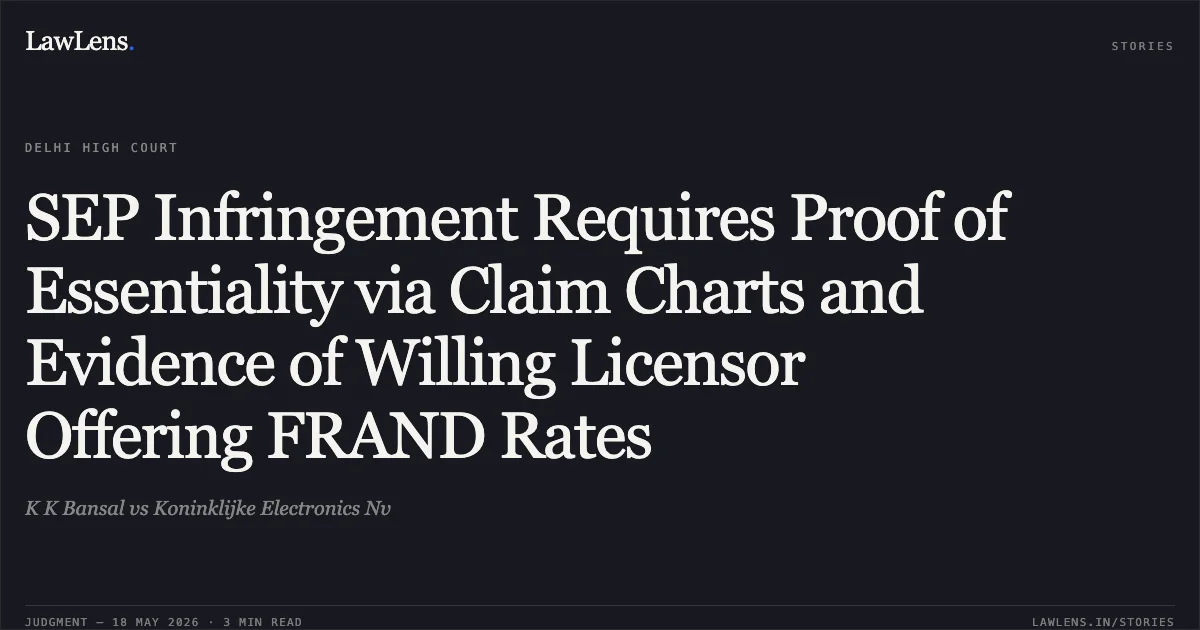
The Division Bench found that Philips failed to prove the suit patent was an SEP because it did not produce "claim charts" mapping the patent to the standard, nor did it examine the authors of the Essentiality Certificates (ECs) as required by Section 45 of the Evidence Act.
Source reference: para 95-97Infringement was not proved because Philips' expert (PW-2) admitted the patent resided in a chip or PCB, yet the tests conducted were on the entire DVD player without producing the analytical logs or mapping the product to the claims.
Source reference: para 115, 120-121The Court held that the "exhaustion" defense under Section 107A(b) was valid; since the Bansals purchased PCBs containing the patented device from MediaTek's authorized distributors, Philips' monopoly over those specific items was terminated upon the initial sale in the market.
Source reference: para 141-145The Court further determined that the Single Judge erred in calculating damages based on "informal negotiations" and the entire value of the DVD player, as a patentee is only entitled to royalty on the specific patented component (the decoding device) and must prove that the offered rate is FRAND by disclosing third-party licenses.
Source reference: para 155, 165-167Holding
The suit patent was not proved to be an SEP due to lack of standard-to-claim mapping and inadmissible expert reports.
Infringement was not established as Philips failed to conduct a proper product-to-claim mapping or provide primary evidence of testing.
Source reference: para 169(xi-xii)The doctrine of international exhaustion under Section 107A(b) protected the Appellants as they purchased the patented components from legally authorized sellers.
Source reference: para 169(xiii)The royalty rates awarded were arbitrary and lacked an evidentiary basis for being "FRAND".
Source reference: para 169(xiv-xv)The Court allowed the appeals and set aside the Single Judge's judgment; the decree for damages and costs was quashed.
Source reference: para 170-171Acts & Sections Cited
8 provisions across 3 statutes referred to in this judgment. Each provision opens on LawLens.
Patents Act, 19705
Telecom Regulatory Authority of India Act, 19972
Code of Civil Procedure, 19081
Original Court PDF
K K BansalvsKoninklijke Electronics Nv
Click to open original judgment
Original judgment, available to read, download and summarize on LawLens.in