Facts
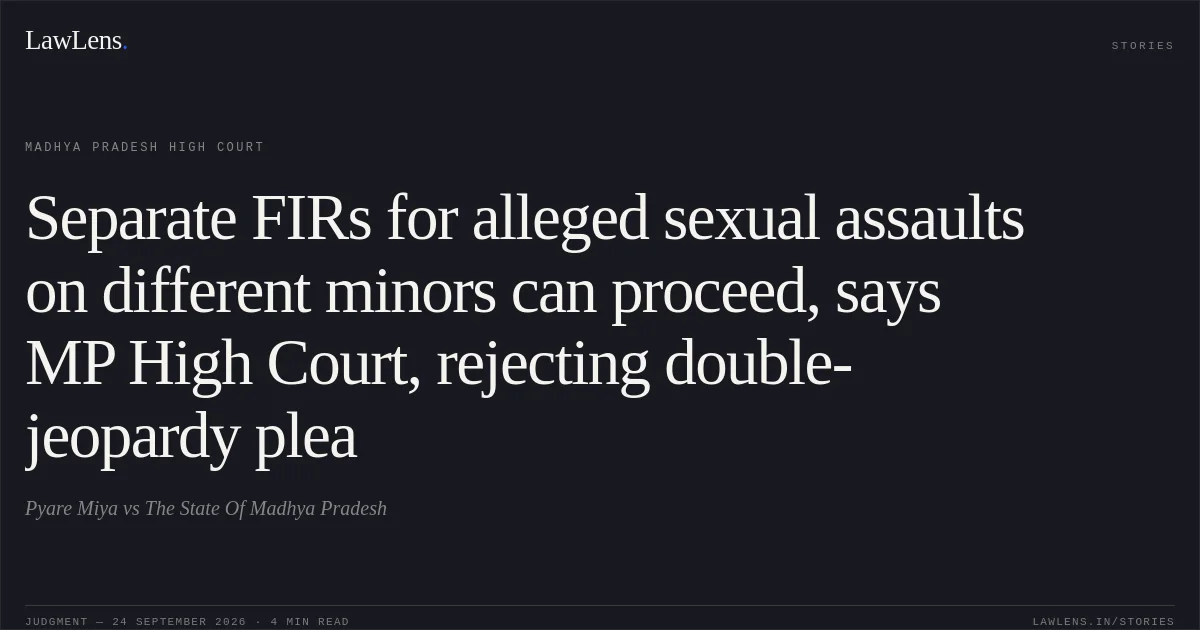
An FIR, Crime No. 372/2020, was registered at Police Station Shahpura, Bhopal, against the petitioner and others for alleged sexual exploitation of five children during 11–12 July 2020. After investigation, a charge-sheet was filed before the Special Court, Bhopal, alleging offences under the IPC, POCSO Act, SC/ST (Prevention of Atrocities) Act, Juvenile Justice Act and Arms Act
Source reference: para. 2During that investigation, the police allegedly discovered that three child victims—“B”, “N” and “P”—had also been sexually exploited at the petitioner’s house in Palasia, Indore, on separate dates. Three separate FIRs were consequently registered at Police Station Palasia: Crime No. 357/2020 concerning victim “B”, Crime No. 358/2020 concerning victim “N”, and Crime No. 359/2020 concerning victim “P”
Source reference: paras. 2.1–2.4Separate charge-sheets were filed and trials were instituted before the competent Special Courts at Indore
Source reference: paras. 2.2–2.4The petitioner sought quashing of the three Indore FIRs and all consequential proceedings under Article 226 of the Constitution and Section 528 of the BNSS, contending that they arose from the same investigative disclosure and transaction as the Bhopal case, thereby violating the principles against multiple FIRs, double jeopardy and abuse of process
Source reference: paras. 1, 3, 6Issues
1. Whether the FIRs in Crime Nos. 357/2020, 358/2020 and 359/2020 at Police Station Palasia, Indore, were impermissible second or subsequent FIRs concerning the same occurrence or transaction as Crime No. 372/2020 at Police Station Shahpura, Bhopal
Source reference: paras. 3, 10–132. Whether the separate proceedings violated Article 20(2) of the Constitution or the statutory bar against successive prosecution under Section 300 CrPC/Section 337 BNSS
Source reference: paras. 3, 143. Whether the High Court should exercise its constitutional and inherent jurisdiction to quash the Indore FIRs and consequential proceedings on the ground of abuse of process
Source reference: paras. 1, 6, 15Law Applied
The Court applied Section 218 CrPC/Section 241 BNSS, which requires separate charges and trials for distinct offences, subject to statutory exceptions permitting joint trial; Sections 219–222 CrPC/Sections 242–245 BNSS, which permit joinder of certain offences forming part of the same transaction
Source reference: paras. 7–8It held that rape or penetrative sexual assault is not a continuing offence and that each incident constitutes a distinct offence, particularly where the offences occurred on different dates, at different places and against different victims
Source reference: para. 9Under Section 177 CrPC/Section 197 BNSS, offences are ordinarily investigated and tried by the court within whose jurisdiction they were committed
Source reference: para. 9The Court relied on T.T. Antony v. State of Kerala, Amitbhai Anilchandra Shah v. CBI, Amit Katyal v. State of Haryana, Anju Chaudhary v. State of U.P., Babubhai v. State of Gujarat, Kari Choudhary v. Sita Devi, Upkar Singh v. Ved Prakash, Nirmal Singh Kahlon v. State of Punjab and State of Rajasthan v. Surendra Singh Rathore for the rule that a second FIR for the same occurrence is generally impermissible, but a subsequent FIR may be sustained where the incidents are separate, the factual ambit differs, a larger conspiracy or new facts emerge, or the second FIR concerns a distinct offence
Source reference: paras. 4, 10, 12Article 20(2) prohibits prosecution and punishment more than once for the same offence, while Section 300 CrPC/Section 337 BNSS operates only after a person has been tried and convicted or acquitted by a competent court
Source reference: para. 14Reasoning
The Court applied the test of sameness or connectedness to the Bhopal and Indore FIRs. Although the Indore cases emerged during the investigation of the Bhopal crime and involved some overlapping accused and victims, the alleged offences concerned different acts of sexual assault, different child victims, different dates and a different place of occurrence—namely, the petitioner’s house at Palasia, Indore
Source reference: paras. 2.1–2.4, 13Since each act of penetrative sexual assault constituted a distinct offence and fell within the territorial jurisdiction of Indore, the subsequent FIRs were not merely duplicate FIRs concerning the same occurrence.
Source reference: no citationThe Court further held that the statutory and constitutional prohibitions against double jeopardy were not attracted because none of the proceedings had culminated in a conviction or acquittal, and the petitioner had therefore neither been previously “tried” nor “prosecuted and punished” for the same offence
Source reference: para. 14The circumstances consequently did not justify quashing under Article 226 or Section 528 BNSS
Source reference: para. 15Holding
The Court held that Crime Nos. 357/2020, 358/2020 and 359/2020 were based on distinct incidents of sexual exploitation involving different victims, dates and place of occurrence, and did not fail the test of sameness or connectedness
Article 20(2) and Section 300 CrPC/Section 337 BNSS were inapplicable because no trial had concluded and there had been no prior conviction or acquittal
Source reference: para. 14The petition seeking quashing of the Indore FIRs and consequential proceedings was accordingly dismissed
Source reference: para. 15Acts & Sections Cited
39 provisions across 7 statutes referred to in this judgment. Each provision opens on LawLens.
Bharatiya Nagarik Suraksha Sanhita, 20238
Indian Penal Code, 18607
Scheduled Castes and the Scheduled Tribes (Prevention of Atrocities) Act, 19891
Juvenile Justice (Care and Protection of Children) Act, 2015.3
Arms Act, 19592
Original Court PDF
Pyare MiyavsThe State Of Madhya Pradesh
Click to open original judgment
Original judgment, available to read, download and summarize on LawLens.in