Facts
The petitioners invoked Section 528 of the BNSS to seek quashing of an FIR registered under Sections 109(1) and 3(5) of the BNS, and the consequential proceedings, on the basis of a compromise
Source reference: para. 1The FIR alleged that the petitioners and others fired at the complainant with a firearm, intending to kill him; the complainant sustained an injury and bullets struck his house
Source reference: para. 2The parties’ compromise applications and affidavits were verified by the Principal Registrar, who reported that the settlement was voluntary
Source reference: paras. 3–4The complainants supported quashing, while the State opposed it
Source reference: paras. 5–8Issues
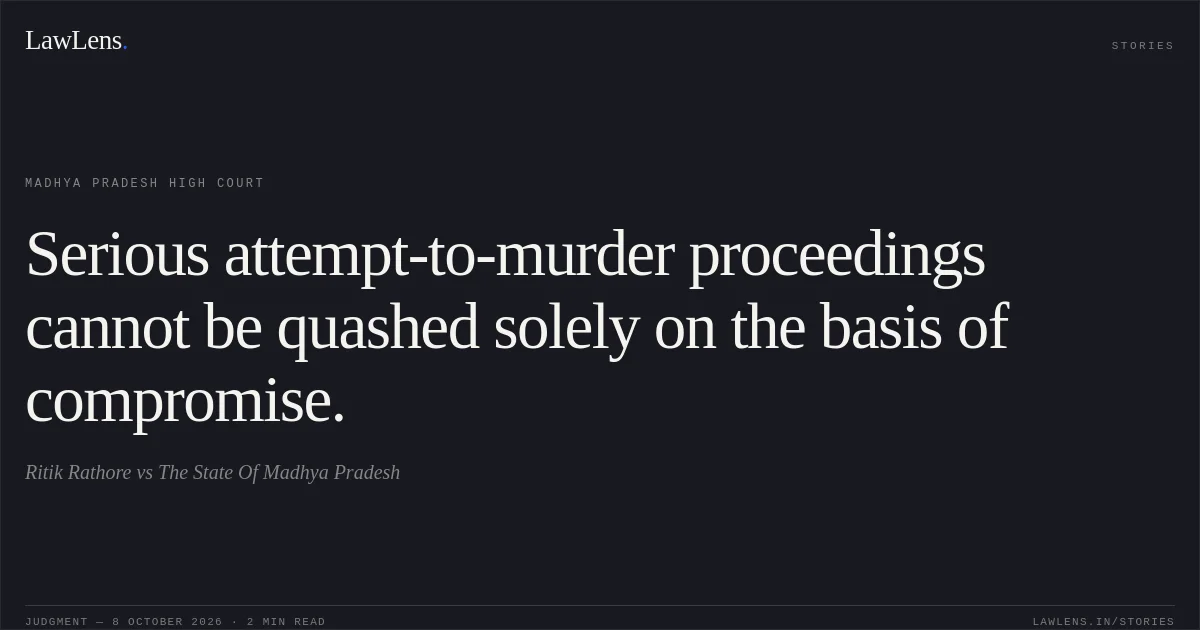
Whether the FIR and consequential proceedings alleging a firearm attack with intent to kill could be quashed under Section 528 of the BNSS solely on the basis of a compromise between the parties
Source reference: paras. 9–14Whether the alleged offence was sufficiently serious and affected public interest such that the compromise did not justify quashing
Source reference: paras. 9–14Law Applied
Section 528 of the BNSS empowers the High Court to exercise inherent jurisdiction to prevent abuse of process or secure the ends of justice; that jurisdiction is not ordinarily exercised to quash serious or heinous offences merely because the parties have settled.
Source reference: no citationIn State of Madhya Pradesh v. Laxmi Narayan, (2019) 5 SCC 688, the Supreme Court held that, in considering compromise-based quashing of an attempt-to-murder allegation, the Court must assess whether the charge is supported by the evidence and circumstances, and that serious offences should not ordinarily be quashed on settlement alone.
Source reference: para. 11The Court also relied on Vijay Kumar Kela & Anr. v. Central Bureau of Investigation & Anr., 2026 INSC 588, for the principle that the nature and gravity of the offence, its societal impact, and the public interest in prosecution must be considered; heinous or serious offences cannot appropriately be quashed merely because the victim or parties have settled.
Source reference: para. 12Reasoning
The Court considered the allegations that the petitioners used a firearm and fired at the injured with the intention of causing his death.
Source reference: para. 9It held that the alleged conduct was not of an overwhelmingly private or civil character and involved a serious offence with a public-interest dimension.
Source reference: paras. 9, 13Although the compromise was voluntary and supported by the complainants, that settlement did not diminish the alleged offence’s seriousness or eliminate the public interest in prosecution.
Source reference: paras. 10, 13–14It therefore did not provide sufficient grounds to exercise the inherent jurisdiction under Section 528 of the BNSS.
Source reference: paras. 13–14Holding
The Court held that the compromise did not warrant quashing the FIR or consequential criminal proceedings.
The petition was dismissed, and the interlocutory applications were disposed of.
Source reference: paras. 14–16The Court clarified that its observations were confined to the petition and would not prejudice either party before the Trial Court.
Source reference: paras. 14–16Acts & Sections Cited
4 provisions across 2 statutes referred to in this judgment. Each provision opens on LawLens.
Bharatiya Nagarik Suraksha Sanhita, 20231
Bharatiya Nyaya Sanhita, 20233
Original Court PDF
Ritik RathorevsThe State Of Madhya Pradesh
Click to open original judgment
Original judgment, available to read, download and summarize on LawLens.in