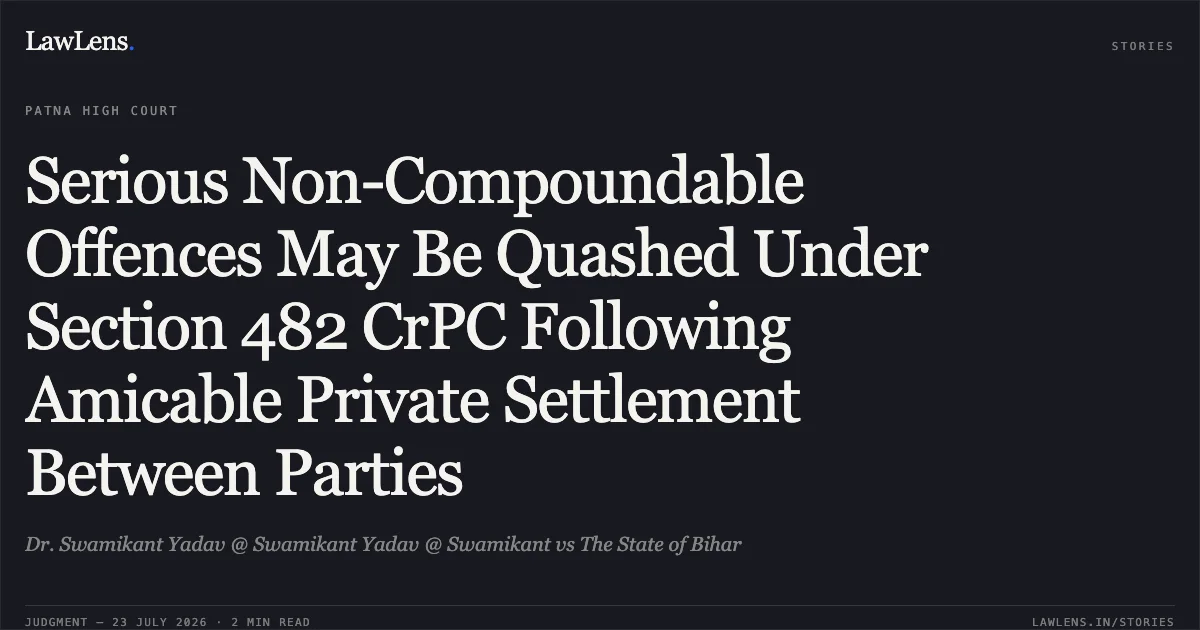
Facts
The opposite party no. 2 (informant) filed a complaint under Section 156(3) Cr.P.C. alleging that during a child delivery operation at Raj Lakshmi Hospital, the petitioner doctors/owners (Petitioners 1–4) negligently left a ‘Tetra’ in the abdomen of the patient, Rupa Devi
Source reference: para. 3–4It was further alleged that Petitioner No. 1 demanded a large sum of money for a corrective operation
Source reference: para. 4Following a police investigation, a "final form" was submitted finding the petitioners innocent; however, the learned Magistrate disagreed and took cognizance under Sections 307, 385, 386, and 387 of the IPC
Source reference: para. 2, 6During the pendency of this quashing petition, the parties entered into an amicable settlement and filed a compromise petition/supplementary affidavit
Source reference: para. 7Issues
1. Whether an offence under Section 307 IPC (attempt to murder) is made out when there is an absence of intention or knowledge that the act was likely to cause death
Source reference: para. 5, 92. Whether the High Court, exercising inherent powers under Section 482 Cr.P.C., can quash criminal proceedings involving non-compoundable offences on the basis of a private settlement
Source reference: para. 11–13Law Applied
The court primarily analyzed Section 307 IPC, noting that the "intention" or "knowledge" to cause death is a prerequisite, as established in Jage Ram and Ors. vs. State of Haryana
Source reference: para. 5Regarding the quashing of non-compoundable offences based on settlement, the court relied on the landmark precedents of Gian Singh vs. State of Punjab (2012), which allows quashing if a settlement makes conviction unlikely and justice would otherwise be a casualty
Source reference: para. 12It further cited Naushey Ali vs. State of U.P. (2025), State of M.P. vs. Laxmi Narayan (2019), and Narinder Singh vs. State of Punjab (2014) to affirm that even serious offences like Section 307 IPC can be quashed if the dispute is private/peculiar in nature and was amicably resolved
Source reference: para. 13Reasoning
The Court observed that no intention to cause death could be imputed to the petitioners from the record, nor was there any apparent motive, thus rendering the charge under Section 307 IPC unsustainable
Source reference: para. 9The allegations of extortion (Sections 385–387 IPC) were deemed "ornamental" and the core of the grievance was identified as medical negligence
Source reference: para. 9Since the dispute was essentially private and lacked a broader public policy implication, the Court reasoned that continuing the trial after a mutual settlement would be a "grave abuse of process" and "futile" as conviction was now improbable
Source reference: para. 11, 13Holding
The Court answered the issues in the affirmative, holding that the specific facts and the amicable settlement necessitated the termination of proceedings
The application was allowed, and the order of cognizance dated 18.10.2023 (as modified on 24.04.2024) passed by the J.M. 1st Class, Samastipur, in Patori P.S. Case No. 431/2020 was quashed
Source reference: para. 15–16Acts & Sections Cited
5 provisions across 2 statutes referred to in this judgment. Each provision opens on LawLens.
Indian Penal Code, 18604
Code of Criminal Procedure, 19731
Original Court PDF
Dr. Swamikant Yadav @ Swamikant Yadav @ SwamikantvsThe State of Bihar
Click to open original judgment
Original judgment, available to read, download and summarize on LawLens.in


