Facts
The petitioner filed a petition under Section 528 of the Bharatiya Nagarik Suraksha Sanhita (BNSS) seeking to quash FIR Crime No. 4/2025 registered at Police Station Baraso, District Bhind.
Source reference: para. 1The FIR alleged offences under Sections 137(2), 87, and 64 of the Bharatiya Nyaya Sanhita (BNS) and Sections 3/4 of the POCSO Act.
Source reference: para. 2The complainant, Balveer Singh, had reported his minor daughter missing from her maternal uncle's home, suspecting she was enticed away.
Source reference: para. 2Subsequently, the parties filed applications (I.A. Nos. 11066/2026 and 11067/2026) seeking to settle the matter through a compromise.
Source reference: para. 3The Principal Registrar verified that the compromise was voluntary.
Source reference: para. 4However, unlike cited precedents, the petitioner and the prosecutrix had not entered into marriage.
Source reference: para. 11Issues
1. Whether an FIR involving serious offences under the POCSO Act and BNS can be quashed under Section 528 of the BNSS solely on the basis of a compromise between the accused and the complainant.
Source reference: para. 8, 122. Whether the inherent powers of the High Court should be exercised to quash proceedings when the accused has not subsequentally married the prosecutrix, distinguishing the case from specific Supreme Court precedents.
Source reference: para. 11, 15Law Applied
The court applied Section 528 of the BNSS regarding the inherent powers of the High Court to prevent abuse of process.
Source reference: para. 12It relied on the Supreme Court decisions in Gian Singh v. State of Punjab (2012), Narinder Singh v. State of Punjab (2014), and State of M.P. v. Laxmi Narayan (2019), which establish that heinous or serious offences with social impact, particularly those against women and children, cannot ordinarily be quashed via compromise.
Source reference: para. 12The court distinguished Mahesh Mukund Patel v. State of U.P. (2025), which allowed quashing only when the accused and victim were happily married.
Source reference: para. 9Reasoning
The court reasoned that while the compromise was verified as voluntary by the Registrar, it is insufficient to invoke inherent jurisdiction in cases involving the POCSO Act.
Source reference: para. 14The court noted that POCSO is special legislation designed to protect children, and such crimes are "offences against society at large" rather than private disputes.
Source reference: para. 13Unlike the precedent in Mahesh Mukund Patel, the petitioner here had not married the prosecutrix, placing the case on a different factual realm.
Source reference: para. 11The court emphasized that quashing such proceedings would defeat the statutory purpose of protecting minors and would violate the settled legal mandate that serious or heinous crimes are not compoundable through private settlements.
Source reference: para. 12-14Holding
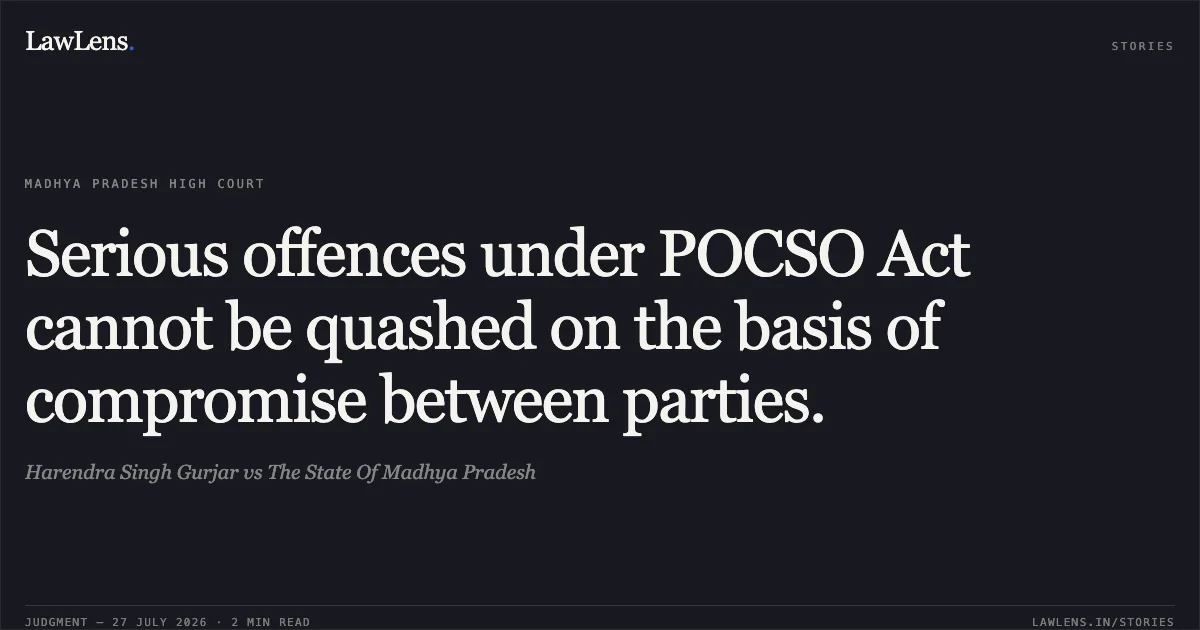
The Court answered the issues in the negative, holding that the nature and gravity of POCSO allegations preclude the quashing of an FIR based on compromise.
The court declined to exercise its jurisdiction under Section 528 of the BNSS, finding the petition devoid of merit. Consequently, the petition was dismissed, and all pending interlocutory applications were disposed of.
Source reference: para. 15-17Acts & Sections Cited
6 provisions across 3 statutes referred to in this judgment. Each provision opens on LawLens.
Bharatiya Nagarik Suraksha Sanhita, 20231
Bharatiya Nyaya Sanhita, 20233
Original Court PDF
Harendra Singh GurjarvsThe State Of Madhya Pradesh
Click to open original judgment
Original judgment, available to read, download and summarize on LawLens.in


