Facts
The Petitioners are teaching and non-teaching staff (and their respective school managements) appointed in private aided schools between 2009 and 2018
Source reference: p. 67-85Their appointments were duly approved by the Education Authorities, and they were assigned "Shalarth IDs" for salary disbursal under a 2012 Government Scheme
Source reference: p. 68-69In March 2025, the Respondents abruptly stopped the Petitioners' salaries without prior notice
Source reference: p. 66Following a news report regarding alleged irregularities and forged signatures of a deceased Education Officer, the State formed a Special Investigation Team (SIT)
Source reference: p. 87In August 2025, the Respondents issued vague, undated show-cause notices alleging "unscrupulous" irregularities
Source reference: p. 70Mass hearings were conducted where up to 150 employees were called simultaneously and directed only to fill out a 22-point questionnaire rather than being granted a personal oral hearing
Source reference: p. 129-130Subsequently, the Deputy Director of Education passed orders in early 2026 cancelling the Petitioners' approvals and Shalarth IDs on grounds of roster violations and non-sanctioned posts
Source reference: p. 91Issues
1. Whether the summary stoppage of salary and the issuance of vague show-cause notices violated the principles of natural justice
Source reference: para 142. Whether the mass hearing procedure involving questionnaires instead of oral representation constituted a fair hearing
Source reference: para 23-243. Whether the Respondents could validly cancel approvals and Shalarth IDs after a decade of service in the absence of specific allegations of fraud against the employees
Source reference: para 31-324. Whether exacting work from teachers while withholding salary constitutes "Begar" under Article 23 of the Constitution
Source reference: para 25Law Applied
The Court primarily relied on the principles of Natural Justice (Audi Alteram Partem), emphasizing that a show-cause notice must be specific and not vague to allow a meaningful defense, as established in Commissioner of Central Excise v. Brindavan Beverages (P) Ltd.
Source reference: para 14It applied Article 21 of the Constitution, recognizing the right to livelihood as an integral part of the right to life
Source reference: para 9.3, 25The Court applied Article 23, which prohibits "Begar" (exacting work without remuneration)
Source reference: para 25The Court further relied on Shivanee Prasanna Deshpande v. State of Maharashtra, which stipulates that approvals cannot be recalled due to departmental errors unless fraud or misrepresentation is established
Source reference: para 31The Court further relied on Hemant Baliram Deore v. State of Maharashtra, which condemned "undue haste" and mass hearings as a "farce"
Source reference: para 23Reasoning
The Court found the show-cause notices fundamentally flawed because they failed to specify individual charges of fraud or misconduct, rendering them unintelligible
Source reference: para 14It criticized the "mass hearing" format (150 people at a time) as a "farce" and an "eye-wash," noting that it precluded any actual application of mind to individual cases
Source reference: para 23-24The Court observed that since these employees had served for 10 to 15 years and had undergone annual inspections without objection, the Respondents could not suddenly cancel approvals on technical grounds (like roster points) which were the responsibility of the Management, not the employees
Source reference: para 19, 34Crucially, the Court noted that the State continued to exact duties—including election and census work—from the Petitioners while withholding pay, which squarely fell within the constitutional prohibition of "Begar"
Source reference: para 25The Court held that unless the teachers were shown to be parties to a fraud, they could not be penalized for administrative lapses or "flaws in the system"
Source reference: para 22, 28Holding
The Court partly allowed the writ petitions, quashing and setting aside the vague show-cause notices and the subsequent cancellation orders
The Court held that the Petitioners are entitled to their full salary arrears from March 2025 and directed the Respondents to continue regular payments
Source reference: para 29While the State was granted liberty to conduct fresh enquiries, it was restricted to doing so only via specific show-cause notices alleging fraud or misrepresentation where the employee was a party; administrative irregularities must be addressed only against the Management or the defaulting officers
Source reference: para 28The restoration of Shalarth IDs and approval orders was directed immediately
Source reference: para 28Acts & Sections Cited
4 provisions across 3 statutes referred to in this judgment. Each provision opens on LawLens.
Maharashtra Employees of Private Schools (Conditions of Service) Regulation Act, 1977.2
Code of Civil Procedure, 19081
delhi rent control act, 19581
Original Court PDF
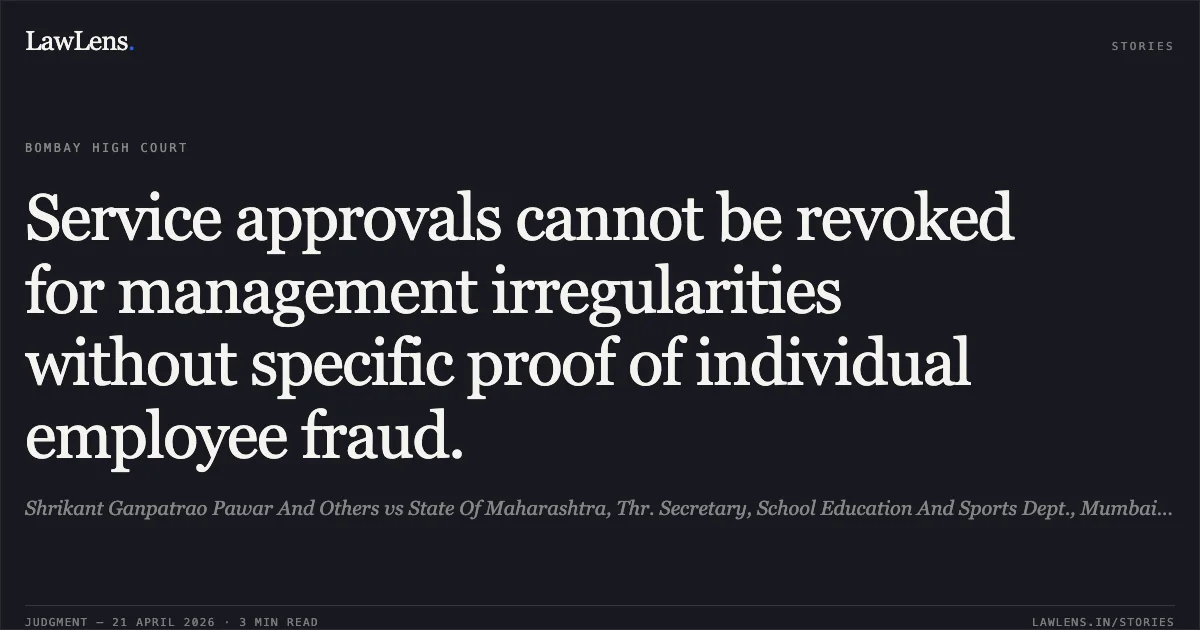
Shrikant Ganpatrao Pawar And OthersvsState Of Maharashtra, Thr. Secretary, School Education And Sports Dept., Mumbai And Ors.
Click to open original judgment
Original judgment, available to read, download and summarize on LawLens.in


