Facts
The respondents initiated eviction proceedings against the petitioner under Section 14(1)(e) of the Delhi Rent Control Act, 1958 (“DRC Act”).
Source reference: no citationThe learned Additional Rent Controller (“ARC”) recorded that the petitioner had been duly served on 21 March 2025 and that his application for leave to defend, filed on 7 April 2025, was barred by limitation; the ARC consequently declined to take it on record.
Source reference: p.5, para.12In revision under Section 25-B(8) of the DRC Act read with Section 151 CPC, the petitioner contended that service was invalid because the summons, delivered at the tenanted premises to the wife of his younger brother, had not been personally received or immediately communicated to him.
Source reference: p.5, para.13He further disputed the existence of a landlord–tenant relationship between the parties.
Source reference: p.2, para.3; p.8, para.20Issues
Whether the petitioner was duly served with summons at the tenanted premises, so that the statutory period for filing an application for leave to defend commenced from 21 March 2025.
Source reference: pp.5–8, paras.13–19Whether the petitioner’s application for leave to defend, filed on 7 April 2025, was barred by limitation.
Source reference: p.5, para.12; p.7, para.18Whether, in a revision under Section 25-B(8) of the DRC Act, the High Court could examine the petitioner’s challenge to the landlord–tenant relationship when the ARC had not adjudicated that issue.
Source reference: pp.8–10, paras.20–23Law Applied
The Court applied Section 25-B(8) of the DRC Act, under which the High Court exercises limited supervisory and revisional jurisdiction over the ARC’s decision-making process and does not act as an appellate court.
Source reference: pp.2–4, paras.5–10Relying on Sarla Ahuja v. United India Insurance Co. Ltd., (1998) 8 SCC 119, Hindustan Petroleum Corporation Ltd. v. Dilbahar Singh, (2014) 9 SCC 78, and Abid-Ul-Islam v. Inder Sain Dua, (2022) 6 SCC 30, the Court held that interference is warranted only for jurisdictional error, manifest illegality, material irregularity, perversity, or an error apparent on the face of the record.
Source reference: pp.2–4, paras.6–10It also relied on Pankaj Pahwa v. Prem Wati, 2024:DHC:9322, and Sanjeev Hiranandani v. Sunny Grover, 2025:DHC:11285, on the restricted scope of revision.
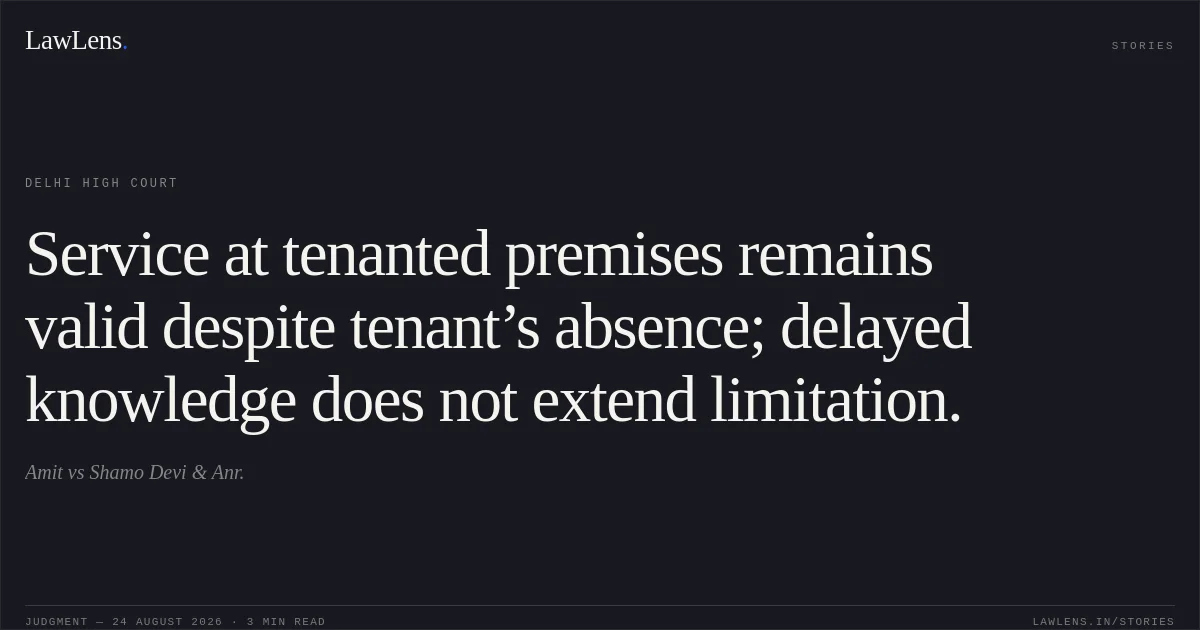
Source reference: p.4, paras.7–10Under Shyam Sundar Wadhawan v. Vivek Arya, 2014 (214) DLT 616, service of summons is assessed on the facts of each case; receipt by a person other than the tenant does not automatically invalidate service, particularly where the tenant has knowledge of, consents to, or avoids service.
Source reference: pp.7–8, para.19Reasoning
The Court held that the petitioner’s own case established his continuing connection with the tenanted premises: his belongings and documents remained there, he retained access to a room, and he visited the premises to collect them.
Source reference: pp.5–6, paras.14–16Therefore, service at that premises could not be invalidated merely because he was not personally present when the summons were received or because the recipient allegedly failed to inform him immediately.
Source reference: p.6, paras.14–16The Court also noted that the petitioner’s assertion that he was residing elsewhere due to a family dispute was absent from his leave-to-defend application and affidavit, and appeared to be a subsequent narrative.
Source reference: p.7, para.17Since service was treated as effective from 21 March 2025, the application filed on 7 April 2025 was beyond the prescribed period, and the ARC’s limitation finding disclosed no revisional error.
Source reference: p.7, para.18The challenge to the landlord–tenant relationship could not be considered because the ARC had not adjudicated it and the High Court’s revisional jurisdiction did not permit examination of issues arising for the first time in revision.
Source reference: pp.8–10, paras.20–23Holding
The High Court answered the service and limitation issues against the petitioner, holding that service at the tenanted premises was valid and that the application for leave to defend was time-barred.
It declined to examine the petitioner’s challenge to the landlord–tenant relationship, leaving that contention to be raised at the appropriate stage and before the appropriate forum, if legally permissible.
Source reference: pp.9–10, paras.21–23Finding no jurisdictional error, illegality, material irregularity, perversity, or error apparent on the face of the record, the Court dismissed the revision petition and disposed of the pending applications.
Source reference: p.10, paras.24–25Acts & Sections Cited
2 provisions across 2 statutes referred to in this judgment. Each provision opens on LawLens.
delhi rent control act, 19581
Code of Civil Procedure, 19081
Original Court PDF
AmitvsShamo Devi & Anr.
Click to open original judgment
Original judgment, available to read, download and summarize on LawLens.in