Facts
The petitioner, a State government employee, challenged orders withdrawing him from deputation and posting him as Joint Director, Yadgir, before the Karnataka Administrative Tribunal (KAT).
Source reference: paras. 3–9The KAT set aside those orders. A subsequent charge memo alleging non-reporting for duty was also challenged and quashed by the KAT.
Source reference: paras. 3–9The petitioner later sought regularisation of the disputed period, 26 April 2010 to 9 October 2011, as compulsory waiting period.
Source reference: paras. 3–9, 17–18The authorities had initially treated part of the period as “Dies-Non” and subsequently classified it as commuted leave and extraordinary leave.
Source reference: paras. 3–9, 17–18An Additional Director recommended treating the period as compulsory waiting period, but the petitioner’s request remained undecided by respondent No. 1.
Source reference: paras. 3–9, 17–18The petitioner sought a writ of mandamus directing the authorities to grant that treatment and consequential benefits.
Source reference: p. 2; para. 1Issues
1. Whether the petitioner could pursue the requested service-related relief directly before the High Court when a remedy before the KAT was available.
Source reference: paras. 19–222. Whether the disputed period should be treated as compulsory waiting period, with consequential service and retirement benefits.
Source reference: paras. 1, 9, 13The Court did not decide this issue on its merits.
Source reference: no citationLaw Applied
Section 15 of the Administrative Tribunals Act, 1985, confers jurisdiction on the State Administrative Tribunal over specified service matters concerning State employees.
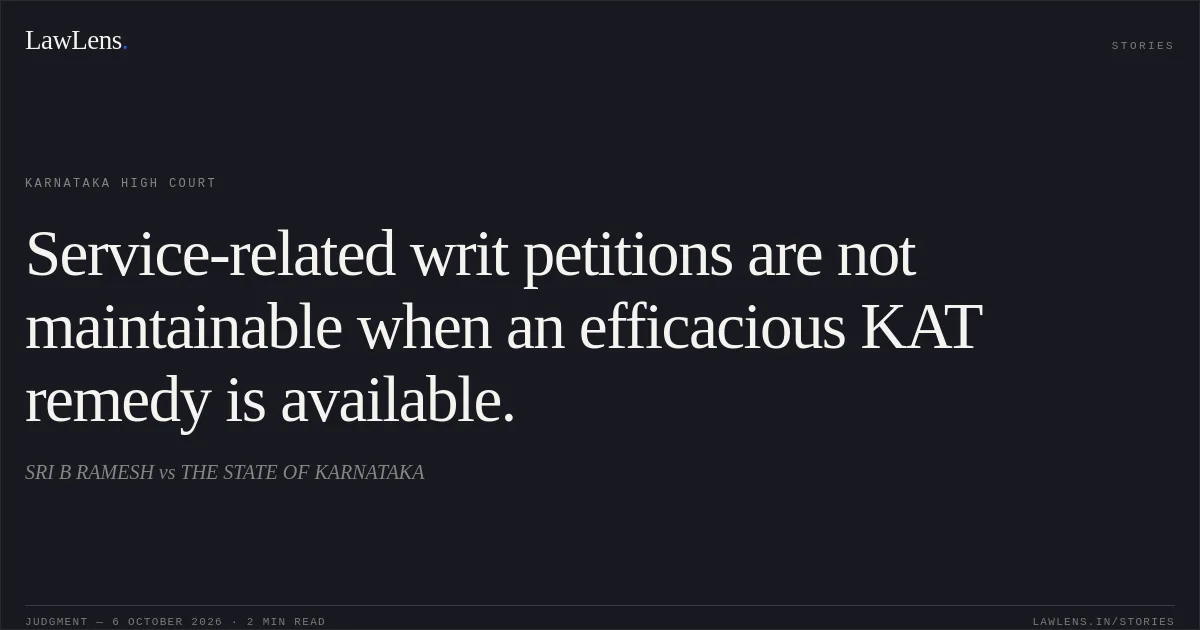
Source reference: para. 19The Court applied the principle that where an efficacious statutory remedy is available before the competent tribunal, a petitioner should pursue that remedy rather than seek the same relief through a writ petition; it relied on Rikhab Chand Jain v. Union of India, 2025 SCC OnLine SC 2510.
Source reference: para. 22The Karnataka Civil Services Rules provisions concerning waiting period, “Dies-Non,” commuted leave and extraordinary leave were referred to in recounting the administrative decisions, but the Court did not determine their application to the petitioner’s claim.
Source reference: paras. 7–8, 14–15Reasoning
The Court noted that the petitioner’s claim arose from the treatment of a period of State service and therefore fell within the service-matter jurisdiction of the KAT under Section 15.
Source reference: paras. 19–21The petitioner had previously invoked the KAT to challenge both the posting orders and the charge memo, and the Court considered the KAT an available forum for seeking the present relief as well.
Source reference: paras. 19–21Although the petitioner relied on the administrative recommendation and the authorities’ failure to act on his representation, the Court held that he ought to have approached the KAT rather than the High Court.
Source reference: paras. 19–21It consequently did not assess whether the disputed period should be regularised as compulsory waiting period.
Source reference: no citationHolding
The writ petition was dismissed as not maintainable because the petitioner had an available remedy before the KAT.
The Court reserved liberty to the petitioner to pursue any remedy available to him in accordance with law.
Source reference: para. 23Acts & Sections Cited
1 provisions across 1 statute referred to in this judgment. Each provision opens on LawLens.
KARNATAKA PARKS, PLAY-FIELDS AND OPEN SPACES (PRESERVATION AND REGULATION) ACT, 19851
Original Court PDF
SRI B RAMESHvsTHE STATE OF KARNATAKA
Click to open original judgment
Original judgment, available to read, download and summarize on LawLens.in