Facts
The petitioner was appointed as an Anganwari Sevika on 11-07-2007. Her services were subsequently terminated, but that termination was set aside by the Patna High Court on 07-08-2017 in CWJC No. 19157 of 2010
Source reference: p. 3In 2025, she applied for the post of "Lady Supervisor" under Advertisement No. 01/2025. Her application was rejected by the Child Development Project Officer (CDPO) on the grounds that she lacked the requisite 10 years of experience, as the period between 2009 and 2017 (during the litigation) was treated as a "break-in-service"
Source reference: p. 2The petitioner filed a representation before the CDPO, which remained unresolved, leading to the present writ petition seeking a mandamus to treat her service as continuous
Source reference: p. 3Issues
1. Whether the petitioner is entitled to a writ of mandamus directing the respondents to treat her service as continuous from 2007 to date for the purpose of seniority and experience eligibility
Source reference: p. 22. Whether the petitioner followed the appropriate administrative remedy before approaching the High Court under Article 226
Source reference: p. 4Law Applied
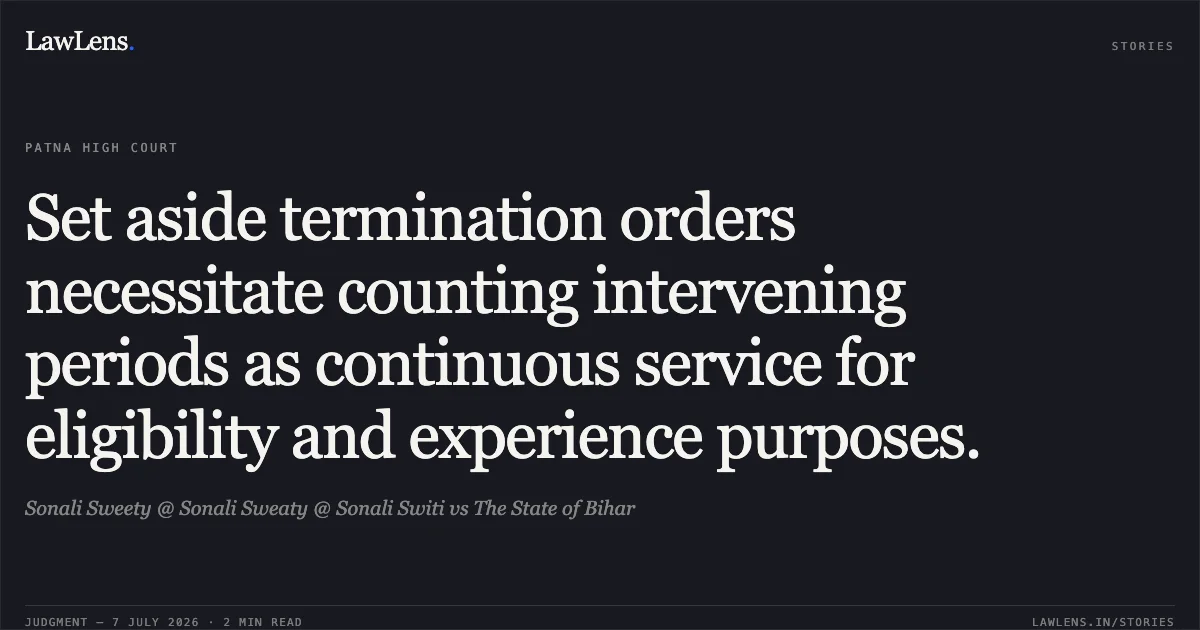
The court relied on the legal principle that when a termination order is set aside by a competent court, the employee is generally entitled to continuity of service
Source reference: p. 3the court referenced the Supreme Court precedent in Gurpreet Singh v. State of Punjab & Ors. (2002), which addresses the consequences of setting aside a termination order regarding service benefits
Source reference: p. 3Procedurally, the court looked to Clause-11 of the recruitment advertisement, which identifies the District Magistrate as the competent authority for grievances related to service conditions
Source reference: p. 4Reasoning
The petitioner argued that since her 2010 termination was legally quashed in 2017, the intervening period cannot be treated as a break-in-service for eligibility purposes
Source reference: p. 3Under the terms of the advertisement (Clause-11), the District Magistrate, Sitamarhi, is the designated authority to adjudicate grievances, not the CDPO to whom the petitioner had submitted her representation
Source reference: p. 4The Court found merit in the State's procedural objection, noting that a writ of mandamus is premature if the petitioner has not exhausted the specific alternative remedy provided in the recruitment guidelines
Source reference: p. 4Holding
The Court declined to issue an immediate mandamus but directed the petitioner to file a fresh representation before the District Magistrate, Sitamarhi (Respondent No. 5), within two weeks
The District Magistrate was ordered to pass a "reasoned and speaking order" on the merits of her continuity of service within 60 days of receipt. The writ petition was disposed of with these directions
Source reference: p. 4, 5Original Court PDF
Sonali Sweety @ Sonali Sweaty @ Sonali SwitivsThe State of Bihar
Click to open original judgment
Original judgment, available to read, download and summarize on LawLens.in


