Facts
The petitioner sought directions to the State Government to decide his representation dated 23 August 2024, investigate the conduct of respondent no. 4, and initiate departmental proceedings against him under the All India Services (Conduct) Rules, 1968.
Source reference: para. 2Respondent no. 4, while serving as Commissioner, Devi Patan Division, Gonda, had passed an order dated 26 June 2024 under Section 331 of the Uttar Pradesh Zamindari Abolition and Land Reforms Act, 1950, entertaining an appeal and granting interim protection without first deciding the application for condonation of delay or affording the petitioner an opportunity of hearing.
Source reference: paras. 3, 5–6; p. 3In Writ-C No. 6033 of 2024, the High Court set aside that order, holding that the appeal had been entertained without notice and that respondent no. 4’s relationship with the President of the concerned society made it undesirable for him to hear the matter; the case was remanded to another competent authority for fresh consideration.
Source reference: para. 4; pp. 1–2The petitioner contended that these circumstances disclosed violation of the All India Services (Conduct) Rules, 1968 and warranted disciplinary action.
Source reference: para. 6The respondents argued that the impugned order was a judicial/quasi-judicial order, that it had already been set aside in writ proceedings, and that mere judicial error or violation of natural justice could not automatically constitute misconduct.
Source reference: paras. 7–12; pp. 3–4Issues
1. Whether the setting aside of a judicial or quasi-judicial order for violation of natural justice and other legal infirmities automatically warrants initiation of disciplinary proceedings against the officer under the All India Services (Conduct) Rules, 1968?
Source reference: paras. 9–17; pp. 4–52. Whether the petitioner had established clear, cogent, and verifiable material showing that respondent no. 4 acted mala fide or for extraneous considerations so as to justify a direction for disciplinary proceedings?
Source reference: paras. 14–21; pp. 5–6Law Applied
The Court considered the All India Services (Conduct) Rules, 1968, particularly the obligations requiring a member of the service to maintain integrity, devotion to duty, and conduct becoming of a public servant, and not to act contrary to law, rules, regulations, or established practice.
Source reference: para. 6It applied the principle that a judicial or quasi-judicial order being set aside in proceedings under Article 226 of the Constitution does not, by itself, establish disciplinary misconduct or justify automatic initiation of departmental proceedings.
Source reference: paras. 9–12, 16Disciplinary action may be considered where there is clear and cogent material demonstrating mala fides, extraneous considerations, abuse of position, or other conduct amounting to misconduct; courts must exercise circumspection before issuing such directions.
Source reference: paras. 16–19The Court also recognised that errors in a judicial determination are ordinarily correctable through the appellate or writ process, rather than through disciplinary proceedings merely because the order was legally infirm.
Source reference: paras. 11–12Reasoning
The Court held that the order dated 26 June 2024 had already been directly challenged by the petitioner in Writ-C No. 6033 of 2024 and had been set aside with a direction for fresh adjudication after complying with the requirements of natural justice.
Source reference: para. 14However, the earlier judgment did not record any finding of mala fides, extraneous considerations, or misconduct against respondent no. 4.
Source reference: paras. 14–15The Court distinguished between an erroneous or procedurally defective judicial order and conduct warranting disciplinary action.
Source reference: paras. 16–19Although the order had been passed without affording an opportunity of hearing and was therefore legally unsustainable, the petitioner failed to produce clear, cogent, and verifiable material demonstrating that it had been passed for an improper purpose or due to mala fide considerations.
Source reference: paras. 16–19The Court further noted that the petitioner had previously raised allegations against respondent no. 4 in other writ proceedings, but had not obtained any direction for disciplinary action and had even sought deletion of respondent no. 4 from the array of parties in a subsequent proceeding.
Source reference: paras. 18, 21Accordingly, the statutory standards for invoking disciplinary jurisdiction were not satisfied.
Source reference: no citationHolding
The Court answered the issues against the petitioner.
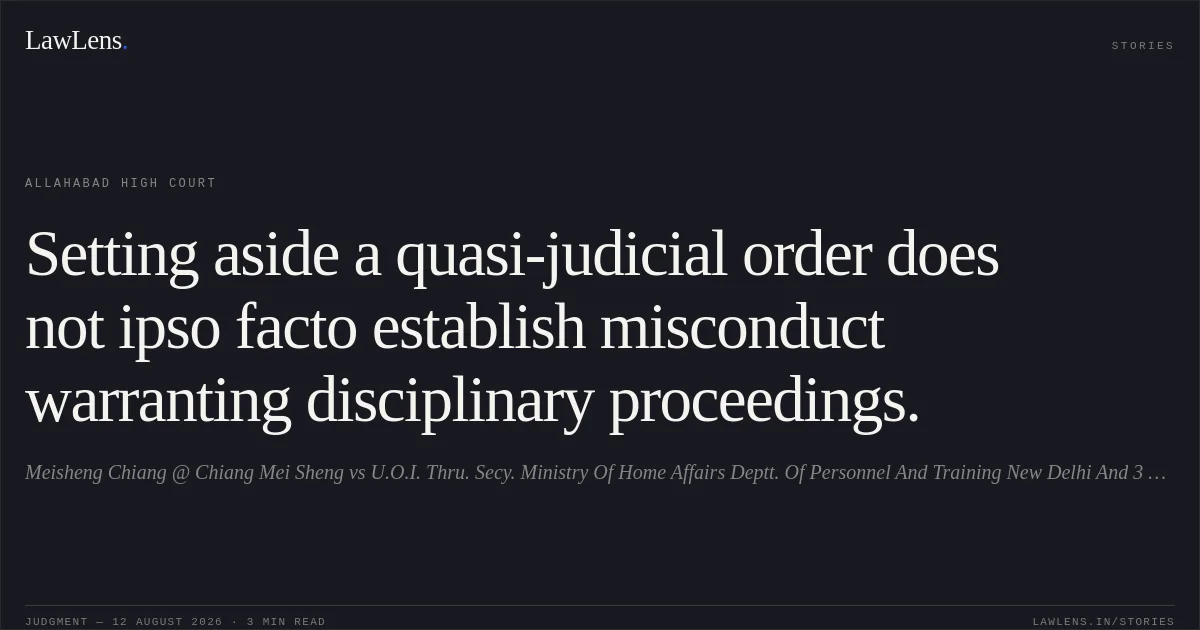
It held that the mere setting aside of a judicial or quasi-judicial order for violation of natural justice or other legal infirmities does not ipso facto justify disciplinary proceedings under the All India Services (Conduct) Rules, 1968.
Source reference: para. 16Since no clear, cogent, and verifiable material established mala fides, extraneous considerations, or misconduct by respondent no. 4, the Court declined to direct investigation or initiation of departmental proceedings.
Source reference: paras. 17, 19–22The writ petition was dismissed as devoid of merit.
Source reference: para. 23; p. 7Acts & Sections Cited
2 provisions across 2 statutes referred to in this judgment. Each provision opens on LawLens.
Limitation Act, 19631
Citizenship Act, 19551
Original Court PDF
Meisheng Chiang @ Chiang Mei ShengvsU.O.I. Thru. Secy. Ministry Of Home Affairs Deptt. Of Personnel And Training New Delhi And 3 Others
Click to open original judgment
Original judgment, available to read, download and summarize on LawLens.in