Facts
The respondent, a bus conductor employed since 1997, was charge-sheeted for misappropriation of ₹57/- after allegedly recycling tickets between two groups of passengers.
Source reference: para. 4Following a departmental inquiry, he was punished with a permanent stoppage of two years' increment on December 30, 2003.
Source reference: para. 7On appeal, the penalty was reduced to 1.5 years in 2004; a second appeal was dismissed in 2006.
Source reference: para. 4, 8The respondent filed a reference (IT No. 39 of 2009) before the Industrial Tribunal, Bhavnagar. The Tribunal, via an order below Exhibit 15, quashed the inquiry proceedings and subsequently set aside the punishment.
Source reference: para. 5, 8The petitioner (Corporation) challenged this award in the High Court, primarily on grounds of limitation and the existence of inquiry documents.
Source reference: para. 4Issues
1. Whether the reference was barred by limitation due to the delay between the departmental orders and the filing of the reference in 2009.
Source reference: para. 4, 82. Whether the Industrial Tribunal was justified in setting aside the punishment in light of the quashing of the departmental inquiry and the nature of evidence produced.
Source reference: para. 9Law Applied
The court applied principles of administrative and labor law concerning the validity of domestic inquiries and the burden of proof in industrial disputes; if the foundational order of a departmental inquiry is quashed and remains unchallenged, the consequential punishment cannot be sustained.
Source reference: para. 8-9The absence of vital witness testimony (such as the person who recorded the workman’s statement) or lack of knowledge by the management's witness vitiates the findings.
Source reference: para. 9Reasoning
The Court rejected the petitioner’s argument on limitation, noting that while the original punishment was in 2003, the second appeal was only dismissed in 2006, making the 2009 reference reasonable.
Source reference: para. 8The Court observed that the Industrial Tribunal’s earlier order (below Exhibit 15) quashing the inquiry was never challenged by the Corporation and had attained finality; thus, no penalty could survive in the absence of a valid inquiry.
Source reference: para. 8-9The Court scrutinized the evidence and found the Corporation’s witness (Exhibit 40) lacked personal knowledge of the incident and route, and noted the failure to examine the reporter/officer who recorded the respondent’s statement.
Source reference: para. 9Consequently, the petitioner failed to prove the legality of the punishment or any perversity in the Tribunal’s award.
Source reference: para. 9Holding
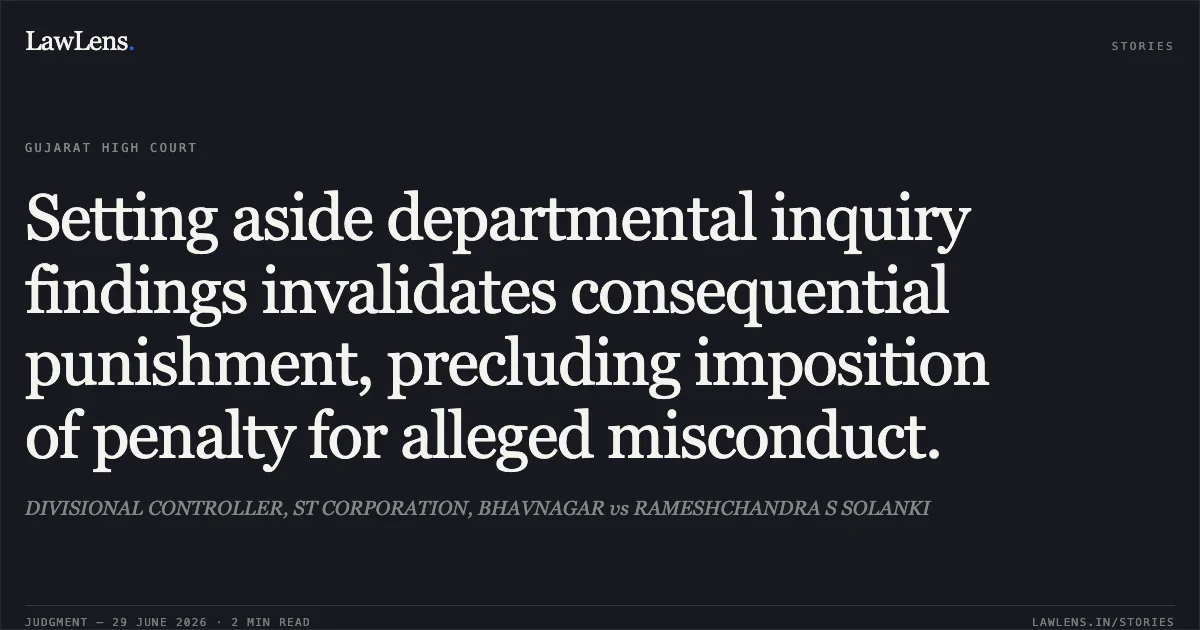
The High Court affirmed that once a departmental inquiry is quashed and becomes final, any punishment derived from it is unsustainable, especially when the employer fails to produce the actual findings of the inquiry to justify the penalty.
The High Court dismissed the petition, holding that the impugned order of the Industrial Tribunal was just and proper and all interim relief was vacated.
Source reference: para. 10Original Court PDF
DIVISIONAL CONTROLLER, ST CORPORATION, BHAVNAGARvsRAMESHCHANDRA S SOLANKI
Click to open original judgment
Original judgment, available to read, download and summarize on LawLens.in